CAS 64681-36-3
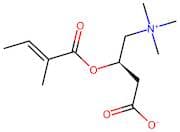
:Tiglylcarnitin
- Tiglylcarnitine
- 1-Propanaminium, 3-carboxy-N,N,N-trimethyl-2-[[(2E)-2-methyl-1-oxo-2-butenyl]oxy]-, inner salt, (2R)-
- 1-Propanaminium, 3-carboxy-N,N,N-trimethyl-2-[(2-methyl-1-oxo-2-butenyl)oxy]-, inner salt, [R-(E)]-
- 1-Propanaminium, 3-carboxy-N,N,N-trimethyl-2-[[(2E)-2-methyl-1-oxo-2-buten-1-yl]oxy]-, inner salt, (2R)-
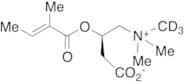
Tiglylcarnitine-d3
CAS:Kontrolliertes ProduktStability Hygroscopic
Applications Tiglylcarnitine-d3 is labelled Tiglylcarnitine (T793780), a long-chain fatty ester of carnitine which is accumulated and released into the circulation, in fatty-acid oxidation defects. Pattern of Tiglylcarnitine can be diagnostic for a number of ß-oxidation defects.
References Adams, S., et al.: J. Nutrition, 139, 1073 (2009); Ventura, F., et al.: Clinica Chimica Acta, 281, 1 (1999); Pourfarzam, M., et al.: Clinical Chem,, 40, 2267 (1994); Schaefer, J., et al.: Pediatric Res., 37, 354 (1995)Formel:C12H18D3NO4Farbe und Form:NeatMolekulargewicht:246.32Tiglylcarnitine Hydrochloride
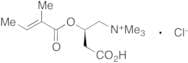
CAS:Kontrolliertes ProduktApplications Tiglylcarnitine Hydrochloride is a long-chain fatty ester of carnitine which is accumulated and released into the circulation, in fatty-acid oxidation defects. Pattern of Tiglylcarnitine Hydrochloride can be diagnostic for a number of ß-oxidation defects.
References Adams, S., et al.: J. Nutrition, 139, 1073 (2009); Ventura, F., et al.: Clinica Chimica Acta, 281, 1 (1999); Pourfarzam, M., et al.: Clinical Chem,, 40, 2267 (1994); Schaefer, J., et al.: Pediatric Res., 37, 354 (1995)Formel:C12H22ClNO4Farbe und Form:NeatMolekulargewicht:279.76Tiglyl carnitine
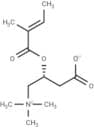
CAS:Tiglyl carnitine is associated with lung cancer and carnitine and glycine to 3-ketothiolase deficiency .Formel:C12H21NO4Reinheit:99.99%Farbe und Form:SolidMolekulargewicht:243.3