CAS 64790-15-4
:Glucagon (19-29) (menschlich, bovin, porcin)
Beschreibung:
Glukagon (19-29) ist ein Peptidfragment, das aus dem größeren Glukagonmolekül abgeleitet ist und eine entscheidende Rolle im Glukosestoffwechsel und der Regulation spielt. Dieses spezifische Fragment besteht aus den Aminosäuren 19 bis 29 der Glukagonsequenz und ist bekannt für seine biologische Aktivität bei der Stimulation der Glykogenolyse und der Gluconeogenese in der Leber, wodurch die Blutzuckerspiegel erhöht werden. Die CAS-Nummer 64790-15-4 identifiziert dieses spezielle Peptid, das sowohl in der menschlichen als auch in der tierischen Physiologie, einschließlich Rinder- und Schweinearten, von Bedeutung ist. Charakteristisch ist, dass Glukagon (19-29) ein hydrophiles Molekül ist, das typischerweise einen hohen Grad an Löslichkeit in wässrigen Lösungen aufweist, was für seine biologische Funktion entscheidend ist. Es wird häufig in der Forschung und in klinischen Umgebungen verwendet, um Stoffwechselprozesse und potenzielle therapeutische Anwendungen bei Bedingungen wie Hypoglykämie und Diabetes zu untersuchen. Die Stabilität und Aktivität dieses Peptids können durch Faktoren wie pH, Temperatur und das Vorhandensein anderer Ionen oder Moleküle in der Lösung beeinflusst werden.
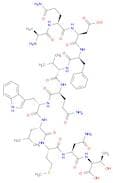
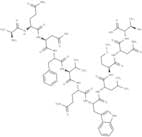
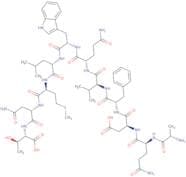
Formel:C61H89N15O18S
InChl:InChI=1/C61H89N15O18S/c1-29(2)23-40(55(87)68-39(21-22-95-7)54(86)73-43(26-47(65)80)59(91)76-50(32(6)77)61(93)94)70-56(88)42(25-34-28-66-36-16-12-11-15-35(34)36)72-53(85)38(18-20-46(64)79)69-60(92)49(30(3)4)75-58(90)41(24-33-13-9-8-10-14-33)71-57(89)44(27-48(81)82)74-52(84)37(17-19-45(63)78)67-51(83)31(5)62/h8-16,28-32,37-44,49-50,66,77H,17-27,62H2,1-7H3,(H2,63,78)(H2,64,79)(H2,65,80)(H,67,83)(H,68,87)(H,69,92)(H,70,88)(H,71,89)(H,72,85)(H,73,86)(H,74,84)(H,75,90)(H,76,91)(H,81,82)(H,93,94)/t31-,32+,37-,38-,39-,40-,41-,42-,43-,44-,49-,50-/m0/s1
Synonyme:- H-Ala-Gln-Asp-Phe-Val-Gln-Trp-Leu-Met-Asn-Thr-OH
- L-alanyl-L-glutaminyl-L-alpha-aspartyl-L-phenylalanyl-L-valyl-L-glutaminyl-L-tryptophyl-L-leucyl-L-methionyl-L-asparaginyl-L-threonine
- Miniglucagon (huMan, rat, porcine)
- GLUCAGON (19-29) (HUMAN, BOVINE, PORCINE)
- Glucagon (19-29) (huMan, rat, porcine)
- L-Alanyl-L-glutaminyl-L-a-aspartyl-L-phenylalanyl-L-valyl-L-glutaminyl-L-tryptophyl-L-leucyl-L-methionyl-L-asparaginyl-L-threonine
- L-Threonine, L-alanyl-L-glutaminyl-L-α-aspartyl-L-phenylalanyl-L-valyl-L-glutaminyl-L-tryptophyl-L-leucyl-L-methionyl-L-asparaginyl-
- glucagon(19-29
- GLUCAGON (19-29), BOVINE, HUMAN, PORCINE
- PHE-VAL-GLN-TRP-LEU-MET-ASN-THR: FVQWLMNT
- GLUCAGON (19-29), HUMAN
- AQDFVQWLMNT
- ALA-GLN-ASP-PHE-VAL-GLN-TRP-LEU-MET-ASN-THR
- Glucagon (19-29) (human, rat, porcine)
- Weitere Synonyme anzeigen
Sortieren nach
Reinheit (%)
0
100
|
0
|
50
|
90
|
95
|
100
4 Produkte.
Glucagon (19-29) (human, rat, porcine)
CAS:Miniglucagon inhibited both the Ca²⁺ activated and Mg²⁺ dependent ATPase activity and Ca²⁺ transport in liver plasma membranes with an efficiency 1000-fold higher than that of glucagon. It is likely to be the active peptide involved in the inhibition of the liver Ca²⁺ pump. Miniglucagon, the ultimate processing product of proglucagon, is a regulator of the pancreatic islet physiology.Formel:C61H89N15O18SReinheit:> 96%Farbe und Form:White PowderMolekulargewicht:1352.53H-Ala-Gln-Asp-Phe-Val-Gln-Trp-Leu-Met-Asn-Thr-OH
CAS:Formel:C61H89N15O18SReinheit:95%Farbe und Form:SolidMolekulargewicht:1352.5141Glucagon (19-29), human
CAS:Glucagon, a 29-amino-acid hormone, is produced by alpha cells in the pancreas' islets of Langerhans.Formel:C61H89N15O18SReinheit:98%Farbe und Form:SolidMolekulargewicht:1352.53Glucagon (19-29) (human, rat, porcine) trifluoroacetate salt
CAS:Glucagon is a peptide hormone that belongs to the group of vasoactive intestinal peptides. It is produced by the alpha cells of the pancreas and stimulates gluconeogenesis in the liver, thereby increasing blood glucose levels. Glucagon has also been shown to cause membrane hyperpolarization and cell death in cancer cells. Glucagon is a homologous protein that has been shown to have physiological effects similar to those of insulin, such as increased levels of cytosolic Ca2+ ions and camp levels. Glucagon binds to its receptor on the plasma membrane with high affinity, activating adenylate cyclase and phospholipase C, which leads to an increase in intracellular camp levels. This results in activation of protein kinase A (PKA), which phosphorylates proteins involved in glycogenolysis, glycolysis, and lipolysis. Glucagon also activates mitogen-activated protein kinases (MAPKFormel:C61H89N15O18SReinheit:Min. 95%Molekulargewicht:1,352.52 g/mol