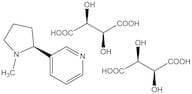
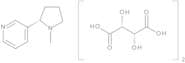
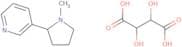
CAS 65-31-6
:Nikotin-Wasserstoff (-)-tartrat (+)
Beschreibung:
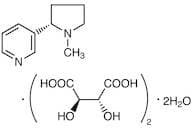
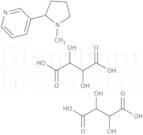
Nikotin-Wasserstoff (-)-tartrat (+), mit der CAS-Nummer 65-31-6, ist ein Salz, das aus dem Alkaloid Nikotin und Weinsäure gebildet wird. Diese Verbindung zeichnet sich durch ihre chirale Natur aus, da sie sowohl das (-)-Nikotin, das das natürlich vorkommende Enantiomer ist, als auch das (+)-Tartrat-Ion enthält. Sie erscheint typischerweise als weißes kristallines Feststoff und ist in Wasser löslich, was eine häufige Eigenschaft vieler Salze ist. Die Verbindung zeigt pharmakologische Aktivität, hauptsächlich aufgrund der Anwesenheit von Nikotin, das als Stimulans wirkt und das zentrale Nervensystem beeinflusst. Ihre Anwendungen finden sich oft in Forschungseinrichtungen, insbesondere in Studien zu den Auswirkungen von Nikotin auf die Neurotransmission und Sucht. Darüber hinaus kann die Anwesenheit der Tartratgruppe die Stabilität und Löslichkeit der Verbindung beeinflussen, was sie in der Formulierung von Arzneimitteln relevant macht. Insgesamt dient Nikotin-Wasserstoff (-)-tartrat (+) als eine wichtige Verbindung sowohl in der chemischen Forschung als auch in potenziellen therapeutischen Anwendungen.
Formel:C18H26N2O12
InChl:InChI=1/C10H14N2.C4H6O6/c1-12-7-3-5-10(12)9-4-2-6-11-8-9;5-1(3(7)8)2(6)4(9)10/h2,4,6,8,10H,3,5,7H2,1H3;1-2,5-6H,(H,7,8)(H,9,10)/t10-;/m0./s1
InChI Key:InChIKey=QLDPCHZQQIASHX-LDGFUSNJSA-N
SMILES:[C@@H]([C@H](C(O)=O)O)(C(O)=O)O.CN1[C@@H](CCC1)C=2C=CC=NC2
Synonyme:- (-)-Nicotine ditartrate
- (-)-Nicotine hydrogen (+)-tartrate
- 3-(1-Methylpyrrolidin-2-Yl)Pyridine 2,3-Dihydroxybutanedioate (1:1)
- 3-[(2S)-1-methylpyrrolidin-2-yl]pyridine 2,3-dihydroxybutanedioate (salt)
- 3-[(2S)-1-methylpyrrolidin-2-yl]pyridine bis(2,3-dihydroxybutanedioate) (salt)
- NSC 97238
- Nicotine acid tartrate
- Nicotine bitartrate
- Nicotine tartrate
- Nicotine, tartrate (1:2)
- Np002
- Pyridine, 3-(1-methyl-2-pyrrolidinyl)-, (S)-, [R-(R*,R*)]-2,3-dihydroxybutanedioate (1:2)
- Pyridine, 3-[(2S)-1-methyl-2-pyrrolidinyl]-, (2R,3R)-2,3-dihydroxybutanedioate (1:2)
- S-(-)-Nicotine hydrogen-(+)-tartrate
- pyridine,3-(1-methyl-2-pyrrolidinyl)-,(s)-,(r-(r*,r*))-2,3-dihydroxybutanedi
- nicotinehydrogentartrate
- tartratedenicotine
- (S)-3-(1-METHYL-2-PYRROLIDINYL)PYRIDINE TARTRATE SALT
- (-)-NICOTINE TARTRATE SALT
- (-)-1-METHYL-2-[3-PYRIDYL]PYRROLIDINE DI-(+) TARTRATE SALT
- nicotineacidtartrate
- pyridine,3-(1-methyl-2-pyrrolidinyl)-,(s)-,(r-(r*,r*))-2,3-dihydroxybutane
- NICOTINE HYDROGEN-L-TARTRATE
- (-)-NICOTINE HYDROGEN TARTRATE SALT
- (-)-nicotinehydrogentartrate
- nikotinbitartrat
- (S)-3-(1-METHYL-2-PYRROLINDINYL)PYRIDINE TARTRATE SALT
- (S)-3-(1-METHYL-2-PYRROLIDINYL)PYRIDINE, DI-D-TARTRATE
- (S)-3-(1-METHYL-2-PYRROLINDINYL)PYRIDINE, DI-D-TARTRATE
- Weitere Synonyme anzeigen
Sortieren nach
Reinheit (%)
0
100
|
0
|
50
|
90
|
95
|
100
9 Produkte.
Nicotine Bi-L-(+)-tartrate Dihydrate
CAS:Formel:C10H14N2·2C4H6O6·2H2OReinheit:>98.0%(HPLC)Farbe und Form:White to Almost white powder to crystalMolekulargewicht:498.44(-)-Nicotine hydrogen tartrate salt
CAS:Formel:C10H14N2·2C4H6O6(anhydrous)Reinheit:(HPLC) 98.5 - 101.5 % (anhydrous basis)Farbe und Form:White to almost white powderMolekulargewicht:462.41 (anhydrous)Nicotine ditartrate
CAS:Kontrolliertes ProduktFormel:C10H14N2C4H6O6Farbe und Form:NeatMolekulargewicht:462.41Nicotine ditartrate
CAS:Natural alkaloidFormel:C10H14N2C4H6O6Reinheit:≥ 95.0 % (HPLC)Farbe und Form:PowderMolekulargewicht:462.41(-)-Nicotine Ditartrate
CAS:Applications (-)-Nicotine ditartrate is a potent agonist of AChR.
Not a dangerous good if item is equal to or less than 1g/ml and there is less than 100g/ml in the package
References Rodriguez, J. et al.: Psychopharmacol., 231, 4455 (2014);Formel:C10H14N2·2C4H6O6Farbe und Form:Off-WhiteMolekulargewicht:462.41(-)-Nicotine ditartrate
CAS:(-)-Nicotine ditartrate is a polymorphic form of nicotine. It is a hydrogen tartrate salt with the chemical formula C10H14N2O4·H2O. (-)-Nicotine ditartrate has been shown to improve locomotor activity and reduce cortisol concentration in mice. In addition, this compound has been shown to inhibit oxidative injury in mice by reducing reactive oxygen species production. (-)-Nicotine ditartrate is also able to inhibit glutamate release from nerve terminals, which may be due to its ability to stimulate nicotinic acetylcholine receptors (nAChRs). Further, it can induce apoptosis in cancer cells through activation of the MCL-1 protein and inhibition of cholinergic neurotransmission. This drug can also be used as an electrochemical impedance spectroscopy probe for the detection of reactive oxygen species.Formel:C10H14N2·2C4H6O6Reinheit:Min. 95%Molekulargewicht:462.41 g/mol