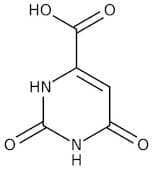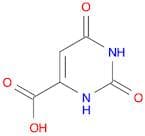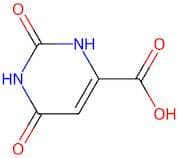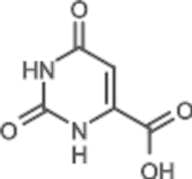
CAS 65-86-1
:Orotinsäure
Beschreibung:
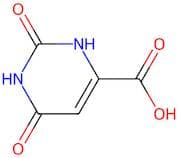
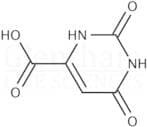
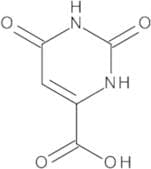
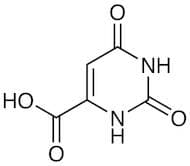
Orotinsäure, auch bekannt als Pyrimidin-2,4-dicarbonsäure, ist eine natürlich vorkommende Verbindung, die eine bedeutende Rolle bei der Biosynthese von Nukleotiden und Nukleinsäuren spielt. Es handelt sich um einen weißen kristallinen Feststoff, der in Wasser löslich ist und aufgrund der Anwesenheit von zwei Carbonsäuregruppen eine schwache Säure zeigt. Orotinsäure wird als Pyrimidinderivat klassifiziert und ist am Stoffwechsel von Pyrimidinen beteiligt, die für die DNA- und RNA-Synthese unerlässlich sind. Es kommt häufig in verschiedenen biologischen Systemen vor, einschließlich Pflanzen und Tieren, und ist besonders wichtig im Kontext des Zellwachstums und der Zellteilung. Neben seiner biologischen Bedeutung wurde Orotinsäure auch auf seine potenziellen therapeutischen Anwendungen untersucht, einschließlich seiner Rolle bei der Verbesserung der sportlichen Leistung und seiner Verwendung zur Behandlung bestimmter Stoffwechselstörungen. Seine CAS-Nummer ist 65-86-1, die diese Verbindung in chemischen Datenbanken eindeutig identifiziert. Insgesamt ist Orotinsäure eine wichtige Verbindung in der Biochemie mit Implikationen sowohl für die Gesundheit als auch für Krankheiten.
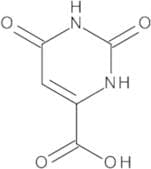
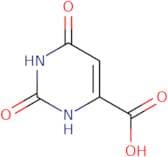
Formel:C5H4N2O4
InChl:InChI=1S/C5H4N2O4/c8-3-1-2(4(9)10)6-5(11)7-3/h1H,(H,9,10)(H2,6,7,8,11)
InChI Key:InChIKey=PXQPEWDEAKTCGB-UHFFFAOYSA-N
SMILES:C(O)(=O)C1=CC(=O)NC(=O)N1
Synonyme:- 1, 2, 3, 6-Tetrahydro-2, 6-dioxo-4-pyrimidine carboxylic acid
- 1,2,3,6-Tetrahydro-2,6-Dioxopyrimidine-4-Carboxylic Acid
- 1,2,3,6-Tetrahydro-2,6-dioxo-4-pyrimidine carboxylic acid
- 1,2,3,6-Tetrahydro-2,6-dioxo-4-pyrimidinecarboxylic acid
- 2,4-Dihydroxypyrimidine-6-carboxylic acid
- 2,4-Dioxo-1H-pyrimidine-6-carboxylic acid
- 2,6-Dihydroxy-4-pyrimidinecarboxylic acid
- 2,6-Dioxo-1,2,3,6-tetrahydropyrimidine-4-carboxylic acid
- 2,6-Dioxo-1,2,3,6-tetrahydropyrimidine-4-carboxylic acid~Uracil-4-carboxylic acid
- 2-Hydroxy-6-oxo-1,6-dihydropyrimidine-4-carboxylic acid
- 4-Pyrimidinecarboxylic acid, 1,2,3,6-tetrahydro-2,6-dioxo-
- 6-Carboxyuracil
- 6-Uracilcarboxylic acid
- Acide orotique
- Acido Orotico
- Animal galactose factor
- Nsc 79560
- Nsc 9791
- Orodin
- Orotic Acid Anhydrous
- Orotic Acid Free Acid Anhydrous Plant*Cell Cultur
- Orotonin
- Orotsaeure
- Orotsaure
- Oroturic
- Orotyl
- Vitamin B13
- Vitamin B<sub>13</sub>
- Whey factor
- Weitere Synonyme anzeigen
Sortieren nach
Reinheit (%)
0
100
|
0
|
50
|
90
|
95
|
100
13 Produkte gefunden.
Orotic acid, anhydrous, 97%
CAS:Orotic acid is an intermediate in de novo pyrimidine biosynthesis that may be used to study the specificity and kinetics of orotate phosphoribosyltransferase (OPRT) which catalyzes the reversible phosphoribosyl transfer from 5?-phospho--d-ribose 1?-diphosphate (PRPP) to orotic acid (OA), forming pyrFormel:C5H4N2O4Reinheit:97%Farbe und Form:White, PowderMolekulargewicht:156.101,2,3,6-Tetrahydro-2,6-dioxo-4-pyrimidinecarboxylic acid
CAS:Formel:C5H4N2O4Reinheit:95%Farbe und Form:SolidMolekulargewicht:156.0963Orotic acid
CAS:Orotic acid (Vitamin B13) is an intermediate product in pyrimidine metabolism.Formel:C5H4N2O4Reinheit:99.42%Farbe und Form:Crystals Physical Description White Crystals Or Crystalline Powder (Ntp 1992)Molekulargewicht:156.12,6-Dioxo-1,2,3,6-tetrahydropyrimidine-4-carboxylic acid
CAS:2,6-Dioxo-1,2,3,6-tetrahydropyrimidine-4-carboxylic acidFormel:C5H4N2O4Reinheit:≥95%Farbe und Form: white fine powderMolekulargewicht:156.10g/molOrotic Acid Monohydrate
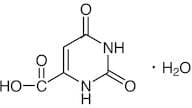
CAS:Formel:C5H4N2O4·H2OReinheit:>98.0%(T)(HPLC)Farbe und Form:White powder to crystalMolekulargewicht:174.12Orotic Acid
CAS:Formel:C5H4N2O4Reinheit:>95.0%(T)(HPLC)Farbe und Form:White to Light yellow powder to crystalMolekulargewicht:156.10Orotic acid anhydrous
CAS:Orotic acid anhydrous is a hydrogen bonding interaction that can be found in biological systems. It plays a role in the physiological effects of orotic acid, which is a metabolite of uridine and an intermediate in the synthesis of pyrimidine nucleotides. Orotic acid has antimicrobial properties and has been shown to inhibit enzyme activities involved in energy metabolism, such as polymerase chain reaction (PCR) and adenosine triphosphate (ATP) synthase. Orotic acid also inhibits the growth of bacteria, fungi, and parasites. Orotic acid anhydrous is used for treating myocardial infarcts or brain functions. The untreated group was given no treatment at all.Formel:C5H4N2O4Reinheit:Min. 98 Area-%Farbe und Form:White PowderMolekulargewicht:156.1 g/mol