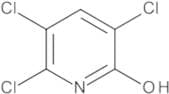
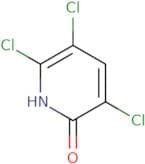
CAS 6515-38-4
:3,5,6-Trichlor-2-pyridinol
Beschreibung:
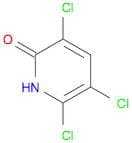
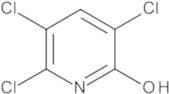
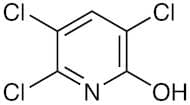
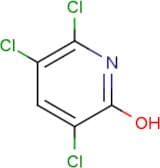
3,5,6-Trichlor-2-pyridinol, mit der CAS-Nummer 6515-38-4, ist ein chloriertes Derivat von Pyridin, das durch das Vorhandensein von drei Chloratomen an den Positionen 3, 5 und 6 des Pyridinrings und einer Hydroxylgruppe an der Position 2 gekennzeichnet ist. Diese Verbindung ist typischerweise ein weißer bis hellgelber Feststoff, der eine moderate Löslichkeit in Wasser und eine höhere Löslichkeit in organischen Lösungsmitteln aufweist. Sie ist bekannt für ihre Verwendung als landwirtschaftliches Chemikalie, insbesondere als Fungizid und Herbizid, aufgrund ihrer Fähigkeit, bestimmte biologische Prozesse in Zielorganismen zu hemmen. Das Vorhandensein mehrerer Chloratome trägt zu ihrer Stabilität und Persistenz in der Umwelt bei, obwohl es auch Bedenken hinsichtlich der Toxizität und der Umweltauswirkungen aufwerfen kann. In Bezug auf die Sicherheit ist es wichtig, diese Verbindung mit Vorsicht zu behandeln, da sie Gesundheitsrisiken bei Exposition darstellen kann. Insgesamt ist 3,5,6-Trichlor-2-pyridinol eine bedeutende Verbindung sowohl in landwirtschaftlichen Anwendungen als auch in der chemischen Forschung.
Formel:C5H2Cl3NO
InChl:InChI=1S/C5H2Cl3NO/c6-2-1-3(7)5(10)9-4(2)8/h1H,(H,9,10)
InChI Key:InChIKey=WCYYAQFQZQEUEN-UHFFFAOYSA-N
SMILES:ClC1=C(Cl)NC(=O)C(Cl)=C1
Synonyme:- 2(1H)-Pyridinone, 3,5,6-trichloro-
- 2(1H)-Pyridone, 3,5,6-trichloro-
- 2,3,5-Trichloro-6-hydroxypyridine
- 2-Hydroxy-3,5,6-trichloropyridine
- 2-Hydroxyl-3,5,6-trichloropyridine
- 2-Pyridinol, 3,5,6-trichloro-
- 3,5,6 Trichloro 2-pyridinal
- 3,5,6-Trichloro-1H-pyridin-2-one
- 3,5,6-Trichloro-2(1H)-pyridinone
- 3,5,6-Trichloro-2-hydroxypyridine
- 3,5,6-Trichloropyridine-2-Diol
- 3,5,6-Trichloropyridine-2-Ol
- Hydroxy-3,5,6-trichloropyridine
- TCP
- 3,5,6-TRICHLOROPYRIDIN-2-OL
- Pyridinol,3,5,6-trichloro-
- TRICHLORO PYRIDINOL
- 3,5,6-TRICHLORO-2-PYRIDONE
- 3,5,6-TRICHLORO-2-PYRIDINOL
- 3,5,6-TRICHLORO-2-PYRIDINONE
- Weitere Synonyme anzeigen
Sortieren nach
Reinheit (%)
0
100
|
0
|
50
|
90
|
95
|
100
11 Produkte.
3,5,6-Trichloropyridin-2(1H)-one
CAS:Formel:C5H2Cl3NOReinheit:98%Farbe und Form:SolidMolekulargewicht:198.43453,5,6-Trichloro-2-pyridinol 100 µg/mL in Acetonitrile
CAS:Formel:C5H2Cl3NOFarbe und Form:Single SolutionMolekulargewicht:198.433,5,6-Trichloropyridine-2-ol
CAS:Formel:C5H2Cl3NOReinheit:>95.0%(T)(HPLC)Farbe und Form:White to Light yellow powder to crystalMolekulargewicht:198.433,5,6-Trichloro-2-pyridinol
CAS:Kontrolliertes ProduktApplications A metabolite of Chlorpyrifos (C425300).
Not a dangerous good if item is equal to or less than 1g/ml and there is less than 100g/ml in the package
References Barron, M.G., et al.: Environ. Toxicol. Chem., 12, 1469 (1993), Tang, J., et al.: Drug Metab. Dispos., 29, 1201 (2001),Formel:C5H2Cl3NOFarbe und Form:NeatMolekulargewicht:198.433,5,6-Trichloro-2-pyridinol
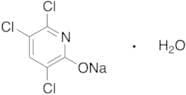
CAS:Formel:C5H2Cl3NOReinheit:95%Farbe und Form:SolidMolekulargewicht:198.43Sodium 3,5,6-trichloro-2-pyridinol Hydrate
CAS:Kontrolliertes ProduktApplications Sodium 3,5,6-trichloro-2-pyridinol is an important pesticide intermediate. New preparation process of insecticide chlorpyrifos.
References Liu, N., et al.: Xiandai Nongyao, 6, 14 (2007); Lu, Y., et al.: Huagong Jishu Yu Kaifa, 37, 5 (2008)Formel:C5HCl3NNaO•xH2OFarbe und Form:NeatMolekulargewicht:220.42 + x(18.02)3,5,6-Trichloro-2-pyridinol
CAS:3,5,6-Trichloro-2-pyridinol (3,5,6-TCP) is an intermediate in the production of chlorpyrifos. It is also a metabolite of chlorpyrifos and has been detected in urine samples. 3,5,6-TCP can be determined by titrimetric analysis using sodium carbonate as a reagent. 3,5,6-TCP is toxic to both humans and animals at high doses. The process optimization for the synthesis of 3,5,6-TCP was investigated in order to reduce the amount of wastewater produced during production. In this study it was found that reaction solution pH was significantly lower when anhydrous sodium carbonate was used instead of water saturated sodium carbonate. This discovery would allow for more efficient wastewater treatment because less wastewater would need to be treated per unit product.Formel:C5H2Cl3NOReinheit:Min. 95%Farbe und Form:PowderMolekulargewicht:198.43 g/mol