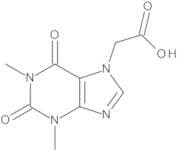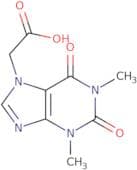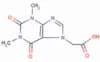
CAS 652-37-9
:Acefyllin
Beschreibung:
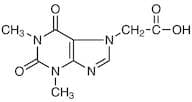
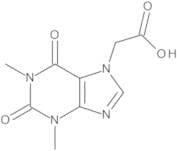
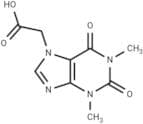
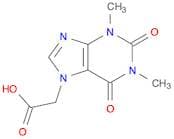
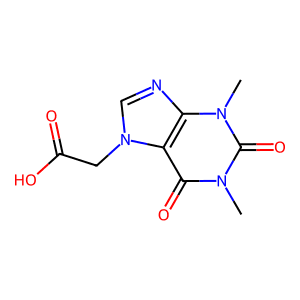
Acefyllin, mit der CAS-Nummer 652-37-9, ist eine chemische Verbindung, die zur Klasse der Xanthinderivate gehört, die für ihre pharmakologischen Eigenschaften bekannt sind. Es wird hauptsächlich für seine Verwendung als Bronchodilatator anerkannt, der bei der Behandlung von Atemwegserkrankungen wie Asthma und chronisch obstruktiver Lungenerkrankung (COPD) hilft. Die Verbindung weist typische Eigenschaften von Xanthinen auf, einschließlich der Fähigkeit, die bronchiale glatte Muskulatur zu entspannen und den Luftstrom zu verbessern. Acefyllin ist in Wasser löslich, was die Verabreichung in verschiedenen pharmazeutischen Formulierungen erleichtert. Sein Wirkmechanismus umfasst die Hemmung der Phosphodiesterase, was zu erhöhten Zyklen von AMP führt, die zur Bronchodilatation beitragen. Darüber hinaus kann es entzündungshemmende Eigenschaften besitzen, was es vorteilhaft für die Behandlung von Atemwegsentzündungen macht. Wie andere Xanthine kann es jedoch Nebenwirkungen wie gastrointestinale Störungen und kardiovaskuläre Effekte haben, was eine sorgfältige Überwachung während der Anwendung erforderlich macht. Insgesamt ist Acefyllin eine wertvolle Verbindung in der Atemtherapie, die zur Verbesserung der Patientenergebnisse bei der Behandlung von Atemwegserkrankungen beiträgt.
Formel:C9H10N4O4
InChl:InChI=1/C9H10N4O4/c1-11-7-6(8(16)12(2)9(11)17)13(4-10-7)3-5(14)15/h4H,3H2,1-2H3,(H,14,15)/p-1
InChI Key:InChIKey=HCYFGRCYSCXKNQ-UHFFFAOYSA-N
SMILES:C(C(O)=O)N1C2=C(N(C)C(=O)N(C)C2=O)N=C1
Synonyme:- (1,3-dimethyl-2,6-dioxo-1,2,3,6-tetrahydro-7H-purin-7-yl)acetate
- (1,3-dimethyl-2,6-dioxo-1,2,3,6-tetrahydro-7H-purin-7-yl)acetic acid
- 1,2,3,6-Tetrahydro-1,3-dimethyl-2,6-dioxo-7H-purine-7-acetic acid
- 1,2,3,6-Tetrahydro-1,3-dimethyl-2,6-dioxopurine-7-acetic acid
- 2-(1,3-Dimethyl-2,6-dioxo-2,3,6,7-tetrahydro-1H-purin-7-yl)acetic acid
- 2-(1,3-Dimethyl-2,6-dioxo-2,3-dihydro-1H-purin-7(6H)-yl)acetic acid
- 2-(1,3-Dimethyl-2,6-dioxopurin-7-yl)acetic acid
- 7-(Carboxymethyl)theophylline
- 7-Theophyllineacetic acid
- 7-Theophyllinylacetic acid
- 7H-Purine-7-acetic acid, 1,2,3,6-tetrahydro-1,3-dimethyl-2,6-dioxo-
- Acefylline
- Acephylline
- Carboxymethyltheophylline
- N-7-Theophyllineacetic acid
- NSC 52996
- Purine-7-acetic acid, 1,2,3,6-tetrahydro-1,3-dimethyl-2,6-dioxo-
- Theophyllineacetic acid
- CAFFEINE CARBOXYLIC ACID
- THEOPHYLINE ACETIC ACID
- LABOTEST-BB LT00053164
- THEOPHYLLINE-7-ACETIC ACID
- 1,2,3,6-tetrahydro-1,3-dimethyl-2,6-dioxopurine-7-aceticacid
- (1,3-DIMETHYL-2,6-DIOXO-1,2,3,6-TETRAHYDRO-PURIN-7-YL)-ACETIC ACID
- theophyllin-7-ylacetic acid
- 1,2,3,6-tetrahydro-1,3-dimethyl-2,6-dioxo-purine-7-aceticaci
- Theophylline-7-aceticacid,98%
- 7-theophyllinylaceticacid
- acidetheophylline-ethanoique-7
- 7-Theophyline Acetic Acid
- 1,3-DIMETHYLXANTHINE-7-ACETIC ACID
- 7-THEOPHYLLINE ACETIC ACID
- Weitere Synonyme anzeigen
Sortieren nach
Reinheit (%)
0
100
|
0
|
50
|
90
|
95
|
100
15 Produkte.
Theophylline-7-acetic Acid
CAS:Formel:C9H10N4O4Reinheit:>98.0%(T)(HPLC)Farbe und Form:White to Almost white powder to crystalMolekulargewicht:238.20Theophylline-7-acetic acid, 98%
CAS:This Thermo Scientific Chemicals brand product was originally part of the Alfa Aesar product portfolio. Some documentation and label information may refer to the legacy brand. The original Alfa Aesar product / item code or SKU reference has not changed as a part of the brand transition to Thermo SciFormel:C9H10N4O4Reinheit:98%Farbe und Form:White, PowderMolekulargewicht:238.2Acefylline
CAS:Acefylline (Theophylline-7-acetic acid), a stimulant drug of the xanthine chemical class, acts as an adenosine receptor antagonist.Formel:C9H10N4O4Reinheit:99.57%Farbe und Form:White Crystalline SolidMolekulargewicht:238.27H-Purine-7-aceticacid, 1,2,3,6-tetrahydro-1,3-dimethyl-2,6-dioxo-
CAS:Formel:C9H10N4O4Reinheit:%Farbe und Form:SolidMolekulargewicht:238.2001Theophylline 7-Acetic Acid
CAS:Formel:C9H10N4O4Farbe und Form:White To Off-White SolidMolekulargewicht:238.202-(1,3-Dimethyl-2,6-Dioxo-1,2,3,6-Tetrahydro-7H-Purin-7-Yl)Acetic Acid
CAS:2-(1,3-Dimethyl-2,6-Dioxo-1,2,3,6-Tetrahydro-7H-Purin-7-Yl)Acetic AcidReinheit:98%Molekulargewicht:238.2g/molAcefylline (Theophylline-7-acetic acid)
CAS:Formel:C9H10N4O4Reinheit:≥ 98.0%Farbe und Form:White to off-white powderMolekulargewicht:238.20Theophylline-7-acetic acid
CAS:Formel:C9H10N4O4Reinheit:98%Farbe und Form:Solid, White to almost white powderMolekulargewicht:238.203Theophylline-7-acetic Acid
CAS:Kontrolliertes ProduktApplications A xanthine derivative with bronchodilator activity. Typically combined as salt component with other medications such as Ambroxol to treat bronchial and pulmonary diseases.
References Kim, S., et al.: J. Med. Chem., 45, 2131 (2002), Bruno-Blanch, L., et al.: Bioorg. Med. Chem. Lett., 13, 2749 (2003), Foppoli, A., et al.: J. Pharm. Sci., 96, 1139(2007),Formel:C9H10N4O4Farbe und Form:NeatMolekulargewicht:238.2Theophylline-7-acetic acid
CAS:Kontrolliertes ProduktTheophylline-7-acetic acid is a substance that has the chemical name of 2-amino-5-(1,3-dimethylxanthin-9-yl)benzoic acid. It is an amorphous substance with a biochemical property of being soluble in water and ethanol. Theophylline-7-acetic acid is used as a reagent for the quantitative determination of cardiac glycosides in human serum. This compound also reacts with a solution of sodium salts under constant pressure at room temperature and an electrochemical detector to yield an intense blue fluorescence. Structural analysis indicates that this substance contains a hydroxyl group, which can be found in proteins, fatty acids, and pharmacokinetics.Formel:C9H10N4O4Reinheit:Min. 95%Farbe und Form:PowderMolekulargewicht:238.2 g/mol