CAS 65236-62-6
:1-ethenyl-4,8-dimethoxy-9H-beta-carbolin
Beschreibung:
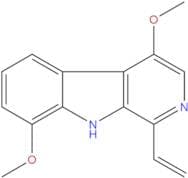
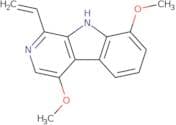
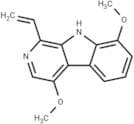
1-ethenyl-4,8-dimethoxy-9H-beta-carbolin, mit der CAS-Nummer 65236-62-6, ist eine chemische Verbindung, die zur Familie der Beta-Carboline gehört und durch eine fusionierte Indol- und Pyridinstruktur gekennzeichnet ist. Diese Verbindung weist eine Vinylgruppe an der Position 1 und zwei Methoxygruppen an den Positionen 4 und 8 des Beta-Carbolin-Kerns auf. Beta-Carboline sind bekannt für ihre vielfältigen biologischen Aktivitäten, einschließlich potenzieller neuroprotektiver, antidepressiver und krebsbekämpfender Eigenschaften. Die Anwesenheit von Methoxygruppen kann die Löslichkeit, Stabilität und Reaktivität der Verbindung beeinflussen und möglicherweise ihr pharmakologisches Profil verbessern. Darüber hinaus kann die Ethenylgruppe zur Fähigkeit der Verbindung beitragen, an verschiedenen chemischen Reaktionen teilzunehmen, wie z.B. Polymerisation oder Vernetzung. Insgesamt stellt 1-ethenyl-4,8-dimethoxy-9H-beta-carbolin ein strukturell interessantes Molekül mit potenziellen Anwendungen in der medizinischen Chemie und Pharmakologie dar, obwohl spezifische Studien zu seinen Eigenschaften und Aktivitäten möglicherweise begrenzt sind.
Formel:C15H14N2O2
InChl:InChI=1/C15H14N2O2/c1-4-10-15-13(12(19-3)8-16-10)9-6-5-7-11(18-2)14(9)17-15/h4-8,17H,1H2,2-3H3
SMILES:C=Cc1c2c(c3cccc(c3[nH]2)OC)c(cn1)OC
Synonyme:- 4,8-Dimethoxy-1-vinyl-9H-beta-carboline
- 9H-pyrido[3,4-b]indole, 1-ethenyl-4,8-dimethoxy-
Sortieren nach
Reinheit (%)
0
100
|
0
|
50
|
90
|
95
|
100
4 Produkte.
Dehydrocrenatidine
CAS:Formel:C15H14N2O2Reinheit:95%~99%Farbe und Form:Yellow powderMolekulargewicht:254.289Dehydrocrenatidine
CAS:Dehydrocrenatidine is a naturally occurring alkaloid, which is derived from certain plant species. This compound is isolated from the roots of Crenata plants and exhibits notable biological activity. Dehydrocrenatidine functions primarily through the inhibition of specific cellular pathways, disrupting processes crucial to cell proliferation and survival. This mechanism of action positions it as a promising candidate for therapeutic applications in oncology.
Formel:C15H14N2O2Reinheit:Min. 95%Molekulargewicht:254.28 g/molDehydrocrenatidine
CAS:Dehydrocrenatidine (Kumujian G) is an inhibitor of JAK and induces cell apoptosis.Formel:C15H14N2O2Reinheit:98%Farbe und Form:SolidMolekulargewicht:254.28