CAS 654-70-6
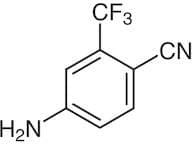
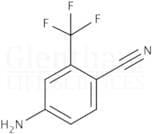
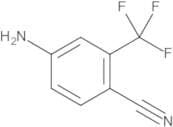
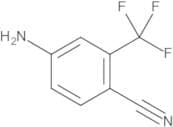
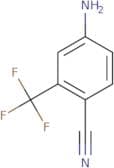
:4-Amino-2-(trifluormethyl)benzonitril
Beschreibung:
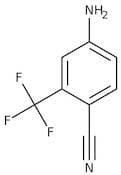
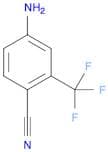
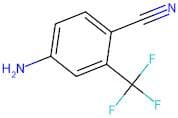
4-Amino-2-(trifluormethyl)benzonitril, mit der CAS-Nummer 654-70-6, ist eine organische Verbindung, die durch das Vorhandensein einer Aminogruppe und einer Trifluormethylgruppe gekennzeichnet ist, die an einen Benzolring gebunden sind, der auch eine Nitrilfunktionalität enthält. Diese Verbindung erscheint typischerweise als Feststoff und ist bekannt für ihre aromatischen Eigenschaften aufgrund der Benzolstruktur. Die Trifluormethylgruppe trägt zu ihren einzigartigen elektronischen Eigenschaften bei, erhöht ihre Reaktivität und macht sie in verschiedenen chemischen Anwendungen, einschließlich Pharmazeutika und Agrochemikalien, nützlich. Die Aminogruppe kann an Wasserstoffbrückenbindungen teilnehmen, was die Löslichkeit der Verbindung und ihre Wechselwirkung mit anderen Molekülen beeinflusst. Darüber hinaus verleiht die Nitrilgruppe Polarität, die das Verhalten der Verbindung in verschiedenen Lösungsmitteln beeinflussen kann. Insgesamt ist 4-Amino-2-(trifluormethyl)benzonitril bemerkenswert für seine potenziellen Anwendungen in der synthetischen Chemie und Materialwissenschaft, wo seine unterschiedlichen funktionalen Gruppen für verschiedene chemische Transformationen genutzt werden können.
Formel:C8H5F3N2
InChl:InChI=1S/C8H5F3N2/c9-8(10,11)7-3-6(13)2-1-5(7)4-12/h1-3H,13H2
InChI Key:InChIKey=PMDYLCUKSLBUHO-UHFFFAOYSA-N
SMILES:C(F)(F)(F)C1=C(C#N)C=CC(N)=C1
Synonyme:- 1-Methoxy-4-Nitro-2-(Trifluoromethyl)Benzene
- 2-Cyano-5-Aminobenzotrifluoride
- 2-Trifluoromethyl-4-aminobenzonitrile
- 2-Trifuloromethyl-4-Aminobenzonitrile
- 4-Amino 2-Trifluoromethyl Benzonitrile
- 4-Amino-2-(Trifluoromethyl)Benzontrile
- 4-Amino-2-trifluoromethylbenzonitrile
- 4-Amino-α,α,α-trifluoro-o-tolunitrile
- 4-Cyano-3-Trifluoromethyl Aniline
- 4-Cyano-3-trifluoromethylaniline
- 5-Amino-2-Cyano Benzotrifluorid
- 5-Amino-2-cyanobenzotrifluoride
- Benzonitrile, 4-amino-2-(trifluoromethyl)-
- Buttpark 22\01-63
- Weitere Synonyme anzeigen
Sortieren nach
Reinheit (%)
0
100
|
0
|
50
|
90
|
95
|
100
13 Produkte.
5-Amino-2-cyanobenzotrifluoride
CAS:Formel:C8H5F3N2Reinheit:>98.0%(GC)Farbe und Form:White to Brown powder to crystalMolekulargewicht:186.144-Amino-2-(trifluoromethyl)benzonitrile, 97%
CAS:This Thermo Scientific Chemicals brand product was originally part of the Alfa Aesar product portfolio. Some documentation and label information may refer to the legacy brand. The original Alfa Aesar product / item code or SKU reference has not changed as a part of the brand transition to Thermo SciFormel:C8H5F3N2Reinheit:97%Farbe und Form:White to cream to brown, Powder or lumps or fused solid or granulesMolekulargewicht:186.14Bicalutamide impurity D
CAS:Bicalutamide impurity DFormel:C12H8N2OFarbe und Form:Off-WhiteMolekulargewicht:196.20474-Cyano-3-trifluoromethylaniline
CAS:Formel:C8H5F3N2Reinheit:98%Farbe und Form:SolidMolekulargewicht:186.13394-Amino-2-(trifluoromethyl)benzonitrile
CAS:4-Amino-2-(trifluoromethyl)benzonitrileFormel:C8H5F3N2Reinheit:98%Farbe und Form: white solidMolekulargewicht:186.13g/molBicalutamide EP Impurity D
CAS:Formel:C8H5F3N2Farbe und Form:White To Off-White SolidMolekulargewicht:186.14Bicalutamide EP Impurity D
CAS:Kontrolliertes ProduktFormel:C8H5F3N2Farbe und Form:NeatMolekulargewicht:186.135-Amino-2-cyanobenzotrifluoride
CAS:Kontrolliertes ProduktImpurity Bicalutamide EP Impurity D
Applications 5-Amino-2-cyanobenzotrifluoride (Bicalutamide EP Impurity D) is used for the preparation of benzene derivatives as non-steroidal androgen receptor modulators.
References Xiao, H.-Y., et al.: Bioorg. Med. Chem. Lett., 20, 4491 (2010),Formel:C8H5F3N2Farbe und Form:Off-WhiteMolekulargewicht:186.135-Amino-2-cyanobenzotrifluoride
CAS:Formel:C8H5F3N2Reinheit:98%Farbe und Form:SolidMolekulargewicht:186.1374-Amino-2-(trifluoromethyl)benzonitrile
CAS:Nilutamide is a drug that belongs to the class of acylation agents. It is used for the treatment of prostate cancer. Nilutamide binds to and inhibits the function of androgen receptors in prostate cancer cells, which prevents the synthesis of testosterone. This results in the death of prostate cancer cells by inhibiting cell growth and triggering apoptosis. It has been shown that nilutamide has a low bioavailability when administered orally, but can be detected in vivo using a model based on human tissues. The molecule was found to have high affinity for fatty acids, which may explain its ability to bind with phospholipids in membranes and inhibit cell proliferation.Formel:C8H5F3N2Reinheit:(1H-Nmr) Min. 95 Area-%Farbe und Form:PowderMolekulargewicht:186.13 g/mol