CAS 6552-68-7
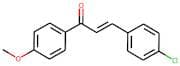
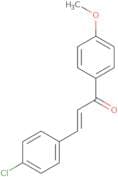
:3-(4-chlorphenyl)-1-(4-methoxyphenyl)prop-2-en-1-on
Beschreibung:
3-(4-chlorphenyl)-1-(4-methoxyphenyl)prop-2-en-1-on, auch bekannt als eine Art von Chalcon, ist eine organische Verbindung, die durch ihr konjugiertes Doppelbindungssystem und das Vorhandensein von aromatischen Ringen gekennzeichnet ist. Diese Verbindung weist ein Prop-2-en-1-on-Rückgrat auf, das zu ihrer Reaktivität und potenziellen biologischen Aktivität beiträgt. Das Vorhandensein einer 4-Chlorphenylgruppe und einer 4-Methoxyphenylgruppe erhöht ihre Lipophilie und kann ihre Wechselwirkung mit biologischen Zielen beeinflussen. Chalcone sind bekannt für ihre vielfältigen pharmakologischen Eigenschaften, einschließlich entzündungshemmender, antioxidativer und krebsbekämpfender Aktivitäten. Die Struktur der Verbindung ermöglicht potenzielle Anwendungen in der medizinischen Chemie und Materialwissenschaft. Sie wird typischerweise durch die Claisen-Schmidt-Kondensationsreaktion synthetisiert, und ihre Eigenschaften können durch Substituenten an den aromatischen Ringen beeinflusst werden. Wie bei vielen organischen Verbindungen sollten Sicherheits- und Handhabungsvorschriften beachtet werden, da sie toxische oder reizende Wirkungen zeigen kann.
Formel:C16H13ClO2
InChl:InChI=1/C16H13ClO2/c1-19-15-9-5-13(6-10-15)16(18)11-4-12-2-7-14(17)8-3-12/h2-11H,1H3
SMILES:COc1ccc(cc1)C(=O)C=Cc1ccc(cc1)Cl
Sortieren nach
Reinheit (%)
0
100
|
0
|
50
|
90
|
95
|
100
2 Produkte.
3-(4-Chlorophenyl)-1-(4-methoxyphenyl)prop-2-en-1-one
CAS:3-(4-Chlorophenyl)-1-(4-methoxyphenyl)prop-2-en-1-oneReinheit:≥95%4-Chloro-4'-methoxychalcone
CAS:4-Chloro-4'-methoxychalcone (4MC) is a chalcone with an antibacterial activity. It is synthesized from 4,4'-dimethoxychalcone by substitution of one or two methoxy groups on the aromatic ring with chlorine atoms. 4MC has shown to be active against a number of different bacterial strains, including Staphylococcus aureus and Pseudomonas aeruginosa. The dilution method is used for the determination of the minimal inhibitory concentrations (MICs). This method involves serial dilutions in which bacteria are grown in liquid media containing increasing concentrations of the test compound. The lowest concentration of the test compound that inhibits bacterial growth is determined and recorded as MIC. Plutella xylostella larvae were found to be resistant to 4MC because they lack esterase enzymes that hydrolyze 4MC. Irradiation can be used to produce esters that are more reactive towardsFormel:C16H13ClO2Reinheit:Min. 95%Farbe und Form:PowderMolekulargewicht:272.73 g/mol