CAS 6553-96-4
:2,4,6-Tris(1-methylethyl)benzolsulfonylchlorid
Beschreibung:
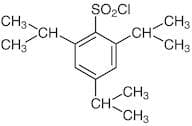
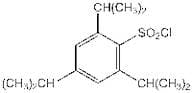
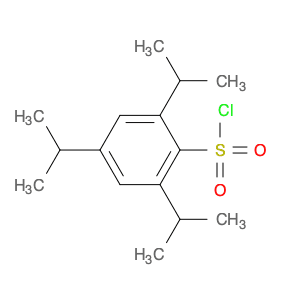
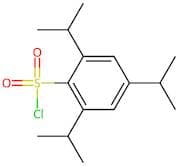
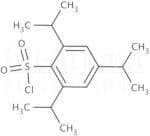
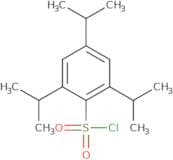
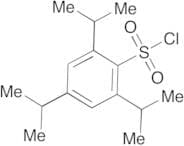
2,4,6-Tris(1-methylethyl)benzolsulfonylchlorid, mit der CAS-Nummer 6553-96-4, ist eine organische Verbindung, die durch ihre Sulfonylchlorid-Funktionalgruppe gekennzeichnet ist, die an einen Benzolring gebunden ist, der zusätzlich mit drei Isopropylgruppen substituiert ist. Diese Struktur verleiht eine signifikante sterische Hinderung, die ihre Reaktivität und Löslichkeit beeinflusst. Die Sulfonylchlorid-Gruppe ist bekannt für ihre hohe Reaktivität, insbesondere in nucleophilen Substitutionsreaktionen, was diese Verbindung in der organischen Synthese nützlich macht, insbesondere für die Einführung von Sulfonylgruppen in verschiedene Substrate. Sie ist typischerweise eine farblose bis blassgelbe Flüssigkeit oder Feststoff, abhängig von ihrer Reinheit und Form. Die Verbindung ist empfindlich gegenüber Feuchtigkeit, da sie hydrolysieren kann, um die entsprechende Sulfonsäure zu bilden. Sicherheitsvorkehrungen sind beim Umgang mit dieser Substanz erforderlich, da sie ätzend und reizend für Haut und Schleimhäute sein kann. Eine ordnungsgemäße Lagerung an einem kühlen, trockenen Ort, fern von Feuchtigkeit und inkompatiblen Substanzen, ist entscheidend, um ihre Stabilität und Reaktivität zu erhalten.
Formel:C15H23ClO2S
InChl:InChI=1S/C15H23ClO2S/c1-9(2)12-7-13(10(3)4)15(19(16,17)18)14(8-12)11(5)6/h7-11H,1-6H3
InChI Key:InChIKey=JAPYIBBSTJFDAK-UHFFFAOYSA-N
SMILES:S(Cl)(=O)(=O)C1=C(C(C)C)C=C(C(C)C)C=C1C(C)C
Synonyme:- 2,4,6-Tri(Propan-2-Yl)Benzenesulfonyl Chloride
- 2,4,6-Triisopropybenzenesulfonyl*Chloride
- 2,4,6-Triisopropylbenzene-1-sulfonyl chloride
- 2,4,6-Triisopropylbenzenesulfonoyl chloride
- 2,4,6-Triisopropylphenylsulfonyl chloride
- 2,4,6-Tris(1-methylethyl)benzenesulfonyl chloride
- 2,4,6-Tris(isopropyl)benzenesulfonyl chloride
- Benzenesulfonyl chloride, 2,4,6-triisopropyl-
- Benzenesulfonyl chloride, 2,4,6-tris(1-methylethyl)-
- NSC 102803
- Tpscl
- Tripsyl chloride
- Weitere Synonyme anzeigen
Sortieren nach
Reinheit (%)
0
100
|
0
|
50
|
90
|
95
|
100
9 Produkte.
2,4,6-Triisopropylbenzenesulfonyl Chloride
CAS:Formel:C15H23ClO2SReinheit:>97.0%(T)Farbe und Form:White powder to lumpMolekulargewicht:302.862,4,6-Triisopropylbenzenesulfonyl chloride, 98%
CAS:2,4,6-Triisopropylbenzenesulfonyl chloride is used for the synthesis of glycerophospholipids as a condensing agent and in the analysis of phosphonolipids in egg yolk by HPLC/MS technique. It acts as a coupling reagent for the synthesis of oligonucleotides and as sulfonates of pyrimidine nucleosides.Formel:C15H23ClO2SReinheit:98%Farbe und Form:Crystals or powder or crystalline powder, White to pale pink to pale creamMolekulargewicht:302.862,4,6-Triisopropylbenzene-1-sulfonyl chloride
CAS:Formel:C15H23ClO2SReinheit:98%Farbe und Form:SolidMolekulargewicht:302.85992,4,6-Tris(isopropyl)benzenesulphonyl chloride
CAS:2,4,6-Tris(isopropyl)benzenesulphonyl chlorideFormel:C15H23ClO2SReinheit:98%Farbe und Form: white to off white solidMolekulargewicht:302.86g/mol2,4,6-Triisopropylbenzenesulfonyl chloride
CAS:2,4,6-Triisopropylbenzenesulfonyl chloride is a molecule that belongs to the class of ethylene diamine. It has been shown to inhibit the replication of herpes simplex virus in cell culture. This compound has an intramolecular hydrogen and steric interactions with a hydroxyl group. The analog of this molecule is 2,4,6-triisopropylbenzenesulfonic acid. 2,4,6-Triisopropylbenzenesulfonyl chloride can be used as a sulfonation agent and is known for its ability to react with nitrogen nucleophiles such as amines or ammonia.Formel:C15H23SO2ClReinheit:Min. 95%Molekulargewicht:302.86 g/mol2,4,6-Triisopropylbenzenesulfonyl chloride
CAS:Formel:C15H23ClO2SReinheit:97%Farbe und Form:Solid, ClearMolekulargewicht:302.862,4,6-Triisopropylbenzenesulfonyl Chloride
CAS:Kontrolliertes ProduktApplications 2,4,6-Triisopropylbenzenesulfonyl Chloride, is a building block used for the synthesis of various pharmaceutical compounds, such as derivatives of Valproic Acid (V094750). It can also be used for the synthesis of glycerophospholipids as a condensing agent.
Not a dangerous good if item is equal to or less than 1g/ml and there is less than 100g/ml in the package
References Aneja, R., et al.: Biochimica et Biophysica Acta, 218, 102 (1970); Loscher, W., Prog. Neurobiol., 58, 31 (1999);Formel:C15H23ClO2SFarbe und Form:NeatMolekulargewicht:302.86