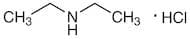
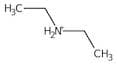
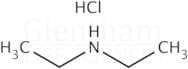
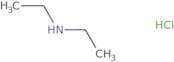
CAS 660-68-4
:Diethylammoniumchlorid
- Diethyl-d10-amine HCl
- Diethylamine Chlorhydrate
- Diethylammonium chloride
- Ethanamine, N-ethyl-, hydrochloride
- Ethanamine, N-ethyl-, hydrochloride (1:1)
- N,N-Diethylamine hydrochloride
- N-Ethylethanamine hydrochloride
- Diethylamine, hydrochloride
Diethylamine Hydrochloride
CAS:Formel:C4H11N·HClReinheit:>98.5%(T)Farbe und Form:White to Almost white powder to crystalMolekulargewicht:109.60Diethylamine hydrochloride, 99%
CAS:Diethylamine hydrochloride acts as a precursor of atrazine and lysergic acid diethylamide. It is also used as a reactant in the production of dyes and pharmaceutical compounds such as ranitidine. Further, it is used in Mannich reaction with paraformaldehyde. In addition to this, it is employed in thFormel:C4H12ClNReinheit:99%Farbe und Form:White to cream to pale brown, Crystals or powder or crystalline powder or lumps, White to cream to pale brown, Crystals or powder or crystalline powder or lumpsMolekulargewicht:109.60Diethylamine hydrochloride
CAS:Diethylamine hydrochlorideReinheit:99%Farbe und Form:Off-White SolidMolekulargewicht:109.60g/molDiethylamine hydrochloride
CAS:Formel:C4H11N·HClReinheit:(Titration) 98.5 - 101.5 %Farbe und Form:White to almost white powder or crystalsMolekulargewicht:109.60Diethylamine hydrochloride
CAS:Diethylamine hydrochloride (METHYLTHIONINIUM CHLORIDE) 用于有机合成。Formel:C4H12ClNReinheit:99.62%Farbe und Form:Off-White SolidMolekulargewicht:109.6Diethylamine Hydrochloride
CAS:Kontrolliertes ProduktApplications Diethylamine Hydrochloride is a secondary amine and a precursor of Atrazine (A794600). It is used as a reactant if the production of pesticides, dyes and pharmaceutical compounds.
References Raghuram, P. et al.: Chromatograph., 71, 963 (2010); Smith, D. & Crowley, D.: FEMS Microbiol. Ecol., 58, 271 (2006); Asiri, A.: Dyes and Pigments., 42, 209 (1999); Rijhsinghani, K. et al.: Canc. Det. Prev., 5, 283 (1982)Formel:C4H12ClNFarbe und Form:NeatMolekulargewicht:109.6Diethylamine hydrochloride
CAS:Kontrolliertes ProduktDiethylamine hydrochloride is a chemical compound that is used as an intermediate in the manufacture of other chemicals. It can be used to treat metabolic disorders such as diabetes, hypothyroidism, and osteoporosis. Diethylamine hydrochloride has been shown to inhibit group P2 phosphodiesterases (PDEs) and prevent their degradation by the enzyme dipeptidyl peptidase-IV (DPP-IV). This inhibition leads to increased levels of cyclic AMP in cells, which contributes to its anti-inflammatory activity. The structural analysis of diethylamine hydrochloride has been performed using x-ray diffraction data and x-ray crystal structures.
Formel:C4H12ClNReinheit:Min. 95%Molekulargewicht:109.6 g/mol