CAS 66328-69-6
:1,2,5-Oxadiazol-3-amin, 4-nitro-
Beschreibung:
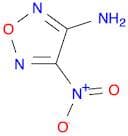
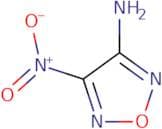
1,2,5-Oxadiazol-3-amin, 4-nitro- ist eine heterocyclische organische Verbindung, die durch das Vorhandensein eines Oxadiazolrings gekennzeichnet ist, der aus zwei Stickstoffatomen und einem Sauerstoffatom innerhalb einer fünfgliedrigen Ringstruktur besteht. Die Verbindung weist eine Aminogruppe (-NH2) an der Position 3 und eine Nitrogruppe (-NO2) an der Position 4 des Oxadiazolrings auf, was zu ihrer Reaktivität und potenziellen Anwendungen in verschiedenen Bereichen, einschließlich der Pharmazie und Agrochemie, beiträgt. Sie ist typischerweise ein kristalliner Feststoff bei Raumtemperatur und kann in polaren Lösungsmitteln löslich sein. Das Vorhandensein sowohl der Amino- als auch der Nitrofunktionalgruppen deutet darauf hin, dass sie an verschiedenen chemischen Reaktionen teilnehmen kann, wie z.B. nucleophile Substitutionen oder Kupplungsreaktionen. Darüber hinaus kann die einzigartige Struktur der Verbindung spezifische biologische Aktivitäten verleihen, was sie für weitere Forschungen in der medizinischen Chemie von Interesse macht. Sicherheitsdaten sollten für den Umgang und die Lagerung konsultiert werden, da Verbindungen mit Nitrogruppen manchmal empfindlich oder gefährlich sein können.
Formel:C2H2N4O3
InChl:InChI=1/C2H2N4O3/c3-1-2(6(7)8)5-9-4-1/h(H2,3,4)
SMILES:c1(c(non1)N(=O)=O)N
Synonyme:- 4-Nitro-1,2,5-oxadiazol-3-amine
- 3-Amino-4-nitrofurazan
Sortieren nach
Reinheit (%)
0
100
|
0
|
50
|
90
|
95
|
100
3 Produkte.
4-Nitro-1,2,5-oxadiazol-3-amine
CAS:Kontrolliertes Produkt4-Nitro-1,2,5-oxadiazol-3-amine is a molecule that has been shown to be an inhibitor of the epidermal growth factor receptor (EGFR). The optimal reaction conditions for this molecule were determined by crystallography. These results were confirmed by prognosis assays and the determination of tautomers. This molecule may be used in diagnosis and as a potential treatment for cancer. 4-Nitro-1,2,5-oxadiazol-3-amine binds to the EGFR at a site different from that of erlotinib, an inhibitor currently used in the clinic. This binding leads to inhibition of protein synthesis and cell division by preventing the activation of downstream signal transduction pathways. The molecule also inhibits tumor cell proliferation and induces apoptosis by preventing the production of nitric oxide (NO) and reactive oxygen species (ROS).Formel:C2H2N4O3Reinheit:Min. 95%Molekulargewicht:130.06 g/mol