CAS 66416-49-7
:2-Methyl-6-phenylpyridin-3-carbonsäure
Beschreibung:
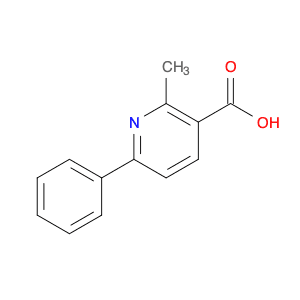
2-Methyl-6-phenylpyridin-3-carbonsäure, mit der CAS-Nummer 66416-49-7, ist eine organische Verbindung, die durch ihre Pyridinringstruktur gekennzeichnet ist, die einen sechsgliedrigen aromatischen Ring mit einem Stickstoffatom enthält. Diese Verbindung weist eine Carbonsäurefunktion (-COOH) an der Position 3 auf, was zu ihren sauren Eigenschaften beiträgt. Das Vorhandensein einer Methylgruppe an der Position 2 und einer Phenylgruppe an der Position 6 erhöht ihre molekulare Komplexität und kann ihre Reaktivität und Löslichkeit beeinflussen. Typischerweise zeigen Verbindungen dieser Art eine moderate bis hohe Polarität aufgrund der Carbonsäuregruppe, die Wasserstoffbrückenbindungen eingehen kann. Die Verbindung kann in verschiedenen chemischen Synthesen oder als Zwischenprodukt in der Herstellung von Arzneimitteln und Agrochemikalien verwendet werden. Ihre spezifischen physikalischen Eigenschaften, wie Schmelzpunkt, Siedepunkt und Löslichkeit, würden von den molekularen Wechselwirkungen und der Anwesenheit von Substituenten abhängen. Insgesamt ist 2-Methyl-6-phenylpyridin-3-carbonsäure in der organischen Chemie aufgrund seiner strukturellen Merkmale und potenziellen Anwendungen von Interesse.
Formel:C13H11NO2
InChl:InChI=1/C13H11NO2/c1-9-11(13(15)16)7-8-12(14-9)10-5-3-2-4-6-10/h2-8H,1H3,(H,15,16)
SMILES:Cc1c(ccc(c2ccccc2)n1)C(=O)O
Synonyme:- 2-Methyl-6-phenylnicotinic acid
- 3-Pyridinecarboxylic Acid, 2-Methyl-6-Phenyl-
Sortieren nach
Reinheit (%)
0
100
|
0
|
50
|
90
|
95
|
100
4 Produkte.
2-Methyl-6-phenylnicotinic acid
CAS:Formel:C13H11NO2Reinheit:98%Farbe und Form:SolidMolekulargewicht:213.23192-Methyl-6-phenylpyridine-3-carboxylic acid
CAS:2-Methyl-6-phenylpyridine-3-carboxylic acid is a compound that has been used as an antimicrobial agent. It is the most active of the aldehydes for the treatment of tuberculosis. 2-Methyl-6-phenylpyridine-3-carboxylic acid inhibits bacterial growth by binding to DNA dependent RNA polymerase, thereby preventing transcription and replication. The high frequency of human activity has been shown using a patch clamp technique on human erythrocytes. This active form is metabolized through a number of metabolic transformations, including hydrolysis by esterases or glucuronidases, oxidation by cytochrome P450 enzymes, reduction by glutathione reductase, or conjugation with glucuronic acid. 2 methyl 6 phenylpyridine 3 carboxylic acid also specifically binds to markers expressed at high levels in Mycobacterium tuberculosis strains (e.gFormel:C13H11NO2Reinheit:Min. 95%Molekulargewicht:213.23 g/mol