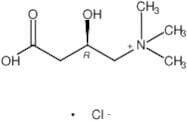
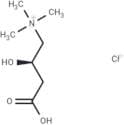
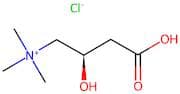
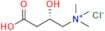
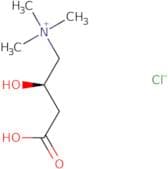
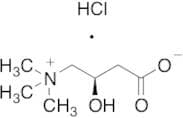
CAS 6645-46-1
:(R)-(3-carboxy-2-hydroxypropyl)trimethylammoniumchlorid
Beschreibung:
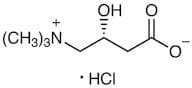
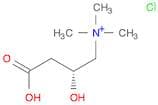
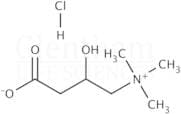
(R)-(3-carboxy-2-hydroxypropyl)trimethylammoniumchlorid, mit der CAS-Nummer 6645-46-1, ist eine quartäre Ammoniumverbindung, die durch ihre Trimethylammoniumgruppe und eine Carbonsäurefunktion gekennzeichnet ist. Diese Verbindung ist typischerweise ein weißes kristallines Feststoff oder Pulver, das in Wasser löslich ist, was sie in verschiedenen Anwendungen nützlich macht, einschließlich als Tensid, Emulgator oder in biologischen Systemen. Ihre Struktur umfasst ein positiv geladenes Stickstoffatom, das an drei Methylgruppen und eine Hydroxypropylkette gebunden ist, die sowohl eine Carbonsäure als auch eine Hydroxylgruppe enthält, was zu ihrer amphiphilen Natur beiträgt. Diese Amphiphilität ermöglicht es ihr, mit sowohl hydrophilen als auch hydrophoben Substanzen zu interagieren, was ihre Nützlichkeit in Formulierungen erhöht. Darüber hinaus verleiht die Anwesenheit der quartären Ammoniumgruppe antimikrobielle Eigenschaften, was sie in pharmazeutischen und kosmetischen Anwendungen relevant macht. Sicherheitsdaten sollten für den Umgang und die potenzielle Toxizität konsultiert werden, da quartäre Ammoniumverbindungen unterschiedliche Grade biologischer Aktivität aufweisen können.
Formel:C7H16NO3·Cl
InChl:InChI=1S/C7H15NO3.ClH/c1-8(2,3)5-6(9)4-7(10)11;/h6,9H,4-5H2,1-3H3;1H/t6-;/m1./s1
InChI Key:InChIKey=JXXCENBLGFBQJM-FYZOBXCZSA-N
SMILES:C([N+](C)(C)C)[C@@H](CC(O)=O)O.[Cl-]
Synonyme:- (2R)-
- (2R)-3-carboxy-2-hydroxy-N,N,N-trimethylpropan-1-aminium chloride
- (R)- 1-Propanaminium
- (R)-(-)-Carnitine hydrochloride
- (R)-(3-Carboxy-2-hydroxypropyl)trimethylammoniumchlorid
- (R)-3-Carboxy-2-Hydroxy-N,N,N-Trimethyl-1-
- (R)-3-Carboxy-2-hydroxy-N,N,N-trimethylpropan-1-aminiumchloride
- (R)-Carnitinehydrochloride
- 1-Butanaminium, 2,4-dihydroxy-N,N,N-trimethyl-4-oxo-, chloride (1:1), (2R)-
- 1-Propanaminium, 3-carboxy-2-hydroxy-N,N,N-trimethyl-
- 1-Propanaminium, 3-carboxy-2-hydroxy-N,N,N-trimethyl-, chloride, (2R)-
- 1-Propanaminium, 3-carboxy-2-hydroxy-N,N,N-trimethyl-, chloride, (R)-
- 3-Carboxy-2-Hydroxy-N,N,N-Trimethyl-,Chloride,(R)-1-Propanaminiu
- 3-carboxy-2-hydroxy-N,N,N-trimethyl-, chloride, (2R)-
- <span class="text-smallcaps">L</span>-(-)-Carnitine hydrochloride
- Ammonium, (3-carboxy-2-hydroxypropyl)trimethyl-, chloride, (-)-
- L-(-)-Carnitine hydrochloride
- L-(3-Carboxy-2-Hydroxypropyl)Trimethylammoniumchloride
- L-Carnitinechloride
- Lc-80
- Levocarnitine chloride
- Levocarnitinechloride
- Propanaminiumchloride
- chlorure de (R)-(3-carboxy-2-hydroxypropyl)trimethylammonium
- cloruro de (R)-(3-carboxi-2-hidroxipropil)trimetilamonio
- Weitere Synonyme anzeigen
Sortieren nach
Reinheit (%)
0
100
|
0
|
50
|
90
|
95
|
100
11 Produkte.
L-Carnitine Hydrochloride
CAS:Formel:C7H15NO3·HClReinheit:>98.0%(T)Farbe und Form:White to Almost white powder to crystalMolekulargewicht:197.66L-Carnitine hydrochloride
CAS:Formel:C7H15NO3·HCIReinheit:98.0 - 102.0 % (dried basis)Farbe und Form:White powderMolekulargewicht:197.66L-Carnitine hydrochloride
CAS:L-Carnitine hydrochloride, a polar zwitterion, supports mitochondrial β-oxidation, fatty acid transport, antioxidant activity, and metabolic research.Formel:C7H16ClNO3Reinheit:99.749%Farbe und Form:White To Slightly Beige Crystalline PowderMolekulargewicht:197.66L-Carnitine hydrochloride
CAS:L-Carnitine hydrochlorideFormel:C7H16NO3·ClReinheit:99%Farbe und Form: white solidMolekulargewicht:197.66g/molL-Carnitine hydrochloride
CAS:L-Carnitine hydrochloride is a naturally occurring amino acid that is involved in the metabolism of fat. L-Carnitine hydrochloride is a low-dose form of L-carnitine and has been shown to improve symptoms of diabetic neuropathy by increasing tissue levels of carnitine and reducing oxidative stress. This drug also has biological properties that include the ability to increase cellular energy production, and to improve the activity of primary cells in tissue culture. It also has proton buffering effects, which have been demonstrated using light microscopy on muscle cells from rats with papillary muscle. In addition, this drug has been shown to have antioxidant properties when tested on redox potential in rat liver mitochondria. L-Carnitine hydrochloride can be used as treatment for congestive heart failure, cardiac arrhythmias, and other metabolic disorders.Formel:C7H16NO3·ClReinheit:Min. 95%Farbe und Form:White PowderMolekulargewicht:197.66 g/mol(R)-3-Carboxy-2-hydroxy-N,N,N-trimethylpropan-1-aminium chloride
CAS:Formel:C7H16ClNO3Reinheit:98%Farbe und Form:SolidMolekulargewicht:197.66(R)-3-Carboxy-2-hydroxy-N,N,N-trimethylpropan-1-aminium Chloride
CAS:Kontrolliertes ProduktStability Hygroscopic
Applications (R)-3-Carboxy-2-hydroxy-N,N,N-trimethylpropan-1-aminium chloride is an important co-factor of mammalian mitochondrial energy metabolism. It is also a good active ingredient for dry-skin.
References Geier, David A., et al.: Neurochem. Res., 38(11), 2336-2341 (2013);Tanno, Osamu, et al.: Fragrance J., 33(8), 82-85 (2005);Formel:C7H16NO3·ClFarbe und Form:White To Off-WhiteMolekulargewicht:197.66