CAS 6652-28-4
:Benzoin-Isopropylether
Beschreibung:
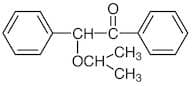
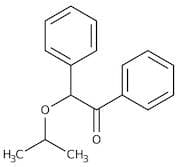
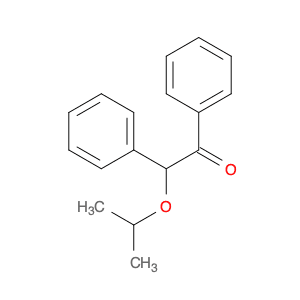
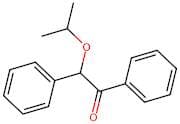
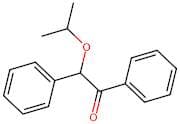
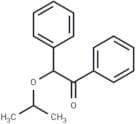
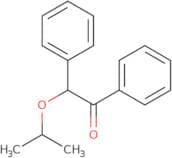
Benzoin-Isopropylether, mit der CAS-Nummer 6652-28-4, ist eine organische Verbindung, die zur Klasse der Ether gehört. Sie zeichnet sich durch ihre Struktur aus, die eine Benzoin-Gruppe enthält, die mit einer Isopropyl-Ether-Gruppe verbunden ist. Diese Verbindung erscheint typischerweise als farblose bis blassgelbe Flüssigkeit und ist bekannt für ihren angenehmen aromatischen Geruch. Benzoin-Isopropylether ist in organischen Lösungsmitteln wie Ethanol und Ether löslich, hat jedoch eine begrenzte Löslichkeit in Wasser. Sie wird hauptsächlich als Photoinitiator in Polymerisationsprozessen verwendet, insbesondere bei der Herstellung von Beschichtungen, Klebstoffen und Tinten, aufgrund ihrer Fähigkeit, bei UV-Licht freie Radikale zu erzeugen. Darüber hinaus zeigt sie Stabilität unter normalen Bedingungen, sollte jedoch mit Vorsicht behandelt werden, da sie unter bestimmten Umständen reaktiv sein kann. Sicherheitsvorkehrungen sind beim Arbeiten mit dieser Verbindung unerlässlich, da sie Gesundheitsrisiken darstellen kann, wenn sie eingeatmet oder eingenommen wird. Insgesamt ist Benzoin-Isopropylether eine wertvolle Substanz in verschiedenen industriellen Anwendungen, insbesondere im Bereich der Photopolymerisation.
Formel:C17H18O2
InChl:InChI=1S/C17H18O2/c1-13(2)19-17(15-11-7-4-8-12-15)16(18)14-9-5-3-6-10-14/h3-13,17H,1-2H3
InChI Key:InChIKey=MSAHTMIQULFMRG-UHFFFAOYSA-N
SMILES:C(C(=O)C1=CC=CC=C1)(OC(C)C)C2=CC=CC=C2
Synonyme:- (2R)-1,2-diphenyl-2-(propan-2-yloxy)ethanone
- (2S)-1,2-diphenyl-2-(propan-2-yloxy)ethanone
- 1,2-Diphenyl-2-(Propan-2-Yloxy)Ethanone
- 1,2-Diphenyl-2-propan-2-yloxyethanone
- 2-(1-Methylethoxy)-1,2-diphenylethanone
- 2-Hydroxy-1,2-Diphenylethanone - 2-(Propan-2-Yloxy)Propane (1:1)
- 2-Isopropoxy-1,2-diphenylethan-1-one
- 2-Isopropoxy-1,2-diphenylethanone
- 2-Isopropoxy-2-phenylacetophenone
- Acetophenone, 2-isopropoxy-2-phenyl-
- Ethanone, 2-(1-methylethoxy)-1,2-diphenyl-
- Glocure 31
- Isopropyl benzoin ether
- Nisso Cure IBPO
- Ps 10A
- Seikuol BIP
- Vicure 30
- alpha-Isopropoxy-alpha-phenylacetophenone
- α-Isopropoxydeoxybenzoin
- Weitere Synonyme anzeigen
Sortieren nach
Reinheit (%)
0
100
|
0
|
50
|
90
|
95
|
100
8 Produkte.
Benzoin Isopropyl Ether
CAS:Formel:C17H18O2Reinheit:>99.0%(GC)Farbe und Form:White to Almost white powder to crystalMolekulargewicht:254.33Benzoin isopropyl ether, 98+%
CAS:This Thermo Scientific Chemicals brand product was originally part of the Alfa Aesar product portfolio. Some documentation and label information may refer to the legacy brand. The original Alfa Aesar product / item code or SKU reference has not changed as a part of the brand transition to Thermo Sci
Formel:C17H18O2Reinheit:98+%Farbe und Form:White, Crystals or powder or crystalline powderMolekulargewicht:254.332-Isopropoxy-2-Phenylacetophenone
CAS:2-Isopropoxy-2-PhenylacetophenoneReinheit:≥98%Molekulargewicht:254.32g/mol2-Isopropoxy-2-Phenylacetophenone
CAS:2-Isopropoxy-2-Phenylacetophenone is a natural compound, a derivative of benzoin. Benzoin is a naturally occurring benzaldehyde found in many plants.Formel:C17H18O2Reinheit:98.37%Farbe und Form:SolidMolekulargewicht:254.32rac-Benzoin isopropyl ether
CAS:Benzoin is a naturally occurring phenolic compound. Benzoin is used as a fragrance and flavoring agent in foods, beverages, sweets, toothpaste, mouthwash, and cigarettes. Benzoin is also used as a reagent to make other chemicals such as acetophenone. Rac-Benzoin isopropyl ether (BEN) is an organic chemical that has a hydroxyl group on the benzoin molecule. It can be used to detect radiation by initiating polymerization of polycarboxylic acid molecules. BEN has been shown to have kinetic properties that are dependent on the matrix effect and the concentration of cross-linking agent. This chemical has also been shown to be useful for the preparation of boron nitride films with high diphenyl ether content and high surface area with low density. The most common use for BEN is as a cross-linking agent in the production of fatty acid matrices for flow assays.Formel:C17H18O2Reinheit:Min. 95%Farbe und Form:PowderMolekulargewicht:254.32 g/mol