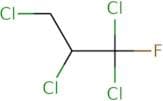
CAS 666-27-3
:1,1,2,3-Tetrachlor-1-fluorpropan
Beschreibung:
1,1,2,3-Tetrachlor-1-fluorpropan, mit der CAS-Nummer 666-27-3, ist eine halogenierte organische Verbindung, die durch ihre vier Chloratome und ein Fluoratoms gekennzeichnet ist, die an einem drei Kohlenstoff-Propangestell befestigt sind. Diese Verbindung ist typischerweise eine farblose Flüssigkeit bei Raumtemperatur und ist bekannt für ihre relativ hohe Dichte und niedrige Flüchtigkeit im Vergleich zu anderen organischen Lösungsmitteln. Sie ist nicht brennbar und hat eine ausgeprägte chemische Stabilität, was sie in verschiedenen industriellen Anwendungen nützlich macht, insbesondere als Lösungsmittel oder in der Produktion anderer Chemikalien. Aufgrund ihrer halogenierten Natur kann sie jedoch Umwelt- und Gesundheitsrisiken darstellen, einschließlich potenzieller Toxizität und Persistenz in der Umwelt. Ihre Verwendung ist in vielen Regionen reguliert, da Bedenken hinsichtlich ihrer Auswirkungen auf die menschliche Gesundheit und die Ozonschicht bestehen. Eine ordnungsgemäße Handhabung und Entsorgung sind entscheidend, um mögliche nachteilige Auswirkungen im Zusammenhang mit der Exposition gegenüber dieser Verbindung zu mindern.
Formel:C3H3Cl4F
InChl:InChI=1S/C3H3Cl4F/c4-1-2(5)3(6,7)8/h2H,1H2
InChI Key:InChIKey=AUCDWYVJFVHEHQ-UHFFFAOYSA-N
SMILES:C(C(Cl)(Cl)F)(CCl)Cl
Synonyme:- HCFC 241db
- Propane, 1,1,2,3-tetrachloro-1-fluoro-
- 1,1,2,3-Tetrachloro-1-fluoropropane
Sortieren nach
Reinheit (%)
0
100
|
0
|
50
|
90
|
95
|
100
1 Produkte.
1,1,2,3-Tetrachloro-1-fluoropropane
CAS:Kontrolliertes Produkt<p>1,1,2,3-Tetrachloro-1-fluoropropane is a solvent that can be used to solvate organic compounds. It is volatile and has a boiling point of -78°C. This compound is used in the chlorination of methane and ethane, which produces 1,1,2-trichloroethane and 1,2-dichloroethane respectively. Hydrogen fluoride is also produced as an unwanted byproduct. The chlorine produced by this process is then catalyzed to form fluorine gas. This gas can be vaporized or depletes depending on the reaction conditions and the temperature of the reactor. Fluorine gas reacts with atmospheric water vapor to produce hydrofluoric acid (HF). When HF comes into contact with moist surfaces it will corrode them and produce hydrogen ions that react with metal oxides to produce metal salts and water. The emission of HF from chlorofluorocarbons</p>Formel:C3H3Cl4FReinheit:Min. 95%Molekulargewicht:199.87 g/mol