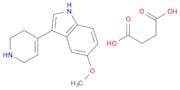
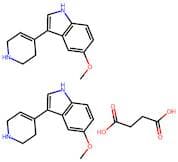
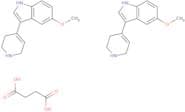
CAS 66611-27-6
:Butandisäure, Verb. mit 5-Methoxy-3-(1,2,3,6-tetrahydro-4-pyridinyl)-1H-indol (1:2)
Beschreibung:
Butandisäure, Verb. mit 5-Methoxy-3-(1,2,3,6-tetrahydro-4-pyridinyl)-1H-indol (1:2), bekannt unter seiner CAS-Nummer 66611-27-6, ist eine chemische Verbindung, die Eigenschaften aufweist, die typisch für beide Komponenten sind. Die Butandisäurekomponente trägt zu seinen sauren Eigenschaften bei und macht es zu einer Dicarbonsäure, die an verschiedenen chemischen Reaktionen teilnehmen kann, einschließlich Esterifizierung und Säure-Base-Reaktionen. Der Indolderivat, das eine Tetrahydropyridinstruktur aufweist, deutet auf eine potenzielle biologische Aktivität hin, die möglicherweise neurochemische Wege beeinflusst, aufgrund seiner strukturellen Ähnlichkeit mit Neurotransmittern. Diese Verbindung kann in polaren Lösungsmitteln löslich sein, und ihre molekularen Wechselwirkungen könnten in pharmakologischen Kontexten von Bedeutung sein. Die Kombination dieser beiden Komponenten kann zu einzigartigen Eigenschaften führen, wie z.B. erhöhter Bioaktivität oder spezifischen Bindungsaffinitäten, was sie in der medizinischen Chemie und der Arzneimittelentwicklung von Interesse macht. Insgesamt stellt diese Verbindung ein komplexes Zusammenspiel organischer funktioneller Gruppen dar, das für verschiedene Anwendungen in Forschung und Industrie erkundet werden könnte.
Formel:C32H38N4O6
InChl:InChI=1/2C14H16N2O.C4H6O4/c2*1-17-11-2-3-14-12(8-11)13(9-16-14)10-4-6-15-7-5-10;5-3(6)1-2-4(7)8/h2*2-4,8-9,15-16H,5-7H2,1H3;1-2H2,(H,5,6)(H,7,8)
InChI Key:InChIKey=AFNQSRYIQUAMNM-UHFFFAOYSA-N
SMILES:O(C)C=1C=C2C(=CNC2=CC1)C=3CCNCC3.C(CC(O)=O)C(O)=O
Synonyme:- 1H-Indole, 5-methoxy-3-(1,2,3,6-tetrahydro-4-pyridinyl)-, butanedioate (2:1)
- 5-Methoxy-3-(1,2,3,6-tetrahydropyridin-4-yl)-1H-indole succinate (2:1)
- Butanedioic acid, compd. with 5-methoxy-3-(1,2,3,6-tetrahydro-4-pyridinyl)-1H-indole (1:2)
- 1H-Indole, 5-methoxy-3-(1,2,3,6-tetrahydro-4-pyridinyl)-, succinate (2:1)
- Butanedioic acid, compd. with5-methoxy-3-(1,2,3,6-tetrahydro-4-pyridinyl)-1H-indole (1:2)OTHER CA INDEX NAMES:1H-Indole, 5-methoxy-3-(1,2,3,6-tetrahydro-4-pyridinyl)-, butanedioate(2:1)
- 5-Methoxy-3-(1,2,3,6-tetrahydro-4-pyridinyl)-1H-indole succinate (2:1)
- RU 24969 hemisuccinate >=98% (HPLC)
Sortieren nach
Reinheit (%)
0
100
|
0
|
50
|
90
|
95
|
100
5 Produkte.
Butanedioic acid, compd. with5-methoxy-3-(1,2,3,6-tetrahydro-4-pyridinyl)-1H-indole (1:2)OTHER CA INDEX NAMES:1H-Indole, 5-methoxy-3-(1,2,3,6-tetrahydro-4-pyridinyl)-, butanedioate(2:1)
CAS:Formel:C32H38N4O6Reinheit:98%Farbe und Form:SolidMolekulargewicht:574.66735-Methoxy-3-(1,2,3,6-tetrahydropyridin-4-yl)-1H-indole hemisuccinate
CAS:5-Methoxy-3-(1,2,3,6-tetrahydropyridin-4-yl)-1H-indole hemisuccinateReinheit:97%Molekulargewicht:574.68g/mol5-Methoxy-3-(1,2,5,6-tetrahydro-4-pyridinyl)-1H-indole hemisuccinate
CAS:5-Methoxy-3-(1,2,5,6-tetrahydro-4-pyridinyl)-1H-indole hemisuccinate is a serotonin receptor agonist that has been shown to stimulate the 5HT1A receptor. It stimulates insulin secretion and glucose uptake in rats and inhibits feeding behavior in mice. It has also been shown to have antihypertensive effects on rats by blocking the 5HT2 receptors. In addition, it stimulates regeneration of injured nerve cells. This drug has potential uses as a treatment for neurological diseases such as Parkinson's disease and depression.Formel:C14H16N2O•(C4H6O4)0Reinheit:Min. 95%Farbe und Form:Yellow solid.Molekulargewicht:287.33 g/molRU 24969 Succinate (2:1)
CAS:Kontrolliertes ProduktFormel:(C14H16N2O)•(C4H6O4)Farbe und Form:NeatMolekulargewicht:574.67