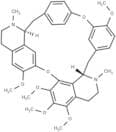
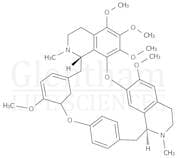
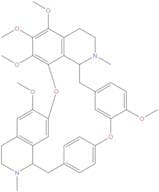
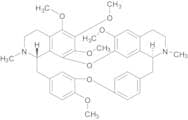
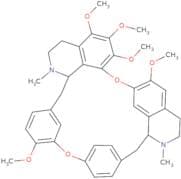
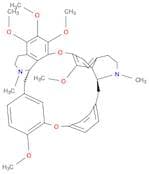
CAS 6681-13-6
:(4aS,16aS)-3,4,4a,5,16a,17,18,19-Octahydro-12,20,21,22,26-pentamethoxy-4,17-dimethyl-16H-1,24:6,9-dietheno-11,15-metheno-2H-pyrido[2′,3′:17,18][1,11]dioxacycloeicosino[2,3,4-ij]isochinolin
Beschreibung:
Die chemische Substanz mit dem Namen "(4aS,16aS)-3,4,4a,5,16a,17,18,19-Octahydro-12,20,21,22,26-pentamethoxy-4,17-dimethyl-16H-1,24:6,9-dietheno-11,15-metheno-2H-pyrido[2′,3′:17,18][1,11]dioxacycloeicosino[2,3,4-ij]isochinolin" und der CAS-Nummer "6681-13-6" ist eine komplexe organische Verbindung, die durch eine Mehrringstruktur gekennzeichnet ist, die verschiedene funktionelle Gruppen, einschließlich Methoxy- und Ethylenmoieties, integriert. Ihre Stereochemie wird durch spezifische Konfigurationen an mehreren chiralen Zentren definiert, die zu ihrer potenziellen biologischen Aktivität beitragen. Das Vorhandensein mehrerer Methoxygruppen deutet darauf hin, dass sie einzigartige Löslichkeits- und Reaktivitätseigenschaften aufweisen könnte. Darüber hinaus deutet das komplexe Gerüst der Verbindung auf potenzielle Anwendungen in der medizinischen Chemie hin, insbesondere bei der Entwicklung von Arzneimitteln. Die strukturelle Komplexität könnte auch ihre Wechselwirkungen mit biologischen Zielen beeinflussen, was sie zu einem interessanten Thema für weitere Forschungen im Bereich der Arzneimittelgestaltung und -synthese macht. Insgesamt veranschaulicht diese Verbindung die Vielfalt und Komplexität, die in der organischen Chemie zu finden sind, insbesondere im Bereich der Derivate natürlicher Produkte.
Formel:C39H44N2O7
InChl:InChI=1S/C39H44N2O7/c1-40-16-14-25-21-32(43-4)34-22-28(25)29(40)18-23-8-11-26(12-9-23)47-33-20-24(10-13-31(33)42-3)19-30-35-27(15-17-41(30)2)36(44-5)38(45-6)39(46-7)37(35)48-34/h8-13,20-22,29-30H,14-19H2,1-7H3/t29-,30-/m0/s1
InChI Key:InChIKey=FUZMQNZACIFDBL-KYJUHHDHSA-N
SMILES:O(C)C1=C2C3=C(C(OC)=C1OC)CCN(C)[C@]3(CC=4C=C(C(OC)=CC4)OC=5C=CC(C[C@]6(C7=CC(O2)=C(OC)C=C7CCN6C)[H])=CC5)[H]
Synonyme:- (+)-Hernandezine
- (4aS,16aS)-3,4,4a,5,16a,17,18,19-Octahydro-12,20,21,22,26-pentamethoxy-4,17-dimethyl-16H-1,24:6,9-dietheno-11,15-metheno-2H-pyrido[2′,3′:17,18][1,11]dioxacycloeicosino[2,3,4-ij]isoquinoline
- 16H-1,24:6,9-Dietheno-11,15-metheno-2H-pyrido[2′,3′:17,18][1,11]dioxacycloeicosino[2,3,4-ij]isoquinoline, 3,4,4a,5,16a,17,18,19-octahydro-12,20,21,22,26-pentamethoxy-4,17-dimethyl-, (4aS,16aS)-
- 16H-1,24:6,9-Dietheno-11,15-metheno-2H-pyrido[2′,3′:17,18][1,11]dioxacycloeicosino[2,3,4-ij]isoquinoline, berbaman deriv.
- Berbaman, 5,6,6',7,12-pentamethoxy-2,2'-dimethyl-, (1beta)-
- Berbaman, 5,6,6′,7,12-pentamethoxy-2,2′-dimethyl-, (1β)-
- Hernandesine
- Thalicsimine
- (1beta)-5,6,6',7,12-Pentamethoxy-2,2'-dimethylberbaman
Sortieren nach
Reinheit (%)
0
100
|
0
|
50
|
90
|
95
|
100
7 Produkte.
Hernandezine
CAS:Hernandezine is an activator of AMPK activator and a selective reversing agent for ABCB1-mediated MDR in cancer cells.Formel:C39H44N2O7Reinheit:99.53%Farbe und Form:SolidMolekulargewicht:652.78Hernandezine
CAS:Kontrolliertes ProduktApplications Hernandezine is a novel anticancer AMPK activator identified as a major major active constituent of Thalictrum Ranunculaceae.
References Song, Y. et al.: J. Pharm. Biomed. Anal., 141, 132 (2017);Formel:C39H44N2O7Farbe und Form:NeatMolekulargewicht:652.776Hernandezine
CAS:Hernandezine is a natural compound that belongs to the class of bisbenzylisoquinoline alkaloids. It is extracted from the bark of Quillaja saponaria, a chinese herb. Hernandezine has been shown to induce autophagy and inhibit lipid accumulation in hl-60 cells. This drug also has antitumor and antimetastatic effects on brain tumor cells, as well as anti-inflammatory properties. Hernandezine inhibits Ca2+ uptake in mitochondria, which can lead to cell death. Hernandezine has been shown to be a potential drug transporter for fat cells and may have immunosuppressive effects on autoimmune diseases such as diabetes or arthritis.Formel:C39H44N2O7Reinheit:Min. 95%Molekulargewicht:652.8 g/mol