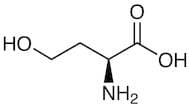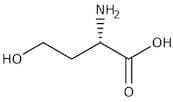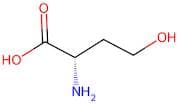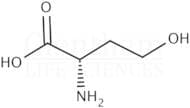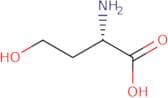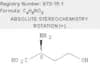
CAS 672-15-1
:L-Homoserin
Beschreibung:
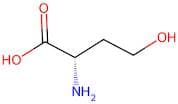
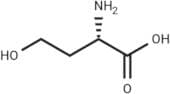
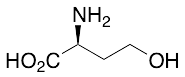
L-Homoserin ist eine Aminosäure, die eine entscheidende Rolle in verschiedenen biologischen Prozessen spielt. Sie wird als nicht essentielle Aminosäure klassifiziert, was bedeutet, dass sie vom Körper synthetisiert werden kann. L-Homoserin ist durch seine Hydroxyl- und Aminogruppen gekennzeichnet, die zu seiner Löslichkeit in Wasser beitragen. Es ist ein farbloser, kristalliner Feststoff bei Raumtemperatur und hat einen leicht süßen Geschmack. Diese Verbindung ist an der Biosynthese anderer Aminosäuren, wie Threonin und Methionin, beteiligt und ist auch ein Vorläufer bei der Synthese bestimmter Vitamine. L-Homoserin wird in verschiedenen Anwendungen eingesetzt, einschließlich als Nahrungsergänzungsmittel und in der biochemischen Forschung. Seine chemische Formel ist C4H9NO3, und es hat ein Molekulargewicht, das seine Struktur widerspiegelt. Darüber hinaus kann L-Homoserin an verschiedenen Stoffwechselwegen teilnehmen, was es sowohl in der Physiologie von Pflanzen als auch von Tieren bedeutend macht. Seine Stabilität und Reaktivität unter verschiedenen Bedingungen sind wichtig für seine Rolle in biochemischen Prozessen.
Formel:C4H9NO3
InChl:InChI=1S/C4H9NO3/c5-3(1-2-6)4(7)8/h3,6H,1-2,5H2,(H,7,8)/t3-/m0/s1
InChI Key:InChIKey=UKAUYVFTDYCKQA-VKHMYHEASA-N
SMILES:[C@H](CCO)(C(O)=O)N
Synonyme:- (2S)-2-Amino-4-hydroxybutanoic acid
- (S)-2-Amino-4-hydroxybutanoic acid
- (S)-Homoserine
- 2-Amino-4-hydroxybutanoic acid
- 2-Amino-4-hydroxybutyric acid
- <span class="text-smallcaps">L</span>-Homoserine
- Butanoic Acid, 2-Amino-4-Hydroxy-, L-
- Butanoic acid, 2-amino-4-hydroxy-, (S)-
- Butyric acid, 2-amino-4-hydroxy-
- Butyric acid, 2-amino-4-hydroxy-, <span class="text-smallcaps">L</span>-
- Butyric acid, 2-amino-4-hydroxy-, L-
- Homoserine
- L-Homoserin
- L-homoserina
- Nsc 206251
- L-Beta-Homo-Ser
- Homoserine (VAN)
- H-Homoserine
- L-Homoser
- L-Homoserine
- Weitere Synonyme anzeigen
Sortieren nach
Reinheit (%)
0
100
|
0
|
50
|
90
|
95
|
100
13 Produkte.
L-Homoserine
CAS:Formel:C4H9NO3Reinheit:>98.0%(T)Farbe und Form:White to Almost white powder to crystalMolekulargewicht:119.12L-Homoserine, 99%
CAS:L-Homoserine is used in the biosynthesis of methionine, threonine and isoleucine. This Thermo Scientific Chemicals brand product was originally part of the Alfa Aesar product portfolio. Some documentation and label information may refer to the legacy brand. The original Alfa Aesar product / item codFormel:C4H9NO3Reinheit:99%Farbe und Form:White to pale cream, Crystals or powder or crystalline powderMolekulargewicht:119.12(2S)-2-Amino-4-hydroxybutanoic acid
CAS:Formel:C4H9NO3Reinheit:97%Farbe und Form:SolidMolekulargewicht:119.1192Ref: IN-DA00IBOQ
1kgNachfragen5kgNachfragen100mg20,00€1g22,00€5g26,00€10g28,00€25g52,00€100g121,00€500g562,00€L-Homoserine
CAS:L-HomoserineFormel:C4H9NO3Reinheit:98%Farbe und Form: pale yellow solidMolekulargewicht:119.12g/molL-Homoserine
CAS:Formel:C4H9NO3Reinheit:≥ 98.0%Farbe und Form:White crystalline powderMolekulargewicht:119.12L-Homoserine
CAS:L-Homoserine is a reactive serine variant with an extra CH2, forms a 5-membered ring, not in proteins, and is made after cyanogen bromide cleavage.Formel:C4H9NO3Reinheit:99.77%Farbe und Form:SolidMolekulargewicht:119.12L-Homoserine
CAS:Kontrolliertes ProduktApplications L-Homoserine is used in the preparation nucleoside amino acids as histone methyltransferase inhibitors
References Schuele, Roland. et al., PCT Int. Appl. 133pp.(2021);Formel:C4H9NO3Farbe und Form:Light Yellow CrystallineMolekulargewicht:119.12L-Homoserine-d4
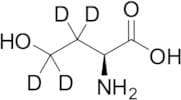
CAS:Kontrolliertes ProduktFormel:C4D4H5NO3Farbe und Form:NeatMolekulargewicht:123.144L-Homoserine
CAS:L-Homoserine is a cyclic dipeptide that inhibits the enzyme homoserine dehydrogenase and its conversion of L-homoserine to L-threonine. L-Homoserine is not an antimicrobial agent, but it has been shown to be a potent antagonist of the bacterial homoserine dehydrogenase. The inhibition of this enzyme prevents the conversion of L-homoserine to L-threonine and leads to a buildup of homoserine in bacteria. This accumulation can lead to bacterial cell death by inhibiting protein synthesis and DNA replication. The use of L-homoserine as an antimicrobial agent is being studied for wastewater treatment because it may be able to degrade hazardous compounds found in wastewater, such as antibiotics and other pharmaceuticals.Formel:C4H9NO3Reinheit:Min. 98.0 Area-%Farbe und Form:White PowderMolekulargewicht:119.12 g/mol