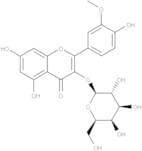
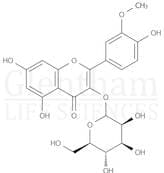
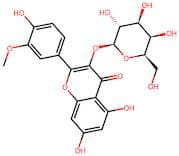
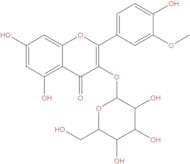
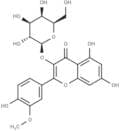
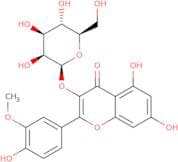
CAS 6743-92-6
:5,7-dihydroxy-2-(4-hydroxy-3-methoxy-phenyl)-3-[(3R,4S,5R,6R)-3,4,5-trihydroxy-6-(hydroxymethyl)tetrahydropyran-2-yl]oxy-chromen-4-on
- Isorhamnetin 3-O-galactoside
- 5,7-dihydroxy-2-(4-hydroxy-3-methoxyphenyl)-3-[(3S,4S,5S,6R)-3,4,5-trihydroxy-6-(hydroxymethyl)oxan-2-yl]oxychromen-4-one
- 3'-O-Methylquercetin 3-galactoside
- Isorhamnetin 3-galactoside
- Isorhamnetol 3-O-galactoside
- 2-(4-Hydroxy-3-methoxyphenyl)-3-(β-D-galactopyranosyloxy)-5,7-dihydroxy-4H-1-benzopyran-4-one
- Cacticin
- 4H-1-Benzopyran-4-one, 3-(β-D-galactopyranosyloxy)-5,7-dihydroxy-2-(4-hydroxy-3-methoxyphenyl)-
- 3-(β-D-Galactopyranosyloxy)-5,7-dihydroxy-2-(4-hydroxy-3-methoxyphenyl)-4H-1-benzopyran-4-one
Isorhamnetin-3-O-galactoside
CAS:Isorhamnetin-3-O-galactoside analytical standard provided with chromatographic purity, to be used as reference material for qualitative determination.Formel:C22H22O12Reinheit:(HPLC) ≥98%Farbe und Form:PowderMolekulargewicht:478.41Isorhamnetin-3-O-galactoside
CAS:Formel:C22H22O12Reinheit:≥ 98.0%Farbe und Form:Off-white powderMolekulargewicht:478.415,7-Dihydroxy-2-(4-hydroxy-3-methoxyphenyl)-3-(((2S,3R,4S,5R,6R)-3,4,5-trihydroxy-6-(hydroxymethyl)tetrahydro-2H-pyran-2-yl)oxy)-4H-chromen-4-one
CAS:5,7-Dihydroxy-2-(4-hydroxy-3-methoxyphenyl)-3-(((2S,3R,4S,5R,6R)-3,4,5-trihydroxy-6-(hydroxymethyl)tetrahydro-2H-pyran-2-yl)oxy)-4H-chromen-4-oneReinheit:99%Molekulargewicht:478.41g/molIsorhamnetin 3-O-galactoside
CAS:Isorhamnetin 3-O-galactoside, a flavonoid from Oenanthe javanica, inhibits thrombin and FXa, showing antithrombotic and hepatoprotective effects for vascular disease research.Formel:C22H22O12Reinheit:99.98%Farbe und Form:SolidMolekulargewicht:478.40Isorhamnetin 3-O-galactoside
CAS:Isorhamnetin 3-O-galactoside is a flavonoid derivative that is found in plant tissue. It has antioxidant properties and has been shown to inhibit leucaena seed germination, growth, and the production of reactive oxygen species (ROS). Isorhamnetin 3-O-galactoside can be extracted from fruit by using an aqueous solution of potassium hydroxide. It is also used as a dietary supplement for its potent inhibitory activity on ROS. Isorhamnetin 3-O-galactoside is found in plants with other flavonoids such as quercetin and kaempferol. The chemical structure of this compound consists of a hydroxyl group at the C3 position and an O-glycosidic linkage to galactose at the C2 position. This compound can be detected by mass spectrometric methods such as electron ionization or electrospray ionization because it
Formel:C22H22O12Reinheit:Min. 95%Molekulargewicht:478.4 g/mol