CAS 67463-44-9
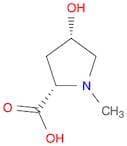
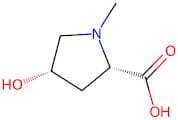
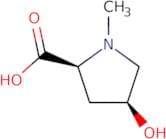
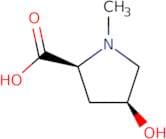
:N-Me-cis-Hyp-OH
Beschreibung:
N-Me-cis-Hyp-OH, auch bekannt als N-Methyl-cis-4-Hydroxyprolin, ist ein Aminosäurederivat, das durch seine strukturellen Merkmale gekennzeichnet ist, zu denen eine Methylgruppe gehört, die an das Stickstoffatom gebunden ist, und eine Hydroxylgruppe am Prolinring. Diese Verbindung ist ein Stereoisomer von Hydroxyprolin, speziell die cis-Form, die ihre biologische Aktivität und Interaktionen beeinflusst. Sie ist in Wasser löslich und zeigt Eigenschaften, die typisch für Aminosäuren sind, wie die Fähigkeit, an Wasserstoffbrückenbindungen teilzunehmen, aufgrund der Anwesenheit der Hydroxylgruppe. N-Me-cis-Hyp-OH ist in verschiedenen Bereichen von Interesse, einschließlich Biochemie und Pharmazie, aufgrund ihrer potenziellen Rolle bei der Proteinsynthese und ihrer Implikationen für die Stabilität und Struktur von Kollagen. Darüber hinaus kann sie als Baustein in der Peptidsynthese dienen und wurde auf ihre Auswirkungen auf zelluläre Prozesse untersucht. Ihre einzigartigen strukturellen Merkmale tragen zu ihrer Funktionalität in biologischen Systemen bei, was sie zu einem Forschungsgegenstand in der medizinischen Chemie und verwandten Disziplinen macht.
Formel:C6H11NO3
Synonyme:- N-Me-Cis-Hydroxyproline
Sortieren nach
Reinheit (%)
0
100
|
0
|
50
|
90
|
95
|
100
5 Produkte.
(2S,4S)-4-Hydroxy-1-methylpyrrolidine-2-carboxylic acid
CAS:(2S,4S)-4-Hydroxy-1-methylpyrrolidine-2-carboxylic acidReinheit:98%Molekulargewicht:145.16g/molN-Methyl-L-cis-4-hydroxyproline hydrochloride
CAS:N-Methyl-L-cis-4-hydroxyproline hydrochloride is a bioactive compound that has been isolated from the leaves of Semecarpifolia. It is an analysis product, which means that it can be used to identify or characterize a biological material. N-Methyl-L-cis-4-hydroxyproline hydrochloride is an essential component of hexane, ethanolic extracts, and leaves of Semecarpifolia. This compound has been shown to have antiinflammatory properties in research on rats. It also has fatty acid properties, as well as cyclic and butanamide structures. N-Methyl-L-cis-4-hydroxyproline hydrochloride belongs to the family Meliaceae, which includes plants like eucalyptus and camphor. This compound is soluble in solvents such as benzene, chloroform, ether, methanol, or petroleum ether.Formel:C6H11NO3•HClReinheit:Min. 95%Molekulargewicht:181.62 g/mol(2S,4S)-4-Hydroxy-1-methylpyrrolidine-2-carboxylic acid
CAS:Formel:C6H11NO3Reinheit:95.0%Farbe und Form:SolidMolekulargewicht:145.158N-Methyl-L-trans-4-hydroxyproline hydrochloride
CAS:N-Methyl-L-trans-4-hydroxyproline hydrochloride is a bioactive compound that is present in the leaves of Semecarpifolia. It has been found to have antioxidant and anti-inflammatory properties. The chemical structure of N-methyl-L-trans-4-hydroxyproline hydrochloride is cyclic, butanamide, hexane, ethanolic extracts, and semecarpifolia. The family Meliaceae includes species such as Eucalyptus, which produces the bioactive compound cineole. Solvents used in this process are hexane and ethanolic extracts.Formel:C6H11NO3·HClReinheit:Min. 95%Farbe und Form:PowderMolekulargewicht:181.62 g/mol