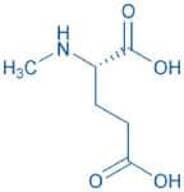
CAS 6753-62-4
:N-Methyl-L-Glutaminsäure
Beschreibung:
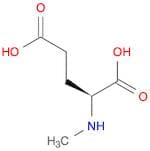
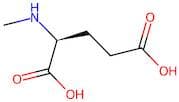
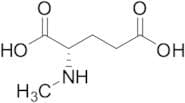
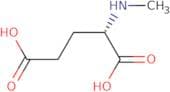
N-Methyl-L-Glutaminsäure ist ein Derivat der Aminosäure L-Glutaminsäure, das durch die Addition einer Methylgruppe an das Stickstoffatom der Aminogruppe gekennzeichnet ist. Diese Modifikation verändert seine Eigenschaften und biologische Aktivität. Die Substanz ist ein weißes kristallines Feststoff, das in Wasser löslich ist, was seine polare Natur aufgrund der Anwesenheit sowohl von Carbonsäure- als auch von Aminofunktionalgruppen widerspiegelt. N-Methyl-L-Glutaminsäure ist bekannt dafür, als selektiver Agonist für bestimmte Glutamatrezeptoren zu wirken, insbesondere den NMDA-Rezeptor, der eine entscheidende Rolle bei der synaptischen Plastizität und der Gedächtnisfunktion im zentralen Nervensystem spielt. Seine chemische Struktur umfasst zwei Carboxylgruppen, die zu seiner Säure beitragen, und es wird als nicht-proteinogener Aminosäure klassifiziert. Aufgrund seiner Rolle in der Neurotransmission ist N-Methyl-L-Glutaminsäure von Interesse in der Neuropharmakologie und könnte Implikationen für das Studium verschiedener neurologischer Störungen haben. Sicherheitsdaten sollten für den Umgang und die potenzielle Toxizität konsultiert werden, wie bei jeder chemischen Substanz.
Formel:C6H11NO4
Synonyme:- N-Me-Glu-OH
- H-L-Meglu-Oh Hcl
- N-ALPHA-METHYL-L-GLUTAMIC ACID HYDROCHLORIDE
- H-L-MEGLU-OH HCL USP/EP/BP
- N-Methyl-L-glutamic aicd
- N-Mathyl-L-glutamic acid
- N-α-Methyl-L-glutamic acid hydrate
- L-Glutamic acid, N-methyl-
- N-METHYL-L-GLUTAMIC ACID HYDROCHLORIDE
- H-N-Me-Glu-OH
- N-Me-L-Glu-OH
- (2S)-2-(methylamino)pentanedioic acid
- N-ME-GLUTAMIC ACID
- H-MEGLU-OH
- N-Methyl-L-glutamic acid hydrochloride (1:1)
- N-ALPHA-METHYL-L-GLUTAMIC ACID
- N-ME-GLU-OH HCL
- N-Methyl-L-glutamic acid≥ 98% (HPLC)
- Weitere Synonyme anzeigen
Sortieren nach
Reinheit (%)
0
100
|
0
|
50
|
90
|
95
|
100
5 Produkte.
(S)-2-(Methylamino)pentanedioic acid
CAS:Formel:C6H11NO4Reinheit:95%Farbe und Form:SolidMolekulargewicht:161.1558(S)-2-(Methylamino)pentanedioic acid
CAS:(S)-2-(Methylamino)pentanedioic acidReinheit:97%Molekulargewicht:161.16g/molN-Methyl-L-glutamic acid
CAS:N-Methyl-L-glutamic acid (NMG) is a metabolite of the amino acid L-glutamic acid. NMG is found in many tissues, and has been detected in plasma, cerebrospinal fluid, urine, and brain tissue. It also has been found in high concentrations in the brains of depressed patients. NMG is converted to n-methyl-d-aspartic acid (NMDA), which may be responsible for some of its effects on neurotransmitters. NMDA receptor antagonists are being investigated as treatments for depression and epilepsy. NMG is also involved in energy metabolism, as it can be converted to oxaloacetate by a number of enzymes. The enzyme activities for this conversion include glutamate carboxypeptidase II, glutamine synthase, glutamate dehydrogenase, glutamine synthetase and aspartate aminotransferase.Formel:C6H11NO4Reinheit:Min. 95%Farbe und Form:PowderMolekulargewicht:161.16 g/molN-Me-Glu-OH
CAS:Bachem ID: 4002660.
Formel:C6H11NO4Reinheit:> 98%Farbe und Form:White PowderMolekulargewicht:161.16