CAS 67776-06-1
:S-Nitroso-N-acetyl-DL-Penicillamin
Beschreibung:
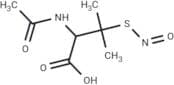
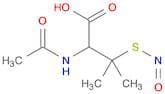
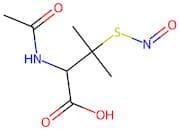
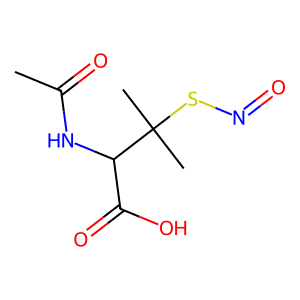
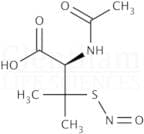
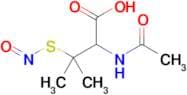
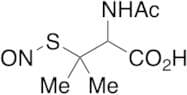
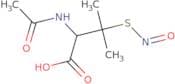
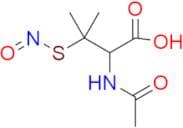
S-Nitroso-N-acetyl-DL-Penicillamin ist eine chemische Verbindung, die zur Klasse der S-Nitrosothiolen gehört, die für ihre Rolle in der biologischen Signalübertragung und potenziellen therapeutischen Anwendungen bekannt sind. Diese Verbindung ist durch das Vorhandensein einer Nitroso-Gruppe (–NO) gekennzeichnet, die an das Schwefelatom der Penicillamin, einem Derivat von Aminosäuren, gebunden ist. Sie weist Eigenschaften auf, wie ein Spender von Stickstoffmonoxid zu sein, was verschiedene physiologische Prozesse beeinflussen kann, einschließlich Vasodilatation und Modulation von zellulären Signalwegen. Die Verbindung ist typischerweise in Wasser und organischen Lösungsmitteln löslich, was sie vielseitig für verschiedene experimentelle Bedingungen macht. Ihre Stabilität kann durch Faktoren wie Licht und Temperatur beeinflusst werden, die wichtige Überlegungen für Lagerung und Handhabung sind. S-Nitroso-N-acetyl-DL-Penicillamin wurde auf seine potenziellen Anwendungen in der kardiovaskulären Gesundheit und als therapeutisches Mittel in Bedingungen untersucht, in denen die Stickstoffmonoxid-Signalübertragung gestört ist. Weitere Forschungen sind jedoch erforderlich, um seine Wirkmechanismen und therapeutischen Potenziale vollständig zu verstehen.
Formel:C7H12N2O4S
InChl:InChI=1S/C7H12N2O4S/c1-4(10)8-5(6(11)12)7(2,3)14-9-13/h5H,1-3H3,(H,8,10)(H,11,12)
InChI Key:InChIKey=ZIIQCSMRQKCOCT-UHFFFAOYSA-N
SMILES:C(C(SN=O)(C)C)(NC(C)=O)C(O)=O
Synonyme:- N-Acetyl-S-nitroso-DL-penicillamine
- S-Nitroso-N-acetyl-DL-penicillamine
- Valine, N-acetyl-3-(nitrosothio)-
- DL-Valine, N-acetyl-3-(nitrosothio)-
- N-Acetyl-3-(nitrosothio)valine
Sortieren nach
Reinheit (%)
0
100
|
0
|
50
|
90
|
95
|
100
9 Produkte.
S-Nitroso-N-acetyl-DL-penicillamine
CAS:S-Nitroso-N-acetyl-DL-penicillamine (SNAP) acts as a stable inhibitor of platelet aggregation, is a nitric oxide donor and .Formel:C7H12N2O4SReinheit:97.42% - >99.99%Farbe und Form:Green Crystalline SolidMolekulargewicht:220.25Valine,N-acetyl-3-(nitrosothio)-
CAS:Formel:C7H12N2O4SReinheit:95%Farbe und Form:SolidMolekulargewicht:220.2462S-Nitroso-N-Acetyl-D,L-Penicillamine
CAS:S-Nitroso-N-Acetyl-D,L-PenicillamineReinheit:97%Molekulargewicht:220.25g/molS-Nitroso-N-acetyl-DL-penicillamine
CAS:S-Nitroso-N-acetyl-DL-penicillamineReinheit:≥95%Molekulargewicht:220.25g/mol2-acetamido-3-methyl-3-(nitrososulfanyl)butanoic acid
CAS:Formel:C7H12N2O4SReinheit:95.0%Farbe und Form:SolidMolekulargewicht:220.24S-Nitroso-N-acetyl-D,L-penicillamine
CAS:Kontrolliertes ProduktApplications Produced concentration-related relaxations of mouse anococcygeus, in a range similar to that already found for NO and other nitrovasodilators. A potent relaxant of non-vascular smooth muscle. Serves as an NO donor.
References Bauer & Fung: J. Pharmacol. Exp. Ther., 256, 249 (1991), Gibson, A., et al.: Brit. J. Pharm., 107, 715 (1992), Shaffer, et al.: J. Pharm. Exper. Ther., 260, 286 (1992), Jansen, A., et al.: J. Pharmacol. Exp. Ther., 261, 154 (1992), Lander, H.M. et al.: J. Immunol., 150, 1509 (1993)Formel:C7H12N2O4SFarbe und Form:Green SolidMolekulargewicht:220.25SNAP
CAS:SNAP is a cyclase inhibitor that binds to the DNA-dependent RNA polymerase, preventing transcription and replication. It has been shown to have potent antibacterial activity against Gram-positive bacteria, such as Staphylococcus aureus, Streptococcus pneumoniae, and Enterococcus faecalis. SNAP also has antioxidant properties in vitro, which may be due to its ability to increase mitochondrial membrane potential and inhibit the production of reactive oxygen species. In addition, SNAP has been shown to have a protective effect on neuronal cells in culture by inhibiting the death of neurons induced by glutamate or oxidant stress. However, SNAP is not active against Gram-negative bacteria or fungi. The effects of SNAP were studied in a pharmacological treatment study on rats with cerebral malaria. Results showed that SNAP was able to significantly reduce mortality rates and neurological deficits caused by cerebral malaria when administered at physiological levels (1mg/kg). Additionally, this drug was found to have low potency as anFormel:C7H12N2O4SReinheit:Min. 95%Molekulargewicht:220.25 g/mol