CAS 68262-20-4
:3-(3-Methoxyphenyl)-2-oxopropansäure
Beschreibung:
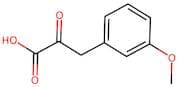
3-(3-Methoxyphenyl)-2-oxopropansäure, mit der CAS-Nummer 68262-20-4, ist eine organische Verbindung, die durch ihre Struktur gekennzeichnet ist, die eine Propansäureeinheit mit einer Ketongruppe und eine methoxy-substituierte Phenylgruppe umfasst. Diese Verbindung zeigt typischerweise Eigenschaften, die sowohl mit aromatischen als auch mit carboxylischen Säurefunktionen verbunden sind, wie eine moderate Löslichkeit in organischen Lösungsmitteln und eine potenzielle Reaktivität in verschiedenen chemischen Reaktionen, einschließlich Veresterung und Acylierung. Die Anwesenheit der Methoxygruppe kann ihre elektronischen Eigenschaften beeinflussen, was möglicherweise ihre Reaktivität erhöht oder ihre Wechselwirkung mit biologischen Systemen beeinflusst. Darüber hinaus können Verbindungen dieser Art biologische Aktivität zeigen, was sie für die pharmazeutische Forschung von Interesse macht. Die molekulare Struktur deutet darauf hin, dass sie an Wasserstoffbrückenbindungen teilnehmen kann, die durch die carboxylische Säuregruppe entstehen, was ihre physikalischen Eigenschaften wie Schmelzpunkt und Siedepunkt beeinflussen kann. Insgesamt ist 3-(3-Methoxyphenyl)-2-oxopropansäure eine Verbindung von Interesse sowohl in der synthetischen organischen Chemie als auch in der medizinischen Chemie.
Formel:C10H10O4
InChl:InChI=1/C10H10O4/c1-14-8-4-2-3-7(5-8)6-9(11)10(12)13/h2-5H,6H2,1H3,(H,12,13)
SMILES:COc1cccc(c1)CC(=O)C(=O)O
Sortieren nach
Reinheit (%)
0
100
|
0
|
50
|
90
|
95
|
100
3 Produkte.
3-(3-Methoxyphenyl)-2-oxopropanoic acid
CAS:3-(3-Methoxyphenyl)-2-oxopropanoic acidReinheit:97%Molekulargewicht:194.19g/molRef: 10-F663973
1g492,00€5g1.309,00€10g2.617,00€2.5g1.150,00€50mg120,00€100mg160,00€250mg223,00€500mg410,00€3-(3-Methoxyphenyl)-2-oxopropanoic acid
CAS:Vanillic acid is a phenolic compound that can be found in vanilla and other plants. It is an important precursor for the synthesis of aromatic compounds such as ferulic acid, lignin, and coumarin. Vanillic acid has been shown to have a variety of biochemical and chemists properties, including the ability to aromatize, which means it can be used in the preparation of synthetic hormones. This compound also acts as an antioxidant by scavenging reactive oxygen species. Vanillic acid is found in two sources: pre-existing vanillin (from plants) and ferulic acid (from microbial metabolism). Vanillin is derived from coniferyl alcohol and coniferaldehyde, which are both found in poria. Ferulic acid is produced by polyporus fungi and can be converted into vanillic acid via decarboxylation.Formel:C10H10O4Reinheit:Min. 95%Molekulargewicht:194.18 g/molRef: 3D-TCA26220
Ausgelaufenes produkt