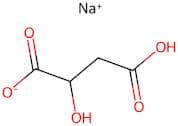
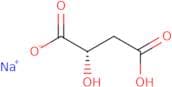
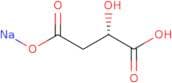
CAS 68303-40-2
:kristallines L-Malinsäure-Monosodium
Beschreibung:
kristallines L-Malinsäure-Monosodium, mit der CAS-Nummer 68303-40-2, ist ein Natriumsalz der L-Malsäure, einer organischen Verbindung, die eine bedeutende Rolle in verschiedenen biochemischen Prozessen spielt, insbesondere im Krebs-Zyklus. Diese Substanz erscheint typischerweise als weißes kristallines Pulver und ist in Wasser löslich, was sie in verschiedenen Anwendungen nützlich macht, einschließlich der Lebensmittel- und Getränkeindustrie als Säuerungsmittel und Geschmacksverstärker. Sie hat einen leicht sauren Geschmack und ist bekannt für ihre Fähigkeit, die Säure von Produkten zu verstärken. Neben ihren kulinarischen Anwendungen kann L-Malsäure-Monosodium auch als Pufferagent dienen und wird in der Pharmazeutik und Kosmetik aufgrund ihrer stabilisierenden Eigenschaften verwendet. Die Verbindung wird allgemein als sicher (GRAS) anerkannt, wenn sie in angemessenen Mengen verwendet wird, sollte jedoch wie alle Substanzen mit Vorsicht behandelt werden, um mögliche unerwünschte Wirkungen zu vermeiden. Ihre chemische Struktur umfasst sowohl Carbonsäure- als auch Hydroxylgruppen, die zu ihrer Reaktivität und Wechselwirkung mit anderen Verbindungen beitragen.
Formel:C4H5NaO5
Synonyme:- L-Malic acid monosodium salt
- L-Hydroxybutanedioic acid sodium salt
- SODIUM BIMALATE
- SODIUM ACID MALATE
- Malic acid-Na-salt
- L-(-)-Malic acid sodiuM salt 95-100% (enzyMatic)
- L-malic acid monosodium crystalline
- SODIUM HYDROGEN MALATE
- DL-MALIC ACID MONOSODIUM SALT
- SODIUM HYDROGEN DL-MALATE
Sortieren nach
Reinheit (%)
0
100
|
0
|
50
|
90
|
95
|
100
4 Produkte.
Sodium 3-carboxy-2-hydroxypropanoate
CAS:Sodium 3-carboxy-2-hydroxypropanoateReinheit:95%Molekulargewicht:156.07g/molL-(-)-Malic acid monosodium
CAS:L-Malic acid is a dicarboxylic acid that is found in many fruits and vegetables. It is the substrate for the enzyme malate dehydrogenase, which catalyzes the oxidation of L-malate to oxaloacetate. L-Malic acid is used to study mitochondrial function, as it can be used as an alternative energy source. The L-malic acid monosodium salt (LAM) has been shown to be effective in preventing muscle damage caused by exercise. This may be due to its ability to decrease oxidative stress and increase ATP production through increased mitochondrial activity. LAM also has been shown to promote photoreceptor cell survival and improve retinal function in animals with damaged photoreceptors, although it does not have any effect on normal animal eyes.Formel:C4H6O5•NaReinheit:Min. 95%Farbe und Form:PowderMolekulargewicht:157.08 g/molL-Malic acid, sodium salt
CAS:L-Malic acid, sodium salt is a white crystalline compound that is soluble in water and has a molecular weight of 136.08. It is a useful scaffold for the synthesis of organic compounds and can be used as a reaction component or as a speciality chemical. L-Malic acid, sodium salt can be used to synthesize many different types of compounds including pharmaceuticals, hormones, industrial chemicals, and research chemicals. This compound is also an important intermediate in the production of amino acids, polymers, and other organic compounds. L-Malic acid, sodium salt has been found to have high purity with few impurities.
Formel:C4H5NaO5Molekulargewicht:156.07 g/mol