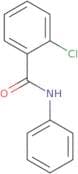
CAS 6833-13-2
:2-chlor-N-phenylbenzamid
Beschreibung:
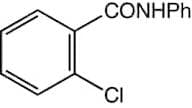
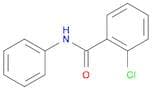
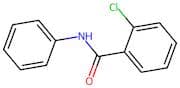
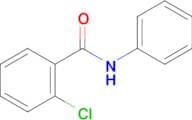
2-chlor-N-phenylbenzamid ist eine organische Verbindung, die durch ihre Amidfunktionalgruppe gekennzeichnet ist, die aus einem Benzolring besteht, der mit einer Chlorguppe und einer N-Phenylgruppe substituiert ist. Diese Verbindung erscheint typischerweise als Feststoff bei Raumtemperatur und ist in organischen Lösungsmitteln löslich. Die Anwesenheit des Chlor-Substituenten führt zu einer einzigartigen Reaktivität, die sie in verschiedenen chemischen Reaktionen nützlich macht, einschließlich nucleophiler Substitutionen und Kupplungsreaktionen. Die Amidbindung trägt zu ihrer Stabilität bei und beeinflusst ihre physikalischen Eigenschaften, wie Schmelz- und Siedepunkte. Darüber hinaus kann 2-chlor-N-phenylbenzamid biologische Aktivität zeigen, was es in der pharmazeutischen Forschung von Interesse macht. Seine molekulare Struktur ermöglicht potenzielle Wechselwirkungen mit biologischen Zielen, die für therapeutische Anwendungen untersucht werden können. Wie bei vielen chlorierten Verbindungen ist es wichtig, diese Substanz mit Vorsicht zu behandeln, da sie potenzielle Toxizität und Umweltbedenken aufweist. Bei der Arbeit mit diesem chemischen Stoff in Laborumgebungen sollten angemessene Sicherheitsmaßnahmen beachtet werden.
Formel:C13H10ClNO
InChl:InChI=1/C13H10ClNO/c14-12-9-5-4-8-11(12)13(16)15-10-6-2-1-3-7-10/h1-9H,(H,15,16)
SMILES:c1ccc(cc1)N=C(c1ccccc1Cl)O
Synonyme:- Benzamide, 2-chloro-N-phenyl-
Sortieren nach
Reinheit (%)
0
100
|
0
|
50
|
90
|
95
|
100
5 Produkte.
2-Chloro-N-phenylbenzamide, 97%
CAS:This Thermo Scientific Chemicals brand product was originally part of the Alfa Aesar product portfolio. Some documentation and label information may refer to the legacy brand. The original Alfa Aesar product / item code or SKU reference has not changed as a part of the brand transition to Thermo Sci
Formel:C13H10ClNOReinheit:97%Molekulargewicht:231.682-Chlorobenzanilide
CAS:2-Chlorobenzanilide is a chlorine compound that has been used to inhibit the growth of soil microorganisms. It is also an inhibitor of phenanthridone, which is an important intermediate in the synthesis of many herbicides. 2-Chlorobenzanilide can be prepared by reacting phenylhydrazine with chloroacetanilide. It can also be prepared by treating benzene with phosphorus chloride and then adding aniline to the reaction product. The rate of this reaction depends on the concentration of reactants, temperature, and pH. If more water is added to the reaction mixture, there will be a lower rate of reaction because hydroxide ions will compete with chloride ions for reactant molecules. The kinetic equation for this reaction follows:Formel:C13H10ClNOReinheit:Min. 95%Molekulargewicht:231.68 g/mol