CymitQuimica logo

CAS 68377-91-3

:

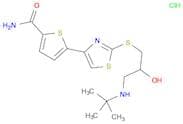
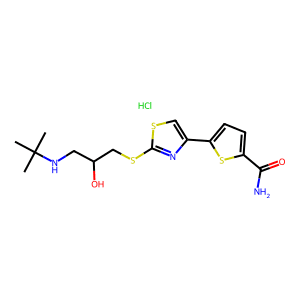
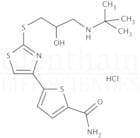
Arotinololhydrochlorid

Beschreibung:
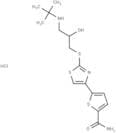
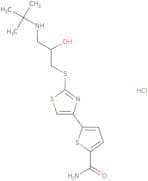
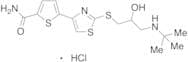
Arotinololhydrochlorid ist eine pharmazeutische Verbindung, die hauptsächlich für ihre Rolle als nicht-selektiver Beta-Adrenozeptor-Antagonist mit zusätzlichen alpha-adrenozeptor-blockierenden Eigenschaften anerkannt ist. Sie wird häufig zur Behandlung von Bluthochdruck und bestimmten Herz-Kreislauf-Erkrankungen eingesetzt. Die Substanz zeichnet sich durch ihre Fähigkeit aus, den Blutdruck zu senken, indem sie die Wirkungen von Katecholaminen auf das Herz und die Blutgefäße hemmt, was zu einer Verringerung der Herzfrequenz und des Gefäßwiderstands führt. Arotinololhydrochlorid wird typischerweise in seiner Hydrochlorid-Salzform verabreicht, die seine Löslichkeit und Bioverfügbarkeit verbessert. Die Verbindung ist bekannt dafür, eine moderate Halbwertszeit aufzuweisen, die effektive Dosierungsschemata ermöglicht. In Bezug auf Sicherheit und Nebenwirkungen kann es zu typischen Reaktionen im Zusammenhang mit Beta-Blockern kommen, wie Müdigkeit, Schwindel oder Bradykardie. Wie bei vielen Arzneimitteln sollte die Anwendung von Gesundheitsfachkräften überwacht werden, um potenzielle Wechselwirkungen und Kontraindikationen effektiv zu managen. Insgesamt stellt Arotinololhydrochlorid eine bedeutende therapeutische Option im Management von Herz-Kreislauf-Erkrankungen dar.
Formel:C15H21N3O2S3·ClH
InChl:InChI=1S/C15H21N3O2S3.ClH/c1-15(2,3)17-6-9(19)7-21-14-18-10(8-22-14)11-4-5-12(23-11)13(16)20;/h4-5,8-9,17,19H,6-7H2,1-3H3,(H2,16,20);1H
InChI Key:InChIKey=XXDAXBZYUXLDRD-UHFFFAOYSA-N
SMILES:C(N)(=O)C=1SC(=CC1)C=2N=C(SCC(CNC(C)(C)C)O)SC2.Cl
Synonyme:
  • 2-Thiophenecarboxamide, 5-[2-[[3-[(1,1-dimethylethyl)amino]-2-hydroxypropyl]thio]-4-thiazolyl]-, hydrochloride (1:1)
  • 2-Thiophenecarboxamide, 5-[2-[[3-[(1,1-dimethylethyl)amino]-2-hydroxypropyl]thio]-4-thiazolyl]-, monohydrochloride
  • 2-Thiophenecarboxamide, 5-[2-[[3-[(1,1-dimethylethyl)amino]-2-hydroxypropyl]thio]-4-thiazolyl]-, monohydrochloride, (S)-
  • 5-(2-{[3-(Tert-Butylamino)-2-Hydroxypropyl]Sulfanyl}-1,3-Thiazol-4-Yl)Thiophene-2-Carboxamide
  • Almarl
  • Arotinolol Hcl
  • S 596
  • Arotinolol hydrochloride
Sortieren nach

Reinheit (%)
0
100
|
0
|
50
|
90
|
95
|
100
7 Produkte.
  • Arotinolol HCl

    CAS:
    Formel:C15H22ClN3O2S3
    Reinheit:98%
    Farbe und Form:Solid
    Molekulargewicht:408.0021

    Ref: IN-DA00F9VU

    10mg
    76,00€
    50mg
    176,00€
  • Arotinolol hydrochloride

    CAS:
    <p>Arotinolol HCl is a non-selective α/β-blocker, anti-hypertensive, anti-obesity, and improves aortic stiffness.</p>
    Formel:C15H22ClN3O2S3
    Reinheit:99.84%
    Farbe und Form:Solid
    Molekulargewicht:408
  • Arotinolol HCl

    CAS:
    Formel:C15H21N3O2S3·HCl
    Farbe und Form:White To Off-White Solid
    Molekulargewicht:371.53 36.46

    Ref: 4Z-A-238001

    5mg
    Nachfragen
    10mg
    444,00€
    25mg
    635,00€
    50mg
    825,00€
    100mg
    Nachfragen
  • Arotinolol hydrochloride

    CAS:
    Arotinolol hydrochloride
    Reinheit:≥98%
    Molekulargewicht:408g/mol

    Ref: 54-BUP08412

    5mg
    163,00€
    10mg
    231,00€
    25mg
    362,00€
    50mg
    521,00€
    100mg
    781,00€
    500mg
    1.483,00€
  • Arotinolol hydrochloride

    CAS:
    Formel:C15H22ClN3O2S3
    Molekulargewicht:408.00

    Ref: 7W-GP8092

    ne
    Nachfragen
  • Arotinolol Hydrochloride

    Kontrolliertes Produkt
    CAS:
    <p>Applications Arotinolol is both and alpha- and beta-adrenoceptor antagonist and is used to treat essential tremors and hypertension.<br>References Kuroda, Y., et al.: Neurology, 38, 650 (1988); Miyagishi, A., et al.: Arch. Pharmacodyn. Ther., 271, 249 (1984); Wu, H., et al.: Hypertens. Res.: Off. J. Jpn. Soc. Hypertens., 24, 605 (2001)<br></p>
    Formel:C15H21N3O2S3·ClH
    Farbe und Form:Neat
    Molekulargewicht:408.002

    Ref: TR-A771503

    5mg
    1.022,00€
  • Arotinolol hydrochloride

    CAS:
    <p>Arotinolol hydrochloride is a beta-blocker that, in contrast to propranolol, has a higher selectivity for the β1 receptor. It is used to treat hypertension and angina pectoris. Arotinolol hydrochloride lowers blood pressure by inhibiting the activity of α-adrenergic receptors, which are found in the heart and vascular smooth muscle. This inhibition reduces the release of norepinephrine and causes vasodilation. Arotinolol hydrochloride also has a positive effect on cardiac function as it decreases myocardial oxygen demand and increases coronary flow. Arotinolol hydrochloride has been shown to lower systolic pressure in anesthetized dogs with an intravenous dose of sodium citrate. The drug also lowers diastolic pressure in conscious dogs at doses of 0.5 mg/kg (0.2 mg/lb) or greater when given intravenously or subcutaneously.</p>
    Formel:C15H22ClN3O2S3
    Reinheit:Min. 98%
    Farbe und Form:Powder
    Molekulargewicht:408 g/mol