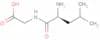
CAS 686-50-0
:L-Leucylglycin
Beschreibung:
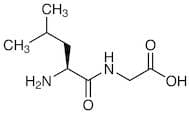
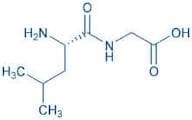
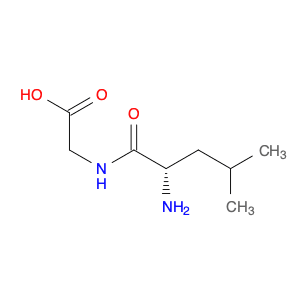
L-Leucylglycin ist ein Dipeptid, das aus den Aminosäuren Leucin und Glycin besteht, die durch eine Peptidbindung verbunden sind. Es wird als nicht essentielles Aminosäurederivat klassifiziert, was bedeutet, dass es vom Körper synthetisiert werden kann. Die Substanz hat typischerweise ein weißes bis off-white Aussehen und ist in Wasser löslich, was sie in verschiedenen biochemischen Anwendungen nützlich macht. L-Leucylglycin zeigt Eigenschaften, die für Peptide typisch sind, wie die Fähigkeit, an Wasserstoffbrückenbindungen teilzunehmen und sekundäre Strukturen zu bilden. Es spielt eine Rolle bei der Proteinsynthese und kann Stoffwechselprozesse beeinflussen. Darüber hinaus kann es Anwendungen in der Pharmazie und Ernährung haben, insbesondere in Formulierungen, die auf Muskelregeneration und -wachstum abzielen, aufgrund der Anwesenheit von Leucin, das für seine Rolle bei der Stimulierung der Proteinsynthese bekannt ist. Die Stabilität und Reaktivität der Verbindung können von Faktoren wie pH und Temperatur beeinflusst werden, die wichtige Überlegungen bei der Handhabung und Lagerung sind. Insgesamt ist L-Leucylglycin eine bedeutende Verbindung in der Biochemie und Ernährung.
Formel:C8H16N2O3
InChl:InChI=1S/C8H16N2O3/c1-5(2)3-6(9)8(13)10-4-7(11)12/h5-6H,3-4,9H2,1-2H3,(H,10,13)(H,11,12)/t6-/m0/s1
InChI Key:InChIKey=LESXFEZIFXFIQR-LURJTMIESA-N
SMILES:[C@@H](C(NCC(O)=O)=O)(CC(C)C)N
Synonyme:- (S)-2-(2-Amino-4-methylpentamido)acetic acid
- 101: PN: EP2161028 PAGE: 10 claimed protein
- 10: PN: WO2011159938 SEQID: 76 claimed protein
- 1374: PN: EP2071334 SEQID: 1452 claimed protein
- 1374: PN: WO2009077864 SEQID: 1452 claimed protein
- 147: PN: US20130123467 SEQID: 176 claimed protein
- 2-[(2S)-2-Amino-4-methylpentanamido]acetic acid
- 2-[[(2S)-2-Amino-4-methylpentanoyl]amino]acetic acid
- 202: PN: WO2011032181 SEQID: 222 unclaimed protein
- 210: PN: WO2009114815 SEQID: 222 unclaimed protein
- 35: PN: WO0028996 SEQID: 4 unclaimed protein
- 436: PN: WO2005081628 SEQID: 438 claimed protein
- <span class="text-smallcaps">L</span>-Leucylglycine
- Glycine, <span class="text-smallcaps">L</span>-leucyl-
- Glycine, N-<span class="text-smallcaps">L</span>-leucyl-
- H-Leu-Gly-OH
- L-Leucyl-glycine
- Leu-Gly hydrate
- Morphine tolerance peptide
- Glycine, N-L-leucyl-
- Glycine, L-leucyl-
- Weitere Synonyme anzeigen
Sortieren nach
Reinheit (%)
0
100
|
0
|
50
|
90
|
95
|
100
6 Produkte gefunden.
L-Leucylglycine
CAS:Formel:C8H16N2O3Reinheit:>98.0%(T)Farbe und Form:White to Almost white powder to crystalMolekulargewicht:188.23H-Leu-Gly-OH
CAS:The dipeptide Leu-Gly inhibits the ubiquitin-mediated proteolysis.Formel:C8H16N2O3Reinheit:> 99%Farbe und Form:White PowderMolekulargewicht:188.23(S)-2-(2-Amino-4-methylpentanamido)acetic acid
CAS:Formel:C8H16N2O3Reinheit:98%Molekulargewicht:188.227Leu-Gly • ½ H2O
CAS:Leu-Gly is a cyclic peptide that is composed of the amino acid sequence Leu-Gly. It has antimicrobial, anti-inflammatory, and immunomodulatory properties. This peptide exhibits calcium binding, which may be due to its structural analysis with trifluoroacetic acid in human serum. A model system using coli K-12 cells was used to study the biological properties of Leu-Gly. The locomotor activity of these cells was inhibited by Leu-Gly, which may be due to its ability to bind with cyclic adenosine monophosphate (cAMP) receptors on the cell surface. LEU Gly is a member of the class of antimicrobial peptides that are important for fighting infections. It has been shown to have strong activity against E. coli K12 and various strains of Staphylococcus aureus isolated from humans with autoimmune diseases.Formel:C8H16N2O3H2OReinheit:Min. 95%Molekulargewicht:197.23 g/mol