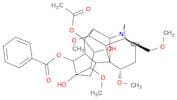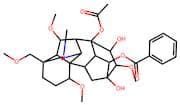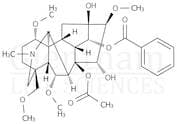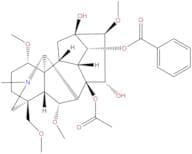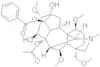
CAS 6900-87-4
:Hypaconitin
Beschreibung:
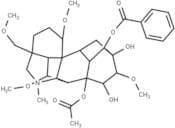
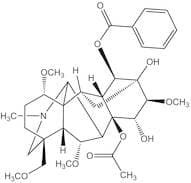
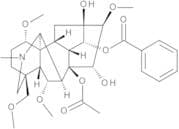
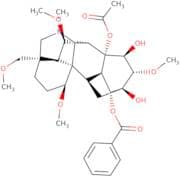
Hypaconitin ist ein potentes Alkaloid, das aus der Pflanzenfamilie Aconitum gewonnen wird, die allgemein als Mönchshood oder Wolfsbane bekannt ist. Es ist durch seine komplexe molekulare Struktur gekennzeichnet, die mehrere Ringe und Stickstoffatome umfasst, was zu seinen pharmakologischen Eigenschaften beiträgt. Hypaconitin ist bekannt für seine neurotoxischen Wirkungen, die hauptsächlich auf das Nervensystem wirken, indem sie Natriumkanäle blockieren, was zu Symptomen wie Muskelparalyse und kardiovaskulären Störungen führen kann. Diese Verbindung ist typischerweise in verschiedenen Aconitum-Arten zu finden und wurde auf ihre potenziellen medizinischen Eigenschaften untersucht, obwohl ihre Toxizität ihre therapeutische Verwendung einschränkt. In Bezug auf die physikalischen Eigenschaften ist Hypaconitin normalerweise ein weißes bis blassgelbes kristallines Feststoff und ist in organischen Lösungsmitteln löslich, hat jedoch eine begrenzte Löslichkeit in Wasser. Aufgrund seiner giftigen Natur erfordert der Umgang mit Hypaconitin Vorsicht, und es ist wichtig, die Sicherheitsprotokolle zu befolgen, wenn man mit dieser Substanz in einem Labor arbeitet.
Formel:C33H45NO10
InChl:InChI=1S/C33H45NO10/c1-17(35)44-33-21-19(14-31(38,28(42-6)26(33)36)27(21)43-29(37)18-10-8-7-9-11-18)32-20(40-4)12-13-30(16-39-3)15-34(2)25(32)22(33)23(41-5)24(30)32/h7-11,19-28,36,38H,12-16H2,1-6H3/t19-,20+,21-,22+,23+,24-,25-,26+,27-,28+,30+,31-,32+,33-/m1/s1
InChI Key:InChIKey=FIDOCHXHMJHKRW-FBYRGYIKSA-N
SMILES:O(C)[C@@H]1[C@]23[C@]4([C@]5([C@@](OC(C)=O)([C@@]6([C@]2(N(C)C[C@@](COC)([C@]3([C@H]6OC)[H])CC1)[H])[H])[C@@H](O)[C@H](OC)[C@@](O)(C4)[C@@H]5OC(=O)C7=CC=CC=C7)[H])[H]
Synonyme:- (16Beta)-8-(Acetyloxy)-13,15-Dihydroxy-1,6,16-Trimethoxy-4-(Methoxymethyl)-20-Methylaconitan-20-Ium-14-Yl Benzoate Bromide
- (6Alpha,14Alpha,15Alpha,16Beta)-8-(Acetyloxy)-13,15-Dihydroxy-1,6,16-Trimethoxy-4-(Methoxymethyl)-20-Methylaconitan-14-Yl Benzoate
- 2H-12,3,6a-Ethanylylidene-7,9-methanonaphth[2,3-b]azocine, aconitane-8,13,14,15-tetrol deriv.
- 8-(Acetyloxy)-13,15-Dihydroxy-1,6,16-Trimethoxy-4-(Methoxymethyl)-20-Methylaconitan-14-Yl Benzoate
- Aconitane-8,13,14,15-tetrol, 1,6,16-trimethoxy-4-(methoxymethyl)-20-methyl-, 8-acetate 14-benzoate, (1α,6α,14α,15α,16β)-
- Hypaconitine
Sortieren nach
Reinheit (%)
0
100
|
0
|
50
|
90
|
95
|
100
8 Produkte.
Hypaconitine
CAS:Hypaconitine (HA), an active and highly toxic constituent derived from Aconitum species, is widely used to treat rheumatism, the hepatic cytochrome P450-catalyzed metabolism of HA.Formel:C33H45NO10Reinheit:95%~99%Farbe und Form:White powderMolekulargewicht:615.72Hypaconitine
CAS:Hypaconitine, an active and highly toxic constituent derived from Aconitum species, has anti-inflammatory activity, is widely used to treat rheumatism.
Formel:C33H45NO10Reinheit:98.75% - 99.63%Farbe und Form:SolidMolekulargewicht:615.71Hypaconitine
CAS:Natural alkaloidFormel:C33H45NO10Reinheit:≥ 90.0 % (HPLC)Farbe und Form:PowderMolekulargewicht:615.72Hypaconitine
CAS:Kontrolliertes ProduktApplications An Aconitine (A189875) analog. Aconitine alkaloid pharmacokinetic analgesic. A highly poisonous, neurotoxic alkaloid.
Not a dangerous good if item is equal to or less than 1g/ml and there is less than 100g/ml in the package
References Li, M., et al.: J. Pharm. Biomed. Anal., 53, 1063 (2010), Yan, G., et al.: J. Pharm. Biomed. Anal., 53, 421 (2010),Formel:C33H45NO10Farbe und Form:NeatMolekulargewicht:615.71Hypaconitine
CAS:Hypaconitine is a toxic alkaloid, which is an active constituent derived from certain Aconitum species of the Ranunculaceae family. These plants, often referred to as monkshood or wolfsbane, are traditionally used in herbal medicine but are notorious for their toxic properties. The alkaloid is sourced primarily from the roots and tubers of these plants and consists of several nitrogen-containing compounds.Formel:C33H45NO10Reinheit:Min. 98 Area-%Farbe und Form:PowderMolekulargewicht:615.71 g/mol