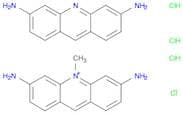
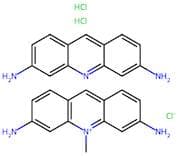
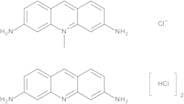
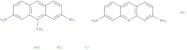
CAS 69235-50-3
:Acriflavin, Hydrochlorid
Beschreibung:
Acriflavin-Hydrochlorid ist eine synthetische Verbindung, die zur Familie der Acridine gehört und durch ihre leuchtend gelbe Farbe und antiseptischen Eigenschaften gekennzeichnet ist. Es ist hauptsächlich bekannt für seine Verwendung als topisches Antiseptikum und in der Tiermedizin zur Behandlung von Infektionen. Die Verbindung zeigt antibakterielle und antifungale Aktivitäten, was sie gegen eine Vielzahl von Mikroorganismen wirksam macht. Acriflavin-Hydrochlorid ist in Wasser und Alkohol löslich, was die Anwendung in verschiedenen Formulierungen erleichtert. Sein Wirkmechanismus besteht darin, in die DNA einzugreifen, wodurch die Synthese von Nukleinsäuren gehemmt und zelluläre Prozesse in Pathogenen gestört werden. Darüber hinaus wurde es auf potenzielle Anwendungen in der Krebsforschung untersucht, da es die Zellproliferation beeinflussen kann. Es ist jedoch Vorsicht bei der Anwendung geboten, da es Hautreizungen verursachen kann und potenziell mutagene Wirkungen hat. Insgesamt ist Acriflavin-Hydrochlorid eine vielseitige chemische Verbindung mit erheblicher historischer und zeitgenössischer Relevanz sowohl in medizinischen als auch in Forschungsumgebungen.
Formel:Unspecified
Synonyme:- Acriflavine dihydrochloride
- Flavacridine hydrochloride
- Acriflavinium chloride
- Acriflavine hydrochloride
- Acriflavine, hydrochloride
Sortieren nach
Reinheit (%)
0
100
|
0
|
50
|
90
|
95
|
100
7 Produkte.
Acriflavine hydrochloride
CAS:Formel:C27H28Cl4N6Reinheit:98%Farbe und Form:SolidMolekulargewicht:578.3634Acriflavine hydrochloride (C.I. 46000)
CAS:Formel:C27H27Cl3N6Reinheit:98.5 - 105.0 % (dried substance, % of C14H14N3Cl · HCl)Farbe und Form:Orange to dark orange, red or brown powderMolekulargewicht:541.90Acriflavine Hydrochloride (>90%)
CAS:Kontrolliertes ProduktApplications Acriflavine is an topical antiseptic agent and has also been used for the treatment of external fungal infections. Dyes and metabolites.
Not a dangerous good if item is equal to or less than 1g/ml and there is less than 100g/ml in the package
References Weisman, J.L., et al.: Chem. Biol. Drug. Des., 67, 409 (2006); Sala, C., et al.: Antimicro. Agents. Chemother., 54, 4150 (2010);Formel:C27H27Cl3N6Reinheit:>90%Farbe und Form:NeatMolekulargewicht:541.9Acriflavine hydrochloride
CAS:Acriflavine hydrochloride is a drug that belongs to the class of acridines, which are used as antiseptics and disinfectants. Acriflavine has been shown to have significant cytotoxic effects on mammalian cells, with a high degree of DNA binding activity. It binds to DNA in the nucleus and interferes with replication and transcription. Acriflavine hydrochloride inhibits cell division by binding to the kinetoplast (a region of mitochondrial DNA) during mitosis. This drug also has an effect on cell metabolism, decreasing ATP production and increasing lactate production in mitochondria. Acriflavine hydrochloride also prevents the formation of reactive oxygen species, which can lead to cellular damage.Formel:C27H28Cl4N6Reinheit:Min. 95%Farbe und Form:Yellow PowderMolekulargewicht:578.36 g/molAcriflavine Hydrochloride (mixture of 3,6-Diamino-10-methylacridinium Chloride Hydrochloride and 3,6-Diaminoacridine Hydrochloride)
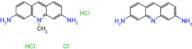
CAS:Reinheit:>90.0%(HPLC)Farbe und Form:Orange to Brown to Dark red powder to crystal