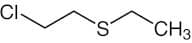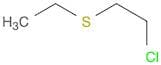
CAS 693-07-2
:2-Chlorethyl-ethylsulfid
- 1-Chloro-2-(Ethylsulfanyl)Ethane
- 1-Chloro-2-(ethylthio)ethane
- 2-(Ethylthio)chloroethane
- 2-Chloro Ethyl Ethyl Sulfide
- 2-Chlorodiethyl sulfide
- 2-Chloroethyl ethyl sulfide
- 2-Chloroethyl ethyl thioether
- 2-Ethylthioethyl chloride
- Brn 0635672
- Chlordiethylsulfid
- Chlordiethylsulfid [Czech]
- Chlorothiolalcohol (CTA)
- Ethane, 1-chloro-2-(ethylthio)-
- Ethyl 2-chloroethyl sulfide
- Ethyl beta-chloroethyl sulfide
- Half-mustard gas
- Half-sulfur mustard
- Hsdb 5744
- Nsc 10977
- Sulfide, 2-chloroethyl ethyl
- Sulfide, 2-chloroethyl ethyl (8CI)
- Sulfide, chloroethyl ethyl
- Sulfide, diethyl 2-chloro
- beta-Ethylmerkaptoethylchlorid
- beta-Ethylmerkaptoethylchlorid [Czech]
- h-MG
- Weitere Synonyme anzeigen
2-Chloroethyl Ethyl Sulfide
CAS:Formel:C4H9ClSReinheit:>97.0%(GC)Farbe und Form:Colorless to Light yellow clear liquidMolekulargewicht:124.632-Chloroethyl ethyl sulfide
CAS:Formel:C4H9ClSReinheit:97%Farbe und Form:LiquidMolekulargewicht:124.63232-Chloroethyl ethyl sulphide
CAS:2-Chloroethyl ethyl sulphide
Reinheit:98%Farbe und Form:Colourless LiquidMolekulargewicht:124.63g/mol2-Chloroethyl Ethyl Sulfide
CAS:Applications 2-Chloroethyl Ethyl Sulfide is used as a reagent in the synthesis of furfuryl xanthines as adenosine receptor antagonists. It is also used as a reagent in the synthesis of methoxypropyl xanthines as putative A2B receptor antagonists.
Not a dangerous good if item is equal to or less than 1g/ml and there is less than 100g/ml in the package
References Balo, M.C., et al.: Bioorg. Med. Chem., 17, 6755 (2009); Nieto, M.I., et al.: Bioorg. Med. Chem., 17, 3426 (2009)Formel:C4H9ClSFarbe und Form:NeatMolekulargewicht:124.631-chloro-2-(ethylsulfanyl)ethane
CAS:Formel:C4H9ClSReinheit:97%Farbe und Form:No data available.Molekulargewicht:124.631-Chloro-2-(ethylthio)ethane
CAS:Kontrolliertes Produkt1-Chloro-2-(ethylthio)ethane (1,2-ETE) is a reactive oxygen species that inhibits the electron transport chain in mitochondria. 1,2-ETE decreases the mitochondrial membrane potential and causes oxidative damage to proteins, such as recombinant cytochrome P450. 1,2-ETE has been shown to decrease photosynthetic activity by inhibiting the light reactions of photosynthesis. It also inhibits the electron transport chain in mitochondria and causes damage to cells by reacting with sulfide to form sulfhydryl compounds. The toxic effects of 1,2-ETE are due to its ability to cause injury by reacting with other molecules.
Formel:C4H9ClSReinheit:Min. 95%Farbe und Form:Clear Colourless To Pale Yellow LiquidMolekulargewicht:124.63 g/mol2-CEES
CAS:2-CEES is a mustard gas analogue that only forms DNA monoadducts. It induces centromere amplification in both human and mouse cells and can lead to chromosome instability.Formel:C4H9ClSFarbe und Form:SolidMolekulargewicht:124.632