CAS 693-13-0
:Diisopropylcarbodiimid
Beschreibung:
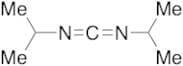
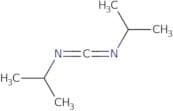
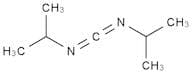
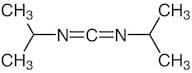
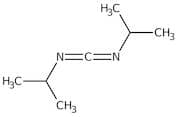
Diisopropylcarbodiimid (DIC) ist eine organische Verbindung, die durch ihre Carbodiimid-Gruppe gekennzeichnet ist, die ein zentrales Kohlenstoffatom aufweist, das doppelt an zwei Stickstoffatome gebunden und einfach an zwei Isopropylgruppen gebunden ist. Es handelt sich um eine farblose bis blassgelbe Flüssigkeit mit einem charakteristischen Geruch und ist bekannt für seine Rolle als Kopplungsreagenz in der Peptidsynthese und anderen organischen Reaktionen. DIC ist hochreaktiv, insbesondere mit Carbonsäuren, und erleichtert die Bildung von Amiden und Estern durch die Aktivierung dieser Säuren. Es ist in organischen Lösungsmitteln wie Dichlormethan und Acetonitril löslich, aber weniger in Wasser. Aufgrund seiner Reaktivität kann DIC stabile Zwischenprodukte bilden, was es in verschiedenen synthetischen Anwendungen wertvoll macht. Es sollte jedoch mit Vorsicht behandelt werden, da es die Haut, die Augen und das Atmungssystem reizen kann. Angemessene Sicherheitsvorkehrungen, einschließlich der Verwendung von persönlicher Schutzausrüstung, sind unerlässlich, wenn man mit dieser Verbindung in Laborumgebungen arbeitet.
Formel:C7H14N2
InChl:InChI=1S/C7H14N2/c1-6(2)8-5-9-7(3)4/h6-7H,1-4H3
InChI Key:InChIKey=BDNKZNFMNDZQMI-UHFFFAOYSA-N
SMILES:C(=NC(C)C)=NC(C)C
Synonyme:- (E)-dipropan-2-yldiazene
- (Propan-2-yl)([[(propan-2-yl)imino]methylidene])amine
- 1,3-Diisopropylcarbodiimide
- 2-Propanamine, N,N'-methanetetraylbis-
- Carbodiimide, diisopropyl-
- Carbodimide, N,N'-Diisopropyl-
- DIC
- Diisopropyl-Carbodiimid
- Diisopropylcarbodiimide
- Dipc
- Dipcdi
- Dipci
- N,N'-Diisopropyl carbodiimide
- N,N'-Methanetetraylbis(1-methylethylamine)
- N,N'-Methanetetraylbis(2-propanamine)
- N,N'-Methantetraylbis(1-methylethylamin)
- N,N'-dipropan-2-ylcarbodiimide
- N,N'-metanotetrailbis(1-metiletilamina)
- N,N′-Diisopropylmethanediimine
- Nsc 42080
- PCI
- Weitere Synonyme anzeigen
Sortieren nach
Reinheit (%)
0
100
|
0
|
50
|
90
|
95
|
100
10 Produkte.
N,N'-Diisopropylcarbodiimide
CAS:Formel:C7H14N2Reinheit:>98.0%(GC)Farbe und Form:Colorless to Almost colorless clear liquidMolekulargewicht:126.20N,N'-Diisopropylcarbodiimide, 99%
CAS:N,N'-Diisopropylcarbodiimide is used as a reagent in synthetic organic chemistry. It serves as a chemical intermediate and as a stabilizer for Sarin (chemical weapon). It is also used in the synthesis of peptide and nucleic acid. Further, it is used as an antineoplastic and involved in the treatmentFormel:C7H14N2Reinheit:99%Farbe und Form:Liquid, Clear colorless to yellowMolekulargewicht:126.20(propan-2-yl)({[(propan-2-yl)imino]methylidene})amine
CAS:Formel:C7H14N2Reinheit:95%Farbe und Form:LiquidMolekulargewicht:126.1995Ref: IN-DA0035B8
5g21,00€10g21,00€1kg137,00€25g25,00€50g25,00€5kg635,00€100g34,00€10kgNachfragen250g60,00€500g90,00€15x1kg1.561,00€N,N''-Diisopropylcarbodiimide
CAS:Formel:C7H14N2Reinheit:≥ 98.5%Farbe und Form:Clear, colourless to light-yellow liquidMolekulargewicht:126.20N,N'-Bis(isopropyl)carbodiimide
CAS:N,N'-Bis(isopropyl)carbodiimideFormel:C7H14N2Reinheit:99%Farbe und Form: clear. colourless liquidMolekulargewicht:126.19946g/molN,N'-Diisopropylcarbodiimide
CAS:Kontrolliertes ProduktApplications N,N'-Diisopropylcarbodiimide can be used as an alternative to N,N’-Dicyclohexylcarbodiimide (D438500) in peptide synthesis.
Not a dangerous good if item is equal to or less than 1g/ml and there is less than 100g/ml in the package
References Kearney, A.S., et al.: Pharm. Res., 10, 1461 (1993); Heinonen, T.M., et al.: Clin. Ther., 18, 853 (1996); Whitfield, L.R., et al.: Eur. J. Drug Metab. Pharmacokinet., 25, 97 (2000); Collingwood, S.P., et al.: Tetrahedron Lett. 28, 4445, (1987); Benoiton, N.L., et al.: J. Chem. Soc., Chem. Commun., 543, (1981)Formel:C7H14N2Farbe und Form:NeatMolekulargewicht:126.2DIC
CAS:DIC is a carbodiimide used as a coupling reagent for amide and ester formation, widely employed in peptide synthesis in presence of additives such as HOBt or HOAt to supress racemisation. Being a liquid, DIC is easier to handle than the solid DCC and forms a DCM-soluble urea by-product, while DCC generates a urea by-product insoluble in most organic solvents. Since the presence of insoluble urea is reportedly problematic in solid-phase peptide synthesis, for this application DIC is more suitable than DCC. A possible side-reaction with DIC and carbodiimides in general is the formation of an N-acylurea, which can be limited by conducting the reaction in DCM or chloroform at low temperatures, and by adding the amine at last.Formel:C7H14N2Reinheit:Min. 99.0%Farbe und Form:Colorless Clear LiquidMolekulargewicht:126.2 g/molN,N'-Diisopropylcarbodiimide
CAS:Formel:(CH3)2CHNCNCH(CH3)2Farbe und Form:colorless to light yellow liq.Molekulargewicht:126.21,3-Diisopropylcarbodiimide
CAS:Please enquire for more information about 1,3-Diisopropylcarbodiimide including the price, delivery time and more detailed product information at the technical inquiry form on this pageFormel:C7H14N2Reinheit:Min. 99.0%Molekulargewicht:126.20 g/molN,N-Diisopropyl Carbodiimide (DIPC) extrapure, 99%
CAS:Formel:C7H14N2Reinheit:min. 99%Farbe und Form:Clear, Colourless to pale yellow to yellow, LiquidMolekulargewicht:126.20


![(propan-2-yl)({[(propan-2-yl)imino]methylidene})amine](/_next/image/?url=https%3A%2Fstatic.cymitquimica.com%2Fproducts%2FIN%2Fthumb%2FDA0035B8.jpg&w=3840&q=75)