CAS 6931-19-7
:5-Methoxychinolin
Beschreibung:
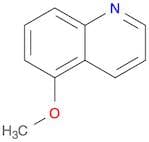
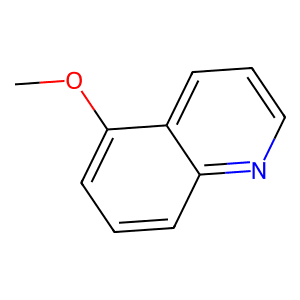
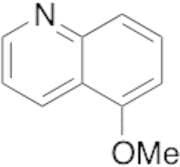
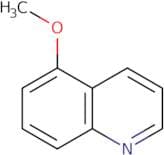
5-Methoxychinolin ist eine organische Verbindung, die durch eine Chinolinstruktur mit einer Methoxygruppe (-OCH₃) an der Position 5 gekennzeichnet ist. Es handelt sich um einen blassgelben bis bräunlichen Feststoff, der in organischen Lösungsmitteln wie Ethanol und Dichlormethan löslich ist, jedoch eine begrenzte Löslichkeit in Wasser aufweist. Diese Verbindung weist eine Reihe interessanter chemischer Eigenschaften auf, einschließlich der Fähigkeit, an verschiedenen elektrophilen und nucleophilen Reaktionen teilzunehmen, aufgrund der Anwesenheit des Stickstoffatoms im Chinoliring. 5-Methoxychinolin ist von Interesse in der medizinischen Chemie und Forschung aufgrund seiner potenziellen biologischen Aktivitäten, einschließlich antimikrobieller und antitumoraler Eigenschaften. Darüber hinaus kann es als Baustein bei der Synthese komplexerer Moleküle dienen. Seine molekulare Formel ist C₉H₉N O, und es hat eine relativ stabile Struktur, die es für verschiedene Anwendungen in der organischen Synthese und der pharmazeutischen Entwicklung geeignet macht. Wie bei vielen organischen Verbindungen sind eine ordnungsgemäße Handhabung und Sicherheitsvorkehrungen aufgrund der potenziellen Toxizität und Reaktivität unerlässlich.
Formel:C10H9NO
InChl:InChI=1/C10H9NO/c1-12-10-6-2-5-9-8(10)4-3-7-11-9/h2-7H,1H3
SMILES:COc1cccc2c1cccn2
Synonyme:- Quinoline, 5-Methoxy-
Sortieren nach
Reinheit (%)
0
100
|
0
|
50
|
90
|
95
|
100
5 Produkte.
5-Methoxyquinoline
CAS:5-MethoxyquinolineFormel:C10H9NOReinheit:97%Farbe und Form: colourless to light yellow liquidMolekulargewicht:159.18g/mol5-Methoxyquinoline
CAS:Kontrolliertes ProduktFormel:C10H9NOFarbe und Form:NeatMolekulargewicht:159.185-Methoxyquinoline
CAS:5-Methoxyquinoline (5MQ) is a chemical compound that belongs to the quinoline derivatives. It has shown anticancer activity in tumor models through a proton-transfer mechanism. 5MQ reacts with an acidic proton, such as the hydronium ion, to produce a reactive intermediate that can react with DNA and other cellular macromolecules. The drug also has been shown to inhibit the growth of bacteria by inhibiting protein synthesis. This inhibition is due to its ability to transfer protons from one molecule to another, which alters the charge distribution on that molecule and prevents it from reacting with other molecules.Formel:C10H9NOReinheit:Min. 95%Farbe und Form:LiquidMolekulargewicht:159.18 g/mol