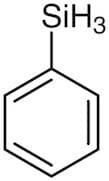
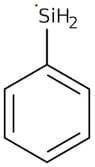
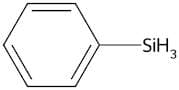
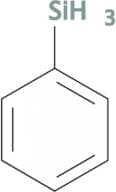
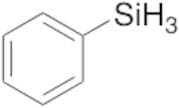
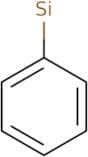
CAS 694-53-1
:Phenylsilan
- Benzene, silyl-
- Fenilsilano
- Monophenylsilane
- Nsc 179699
- Phenylsilan
- Phenylsilane
- Silylbenzene
- Sip 6750.0
- Z 6047
- Silane, phenyl-
- Silane, phenyl-
- Fenylsilan
- Weitere Synonyme anzeigen
Phenylsilane
CAS:Formel:C6H8SiReinheit:>96.0%(GC)Farbe und Form:Colorless to Almost colorless clear liquidMolekulargewicht:108.22Phenylsilane, 97%
CAS:It is used as a pharmaceutical intermediate. This Thermo Scientific Chemicals brand product was originally part of the Alfa Aesar product portfolio. Some documentation and label information may refer to the legacy brand. The original Alfa Aesar product / item code or SKU reference has not changed asFormel:C6H7SiReinheit:97%Farbe und Form:Clear colorless, LiquidMolekulargewicht:107.21Silylbenzene
CAS:SilylbenzeneFormel:C6H8SiReinheit:97%Farbe und Form: clear. colourless liquidMolekulargewicht:108.21322g/molPhenylsilane
CAS:S13600 - Phenylsilane
Formel:C6H8SiReinheit:97%Farbe und Form:Liquid, Clear LiquidMolekulargewicht:108.215PHENYLSILANE
CAS:Mono-substituted Silane Reducing Agent
Organosilanes are hydrocarbon-like and possess the ability to serve as both ionic and free-radical reducing agents. These reagents and their reaction by-products are safer and more easily handled and disposed than many other reducing agents. The metallic nature of silicon and its low electronegativity relative to hydrogen lead to polarization of the Si-H bond yielding a hydridic hydrogen and a milder reducing agent compared to aluminum-, boron-, and other metal-based hydrides. A summary of some key silane reductions are presented in Table 1 of the Silicon-Based Reducing Agents brochure.
Trihydridosilane
Silyl Hydrides are a distinct class of silanes that behave and react very differently than conventional silane coupling agents. They react with the liberation of byproduct hydrogen. Silyl hydrides can react with hydroxylic surfaces under both non-catalyzed and catalyzed conditions by a dehydrogenative coupling mechanism. Trihydridosilanes react with a variety of pure metal surfaces including gold, titanium, zirconium and amorphous silicon, by a dissociative adsorption mechanism. The reactions generally take place at room temperature and can be conducted in the vapor phase or with the pure silane or solutions of the silane in aprotic solvents. Deposition should not be conducted in water, alcohol or protic solvents.
Phenylsilane; Silylbenzene
ΔHvap: 34.8 kJ/molEmployed in the reduction of esters to ethersReduces α,β-unsaturated ketones to saturated ketones in the presence of tri-n-butyltin hydrideReduces tin amides to tin hydridesUsed in the tin-catalyzed reduction of nitroalkanes to alkanesReduces α-halo ketones in presence of Mo(0)Adds to norbornene with high eeReducing reagent in radical reductionsYields ISiH3 on treatments with HI in presence of AlI3Extensive review of silicon based reducing agents: Larson, G.; Fry, J. L. "Ionic and Organometallic-Catalyzed Organosilane Reductions", Wipf, P., Ed.; Wiley, 2007Formel:C6H8SiReinheit:97%Farbe und Form:LiquidMolekulargewicht:108.21Phenylsilane
CAS:Kontrolliertes ProduktApplications Phenylsilane is used as a stoichiometric reductant for direct reductive amination of aldehydes and ketones. It is also used as nerve cell growth substrates in its polymer form.
Not a dangerous good if item is equal to or less than 1g/ml and there is less than 100g/ml in the package
References Apodaca, Richard., et al.: Org. Lett., 3(11), 1745-1748 (2001); Gikonyo, Barnabas K., et al.: Polym. Chem., 47(1), 222 (2006)Formel:C6H8SiFarbe und Form:NeatMolekulargewicht:108.21Phenylsilane
CAS:Phenylsilane is a model system for the study of the reaction mechanism of nucleophilic substitution. It is used to investigate the steric interactions between a substrate molecule and an electrophile that are important in determining the rate of reactivity. Phenylsilane has been shown to have antioxidative properties, which may be due to its ability to scavenge reactive oxygen species (ROS), such as hydroxyl radicals, superoxide ions, and hydrogen peroxide. Phenylsilane also has low kinetic energy and can form hydrogen bonds with carbonyl groups and amines. This chemical substance can react with quinoline derivatives, including benzoquinone, which is a toxic by-product of the metabolism of many drugs.
Formel:C6H8SiReinheit:Min. 95%Farbe und Form:Clear LiquidMolekulargewicht:108.21 g/mol