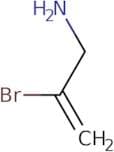
CAS 6943-51-7
:2-Propen-1-amin, 2-bromo-
Beschreibung:
2-Propen-1-amin, 2-bromo- ist eine organische Verbindung, die durch ihre Struktur gekennzeichnet ist, die eine Propenylgruppe (ein Alken) und eine Aminfunktionalgruppe umfasst, zusammen mit einem Bromatom, das am zweiten Kohlenstoff der Propenylkette gebunden ist. Diese Verbindung ist typischerweise eine farblose bis blassgelbe Flüssigkeit mit einem stechenden Geruch, der auf ihre Aminnatur hinweist. Sie ist in Wasser und verschiedenen organischen Lösungsmitteln löslich, was sie in chemischen Reaktionen vielseitig macht. Die Anwesenheit der Doppelbindung in der Propenylgruppe ermöglicht eine potenzielle Reaktivität in Additionsreaktionen, während die Amingruppe an nucleophilen Reaktionen teilnehmen kann. Darüber hinaus kann das Bromatom als Abgangsgruppe in Substitutionsreaktionen dienen. Aufgrund ihrer funktionellen Gruppen kann 2-Propen-1-amin, 2-bromo- in der Synthese verschiedener chemischer Verbindungen, einschließlich pharmazeutischer Produkte und Agrochemikalien, verwendet werden. Es sollte jedoch mit Vorsicht behandelt werden, da es potenziell reaktiv ist und Gesundheitsrisiken im Zusammenhang mit Aminen und halogenierten Verbindungen birgt.
Formel:C3H6BrN
InChl:InChI=1S/C3H6BrN/c1-3(4)2-5/h1-2,5H2
InChI Key:InChIKey=XFSISDMYBCYBKG-UHFFFAOYSA-N
SMILES:C(CN)(Br)=C
Synonyme:- 2-Bromo-2-propen-1-amine
- 2-Bromoallylamine
- 2-Propen-1-Amine, 2-Bromo-
- 3-Amino-2-bromo-1-propene
- Allylamine, 2-bromo-
- NSC 53432
- 2-Bromoprop-2-en-1-amine
Sortieren nach
Reinheit (%)
0
100
|
0
|
50
|
90
|
95
|
100
2 Produkte.
2-Bromo-allylamine
CAS:2-Bromo-allylamine is an inorganic compound that can be used as a synthetic intermediate for organic synthesis. It has been used to synthesize a variety of compounds, such as pharmaceuticals and agrochemicals. The bromide group is attached to the amine group through an ether bond. Bromoallylation is a chemoenzymatic reaction system that uses 2-bromo-allylamine as an intermediate.
2-Bromo-allylamine can also be synthesized by reacting allyl chloride with bromine or chlorodibromomethane in the presence of catalysts such as copper(II) acetate and sodium methoxide. This reaction has been shown to be able to produce 2-bromo-allylamine in high yield without any side reactions.Formel:C3H6BrNReinheit:Min. 95%Molekulargewicht:135.99 g/mol