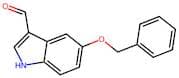
CAS 6953-22-6
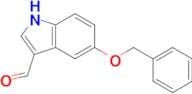
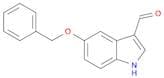
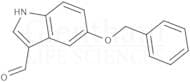
:5-(Phenylmethoxy)-1H-indol-3-carboxaldehyd
- 1H-Indole-3-carboxaldehyde, 5-(phenylmethoxy)-
- 5-(Phenylmethoxy)-1H-Indole-3-Carbaldehyde
- 5-(Phenylmethoxy)-1H-indole-3-carboxaldehyde
- 5-Benzyloxy-1H-indole-3-carboxaldehyde
- 5-Benzyloxy-3-formylindole
- 5-Benzyloxy-3-indolecarboxaldehyde
- Indole-3-carboxaldehyde, 5-(benzyloxy)-
- NSC 71049
- 5-BENZYLOXYINDOLE-3-CARBOXALDEHYDE
- 5-Benzyloxy-3-formyl-1H-indole
- 5-Benzyloxy-3-formaldehyde
- 5-(BENZYLOXY)-1H-INDOLE-3-CARBALDEHYDE
- 5-BENZYLOXY INDOLE-3-CARBOXYALDEHYDE
- 5-BENZYLOXYINDOLE-3-ALDEHYDE
- 5-BENZYLOXYINDOLE-3-CARBALDEHYDE
- 5-Benzyloxyindole-3-carboxaldehyde ,98%
- 5-BENZYLOXYINDOLE-3-FORMALDEHYDE
- Weitere Synonyme anzeigen
5-Benzyloxyindole-3-carboxaldehyde, 98%
CAS:This Thermo Scientific Chemicals brand product was originally part of the Alfa Aesar product portfolio. Some documentation and label information may refer to the legacy brand. The original Alfa Aesar product / item code or SKU reference has not changed as a part of the brand transition to Thermo SciFormel:C16H13NO2Reinheit:98%Farbe und Form:Pale yellow to Dark Yellow or Pale Cream to Brown, PowderMolekulargewicht:251.295-Benzyloxyindole-3-carboxaldehyde
CAS:Reinheit:98.0%Farbe und Form:Solid, Crystalline Powder or PowderMolekulargewicht:251.285003662109385-Benzyloxy-3-formylindole
CAS:Formel:C16H13NO2Reinheit:97%Farbe und Form:SolidMolekulargewicht:251.27995-(Benzyloxy)-1H-indole-3-carboxaldehyde
CAS:5-(Benzyloxy)-1H-indole-3-carboxaldehydeFormel:C16H13NO2Reinheit:≥95%Farbe und Form:PowderMolekulargewicht:251.28g/mol5-Benzyloxyindole-3-carboxaldehyde
CAS:5-Benzyloxyindole-3-carboxaldehyde is a high purity chemical that is used as a reagent in organic synthesis.
Formel:C16H13NO2Reinheit:Min. 98.0 Area-%Molekulargewicht:251.29 g/molRef: 3D-B-1870
-Unit-ggNachfragen1kgNachfragen100gNachfragen250gNachfragen500gNachfragen2500gNachfragen5-Benzyloxyindole-3-carboxaldehyde
CAS:5-Benzyloxyindole-3-carboxaldehyde is a merocyanine dye that can be used as an antimycobacterial agent in cell culture. It is also fluorescent and has been shown to inhibit the growth of Mycobacterium tuberculosis. 5-Benzyloxyindole-3-carboxaldehyde has been synthesised by reacting 5,5′-dibenzoyloxydihydropyrene with indole and benzaldehyde. The hydrolysis of this compound yields the corresponding carboxylic acid and benzoic acid, which are then converted to the desired product by action of sodium ethoxide. Merocyanine dyes are characterized by a distinctive absorption band in the visible region at about 540 nm. These compounds have also been shown to inhibit renal cells, which may be due to their ability to act as nucleophiles or tautomers.
Formel:C16H13NO2Reinheit:Min. 95%Farbe und Form:Off-White PowderMolekulargewicht:251.28 g/mol