CAS 69610-40-8
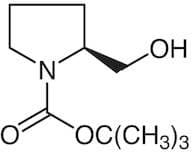
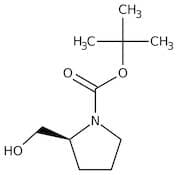
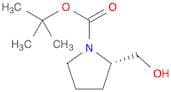
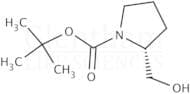
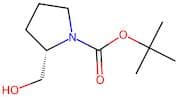
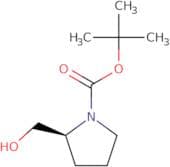
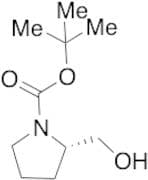
:N-ALPHA-tert-Butoxycarbonyl-L-prolinol
Beschreibung:
N-ALPHA-tert-Butoxycarbonyl-L-prolinol, mit der CAS-Nummer 69610-40-8, ist eine organische Verbindung, die häufig in der Peptidsynthese und als Schutzgruppe in der organischen Chemie verwendet wird. Diese Verbindung weist ein Prolinol-Rückgrat auf, das ein Aminoalkohol ist, das von Prolin abgeleitet ist, und ist mit einer tert-Butoxycarbonylgruppe (Boc) modifiziert. Die Boc-Gruppe dient als schützende Einheit für die Aminofunktion, sodass selektive Reaktionen möglich sind, ohne die Reaktivität der Amin zu beeinträchtigen. N-ALPHA-tert-Butoxycarbonyl-L-prolinol ist typischerweise ein weißer bis off-white fester Stoff und in gängigen organischen Lösungsmitteln wie Dichlormethan und Methanol löslich. Seine Stabilität unter verschiedenen Bedingungen macht es zu einem wertvollen Zwischenprodukt in der Synthese von Arzneimitteln und biologisch aktiven Verbindungen. Darüber hinaus verleiht die Anwesenheit der Prolinolstruktur einzigartige stereochemische Eigenschaften, die die Konformation und biologische Aktivität der resultierenden Peptide beeinflussen können. Eine ordnungsgemäße Handhabung und Lagerung sind unerlässlich, wie bei vielen organischen Verbindungen, um seine Integrität und Wirksamkeit in synthetischen Anwendungen zu erhalten.
Formel:C10H19NO3
InChl:InChI=1/C10H19NO3/c1-10(2,3)14-9(13)11-6-4-5-8(11)7-12/h8,12H,4-7H2,1-3H3/t8-/m1/s1
SMILES:CC(C)(C)OC(=O)N1CCC[C@@H]1CO
Synonyme:- BOC-L-Prolinol
- N-Boc-L-prolinol
- Boc-Pro-ol
- N-(tert-Butoxycarbonyl)-L-prolinol
- (S)-(-)-1-tert-Butoxycarbonyl-2-pyrrolidinemethanol
- Tert-Butyl 2-(Hydroxymethyl)Pyrrolidine-1-Carboxylate
- tert-butyl (2S)-2-(hydroxymethyl)pyrrolidine-1-carboxylate
- tert-butyl (2R)-2-(hydroxymethyl)pyrrolidine-1-carboxylate
- (S)-(-)-1-Boc-2-Pyrrolidinemethanol
- 1-Pyrrolidinecarboxylic acid, 2-(hydroxymethyl)-, 1,1-dimethylethyl ester, (2S)-
- 2-Hydroxymethylpyrrolidine-1-carboxylic acid tert butyl ester
- Weitere Synonyme anzeigen
Sortieren nach
Reinheit (%)
0
100
|
0
|
50
|
90
|
95
|
100
9 Produkte.
N-(tert-Butoxycarbonyl)-L-prolinol
CAS:Formel:C10H19NO3Reinheit:>98.0%(GC)Farbe und Form:White to Almost white powder to crystalMolekulargewicht:201.27N-Boc-L-prolinol, 98+%
CAS:This Thermo Scientific Chemicals brand product was originally part of the Alfa Aesar product portfolio. Some documentation and label information may refer to the legacy brand. The original Alfa Aesar product / item code or SKU reference has not changed as a part of the brand transition to Thermo SciFormel:C10H19NO3Reinheit:98+%Farbe und Form:crystalline powder, WhiteMolekulargewicht:201.27tert-Butyl (S)-2-(hydroxymethyl)pyrrolidine-1-carboxylate
CAS:Formel:C10H19NO3Reinheit:97%Farbe und Form:SolidMolekulargewicht:201.2628Ref: IN-DA0035D1
5kgNachfragen25kgNachfragen50kgNachfragen1g21,00€5g21,00€10g25,00€25g28,00€100g51,00€250g99,00€500g154,00€(2S)-(+)-2-(Hydroxymethyl)pyrrolidine, N-BOC protected
CAS:(2S)-(+)-2-(Hydroxymethyl)pyrrolidine, N-BOC protectedFormel:C10H19NO3Reinheit:≥95%Farbe und Form: slightly yellow powderMolekulargewicht:201.26g/molN-Boc-L-prolinol
CAS:N-Boc-L-prolinol is a chiral proline derivative that has been modified with an allyl group. It is a potent nicotinic acetylcholine antagonist, and it has been shown to have immune functions in vitro. The synthesis of N-Boc-L-prolinol occurs through a three-step process involving the use of organocatalysts, asymmetric synthesis, and stereoselective reactions. This molecule is also useful for the study of apoptotic signaling pathways in cells.Formel:C10H19NO3Reinheit:Min. 95%Farbe und Form:White PowderMolekulargewicht:201.26 g/moltert-Butyl (S)-2-(hydroxymethyl)pyrrolidine-1-carboxylate
CAS:Kontrolliertes ProduktApplications tert-Butyl (S)-2-(hydroxymethyl)pyrrolidine-1-carboxylate, is a building block used foe the synthesis of novel nicotinic acetylcholine receptor ligands with cognition-enhancing properties. It can also be used in the synthesis of chiral β-amino sulfides and β-amino thiols.
References Elliiot, R. L., et al.: Bioorg. Med. Chem. Lett., 6, 2283 (1996); Abreo, M. A., et al.: J. Med. Chem., 39(4), 817 (1996);Formel:C10H19NO3Farbe und Form:NeatMolekulargewicht:201.26