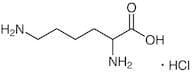
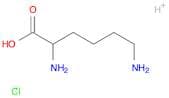
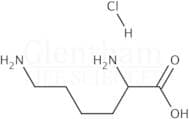
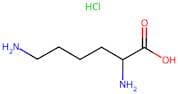
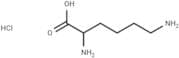
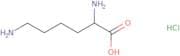
CAS 70-53-1
:Lysin, Hydrochlorid (1:1)
Beschreibung:
Lysin-Hydrochlorid (1:1), mit der CAS-Nummer 70-53-1, ist ein Salz, das aus der Aminosäure Lysin und Salzsäure gebildet wird. Es handelt sich um ein weißes kristallines Pulver, das hochgradig in Wasser löslich ist, was es für verschiedene Anwendungen in der Biochemie und Ernährung geeignet macht. Lysin wird als essentielle Aminosäure eingestuft, was bedeutet, dass sie über die Nahrung aufgenommen werden muss, da der menschliche Körper sie nicht synthetisieren kann. Diese Verbindung spielt eine entscheidende Rolle bei der Proteinsynthese, der Hormonproduktion und der Calciumaufnahme. Neben ihrer ernährungsphysiologischen Bedeutung wird Lysin-Hydrochlorid häufig in Nahrungsergänzungsmitteln und als Lebensmittelzusatzstoff verwendet, um das Nährstoffprofil verschiedener Produkte zu verbessern. Es wird auch in pharmazeutischen Formulierungen eingesetzt, da es die Fähigkeit hat, Proteine zu stabilisieren und deren Löslichkeit zu verbessern. Obwohl es allgemein als sicher gilt, kann eine übermäßige Einnahme zu gastrointestinalen Störungen führen. Insgesamt wird Lysin-Hydrochlorid für seine funktionalen Eigenschaften sowohl in der Gesundheits- als auch in der Industrieanwendung geschätzt.
Formel:C6H14N2O2·ClH
InChl:InChI=1S/C6H14N2O2.ClH/c7-4-2-1-3-5(8)6(9)10;/h5H,1-4,7-8H2,(H,9,10);1H
InChI Key:InChIKey=BVHLGVCQOALMSV-UHFFFAOYSA-N
SMILES:C(CCCCN)(C(O)=O)N.Cl
Synonyme:- 2,6-Diaminohexanoic acid hydrochloride
- <span class="text-smallcaps">DL</span>-Lysine hydrochloride
- <span class="text-smallcaps">DL</span>-Lysine, monohydrochloride
- D-lysine - L-lysine hydrochloride (1:1:2)
- DL-lysine monohydrochloride
- Lysine, hydrochloride (1:1)
- Lysine, monohydrochloride
- Lysine, monohydrochloride, <span class="text-smallcaps">DL</span>-
- NSC 46705
- Lysine, monohydrochloride, DL-
- DL-Lysine hydrochloride
Sortieren nach
Reinheit (%)
0
100
|
0
|
50
|
90
|
95
|
100
8 Produkte.
DL-Lysine Monohydrochloride
CAS:Formel:C6H14N2O2·HClReinheit:>98.0%(T)Farbe und Form:White to Light yellow powder to crystalMolekulargewicht:182.65DL-Lysine monohydrochloride, 99%
CAS:DL-Lysine monohydrochloride acts as an intermediate in the preparation of 3-amino-azepan-2-one. It also serves as an essential amino acid. It is used as animal feed. In addition to this, it is used in the construction of polylysine polymers, which finds application in lysine-based polypeptide gelsFormel:C6H15ClN2O2Reinheit:99%Farbe und Form:White to pale cream, PowderMolekulargewicht:182.65DL-Lysine monohydrochloride
CAS:Formel:C6H14N2O2·HClReinheit:≥ 98.0%Farbe und Form:White to off-white, crystalline powderMolekulargewicht:182.65H-DL-Lys-OH HCl
CAS:H-DL-Lys-OH HCl is the hydrochloride salt of lysine, widely used in biochemical experiments and drug synthesis research.Formel:C6H15ClN2O2Reinheit:99.94%Farbe und Form:SolidMolekulargewicht:182.65DL-Lysine hydrochloride
CAS:The solubility of DL-Lysine hydrochloride in water is low, with a solubility of 0.01 g/100 mL at 25 °C. The pH of the solution is 7.0 and the concentration is 10.00%. The pH of the solution was determined using a pH meter. The concentration was determined by weight measurements using a balance and a volumetric flask. DL-Lysine hydrochloride reacts with hydrochloric acid to form an amide linkage between lysine residues on adjacent polypeptides or proteins, which may be used as a cross-linking agent for cell culture experiments. This compound has been shown to inhibit the growth of herpes simplex virus type 1 (HSV-1) in cell culture experiments, although it has no effect on HSV-2 because it lacks an amino group at position 2 on its side chain.Formel:C6H14N2O2·HClReinheit:Min. 98%Farbe und Form:PowderMolekulargewicht:182.65 g/mol2,6-Diaminohexanoic acid hydrochloride
CAS:Formel:C6H15ClN2O2Reinheit:97%Farbe und Form:Solid, White to slightly pale yellow powderMolekulargewicht:182.65