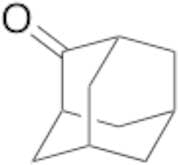
CAS 700-58-3
:Adamantanon
Beschreibung:
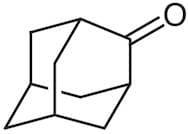
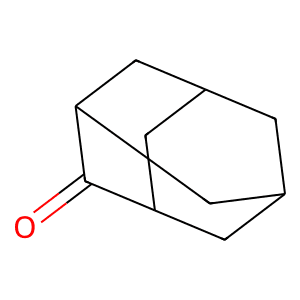
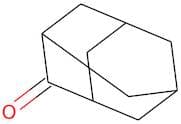
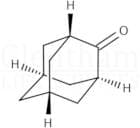
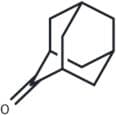
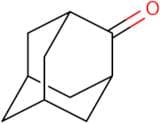
Adamantanon, mit der CAS-Nummer 700-58-3, ist ein Ketonderivat von Adamantan, einem polycyclischen Kohlenwasserstoff. Es ist durch seine starre, käfigartige Struktur gekennzeichnet, die zu seinen einzigartigen chemischen Eigenschaften beiträgt. Adamantanon ist typischerweise ein farbloser bis blassgelber Feststoff bei Raumtemperatur und hat einen charakteristischen Geruch. Es ist relativ stabil und zeigt aufgrund der sterischen Hinderung, die durch sein Adamantan-Gerüst bereitgestellt wird, eine geringe Reaktivität. Die Verbindung ist in organischen Lösungsmitteln wie Ethanol und Ether löslich, hat jedoch eine begrenzte Löslichkeit in Wasser. Adamantanon ist in verschiedenen Bereichen von Interesse, einschließlich der medizinischen Chemie, wo es auf potenzielle antivirale und entzündungshemmende Eigenschaften untersucht wurde. Seine strukturellen Merkmale ermöglichen Modifikationen, die die biologische Aktivität verbessern oder die physikalischen Eigenschaften verändern können, was es zu einer wertvollen Verbindung in Forschung und Entwicklung macht. Darüber hinaus spielt die Anwesenheit der Carbonylgruppe in seiner Struktur eine entscheidende Rolle bei seiner Reaktivität und den Wechselwirkungen mit anderen chemischen Spezies.
Formel:C10H14O
InChl:InChI=1S/C10H14O/c11-10-8-2-6-1-7(4-8)5-9(10)3-6/h6-9H,1-5H2
InChI Key:InChIKey=IYKFYARMMIESOX-UHFFFAOYSA-N
SMILES:O=C1C2CC3CC1CC(C2)C3
Synonyme:- 2-Adamantane Ketone
- 2-Adamantaneone
- 2-Adamantantanone
- 2-Adamantone
- 2-Oxoadamantane
- Adamantan-2-one
- Adamantanone
- Nsc 126345
- Triciclo[3.3.1.13,7]Decan-2-Ona
- Tricyclo[3.3.1.1(3,7)]decane-2-one
- Tricyclo[3.3.1.13,7]Decan-2-One
- Tricyclo[3.3.1.13,7]Decane-2-One
- Tricyclo[3.3.1.13,7]decan-2-on
- Tricyclo[3.3.1.13,7]decanone
- Tricyclo[3.3.1.1<sup>3,7</sup>]decan-2-one
- Tricyclo[3.3.1.1<sup>3,7</sup>]decanone
- Tricyclo[3.3.1.1~3,7~]Decan-2-One
- Weitere Synonyme anzeigen
Sortieren nach
Reinheit (%)
0
100
|
0
|
50
|
90
|
95
|
100
11 Produkte.
2-Adamantanone
CAS:Formel:C10H14OReinheit:>98.0%(GC)Farbe und Form:White to Almost white powder to crystalMolekulargewicht:150.222-Adamantanone, 98%
CAS:It is used in the synthesis of dispiro N-Boc-protected 1,2,4-trioxane1 and ()-1-(adamantan-2-yl)-2-propanamine. It is employed in reductive coupling (TiCl3/Li) which gives (adamantylidene)adamantane, an example of a general method for the synthesis of highly-substituted alkenes and in the preparatioFormel:C10H14OReinheit:98%Farbe und Form:Powder or lumps, WhiteMolekulargewicht:150.22Adamantan-2-one
CAS:Adamantan-2-oneFormel:C10H14OReinheit:98%Farbe und Form: white powderMolekulargewicht:150.22g/mol2-Adamantanone
CAS:Formel:C10H14OReinheit:≥ 99.0%Farbe und Form:White crystalline powder or crystalsMolekulargewicht:150.222-Adamantanone
CAS:2-Adamantanone is a bioactive chemical.Formel:C10H14OReinheit:99.81%Farbe und Form:White To Off-White Crystalline PowderMolekulargewicht:150.222-Adamantanone
CAS:2-Adamantanone is a chemical compound that belongs to the group of p2-adamantanes. It has been shown to have acute toxicities in rats and mice, as well as a high reactivity with water vapor. 2-Adamantanone is used as an oxidation catalyst in organic synthesis reactions and has biological properties that are related to its inhibitory effects on acetylcholinesterase. This compound also reacts readily with malonic acid and fatty acid, which may be due to steric interactions between the two molecules. 2-Adamantanone is also shown to have chemiluminescent activity, which can be used for the detection of trifluoroacetic acid (TFA) in vitro. It is also active against fungus cells when combined with hydroxyl groups, such as those found in fatty acids.Formel:C10H14OReinheit:Min. 95%Farbe und Form:White PowderMolekulargewicht:150.22 g/mol2-Adamantanone
CAS:Kontrolliertes ProduktApplications 2-Adamantanone has been used as a probe for the dimensions and characteristics for the substrate binding pocket of alcohol dehydrogenases.
References Ringold, H.J., Bellas, T.E., Clark. A.: Biochem. Bioph. Res. Co., 27, 361 (1967)Formel:C10H14OFarbe und Form:NeatMolekulargewicht:150.22