CAS 70023-02-8
:Glycin-Asparaginsäure-Asparaginsäure-Asparaginsäure-Asparaginsäure-Lysin-B-naphthylamid
Beschreibung:
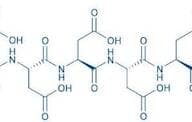
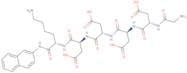
Glycin-Asparaginsäure-Asparaginsäure-Asparaginsäure-Asparaginsäure-Lysin-B-naphthylamid, auch bekannt unter seiner CAS-Nummer 70023-02-8, ist ein synthetisches Peptid, das aus einer Sequenz von Aminosäuren besteht, insbesondere Glycin (Gly), Asparaginsäure (Asp) und Lysin (Lys), die an eine B-Naftylamid-Gruppe gebunden sind. Diese Verbindung zeichnet sich durch ihre einzigartige Struktur aus, die sowohl peptide als auch aromatische Komponenten kombiniert, was potenziell ihre biologische Aktivität und Interaktionen beeinflussen kann. Das Vorhandensein mehrerer Asparaginsäurereste kann zu ihrer Fähigkeit beitragen, Wasserstoffbrücken zu bilden und mit verschiedenen biologischen Zielen zu interagieren, während die B-Naftylamid-Gruppe die Lipophilie erhöhen und die Membranpermeabilität erleichtern kann. Solche Eigenschaften machen sie von Interesse in der biochemischen Forschung, insbesondere in Studien zur Peptidsynthese, Arzneimittelentwicklung und molekularen Erkennung. Ihre spezifischen Eigenschaften, wie Löslichkeit, Stabilität und Reaktivität, würden von den Bedingungen abhängen, unter denen sie untersucht wird, einschließlich pH und Temperatur. Insgesamt veranschaulicht diese Verbindung die Komplexität und Vielseitigkeit von peptidbasierten Molekülen in der medizinischen Chemie.
Formel:C34H44N8O14
InChl:InChI=1/C34H44N8O14/c35-10-4-3-7-20(30(52)37-19-9-8-17-5-1-2-6-18(17)11-19)39-32(54)22(13-27(46)47)41-34(56)24(15-29(50)51)42-33(55)23(14-28(48)49)40-31(53)21(12-26(44)45)38-25(43)16-36/h1-2,5-6,8-9,11,20-24H,3-4,7,10,12-16,35-36H2,(H,37,52)(H,38,43)(H,39,54)(H,40,53)(H,41,56)(H,42,55)(H,44,45)(H,46,47)(H,48,49)(H,50,51)/t20-,21-,22?,23-,24-/m0/s1
SMILES:c1ccc2cc(ccc2c1)N=C([C@H](CCCCN)N=C(C(CC(=O)O)N=C([C@H](CC(=O)O)N=C([C@H](CC(=O)O)N=C([C@H](CC(=O)O)N=C(CN)O)O)O)O)O)O
Synonyme:- H-Gly-Asp-Asp-Asp-Asp-Lys-.beta.NA
- glycyl-L-alpha-aspartyl-L-alpha-aspartyl-L-alpha-aspartyl-alpha-aspartyl-N-naphthalen-2-yl-L-lysinamide
- Gly-Asp-Asp-Asp-Asp-Lys Beta-Naphthylamide
Sortieren nach
Reinheit (%)
0
100
|
0
|
50
|
90
|
95
|
100
3 Produkte.
H-Gly-Asp-Asp-Asp-Asp-Lys-βNA
CAS:GDDDDK-βNA, specific substrate for the determination of enteropeptidase (enterokinase), also used in histochemistry.Formel:C34H44N8O14Reinheit:98.1%Farbe und Form:WhiteMolekulargewicht:788.77Gly-L-Asp-L-Asp-L-Asp-L-Asp-L-Lys-beta-naphthylamide
CAS:Gly-L-Asp-L-Asp-L-Asp-L-Asp-L-Lys (GLAD) is a peptide that has been shown to inhibit the activity of protein kinases. GLAD binds to the ATP binding site and prevents ATP from binding to the kinase, which inhibits the phosphorylation of other proteins. GLAD may also activate certain protein kinases by binding to their ATP binding site. GLAD is a valuable research tool for studying protein interactions, as well as for identifying new receptor ligands and ion channels.Formel:C34H44N8O14Reinheit:Min. 95%Molekulargewicht:788.8 g/molH-Gly-Asp-Asp-Asp-Asp-Lys-bNA trifluoroacetic acid
CAS:H-Gly-Asp-Asp-Asp-Asp-Lys-bNA trifluoroacetic acid is a peptide that is used as a biocatalyst in the production of microspheres. It is also known as enterokinase, and cleaves proteins at their N termini. This enzyme has been immobilized on silica gel and then applied to the production of microspheres. The half life of this enzyme is 1 hour at 37°C, but it can be increased to 8 hours by immobilizing it on silica gel using glutaraldehyde. HGAASDAAKLysBNAtrifluoroacetic acid has been shown to have a high specific activity with an efficiency of 60% and a pH range between 4 and 10. It has been shown to have high protein cleavage rates at 30°C, 37°C, and 40°C, with bovine serum albumin being the
Formel:C38H45N8O16F3Reinheit:Min. 95%Molekulargewicht:788.76 g/mol