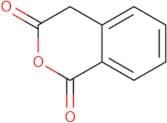
CAS 703-59-3
:Homophthalsäureanhydrid
Beschreibung:
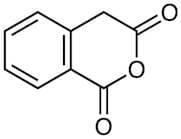
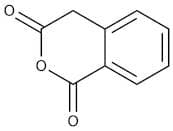
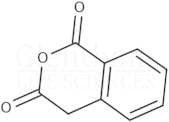
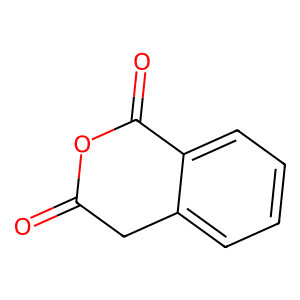
Homophthalsäureanhydrid, mit der CAS-Nummer 703-59-3, ist eine organische Verbindung, die durch ihre Anhydrid-Funktionalgruppe, die vom Homophthalsäure abgeleitet ist, gekennzeichnet ist. Sie erscheint als kristalliner Feststoff von weiß bis hellgelb und ist bekannt für ihren hohen Schmelzpunkt und ihre geringe Löslichkeit in Wasser, ist jedoch in organischen Lösungsmitteln wie Aceton und Ethylacetat löslich. Diese Verbindung wird hauptsächlich in der Synthese verschiedener Polymere verwendet, insbesondere in der Herstellung von Epoxidharzen und als Härter in Beschichtungen und Klebstoffen. Homophthalsäureanhydrid zeigt eine für Anhydride typische Reaktivität und unterliegt leicht einer Hydrolyse, um in Gegenwart von Wasser Homophthalsäure zu bilden. Sie ist auch bekannt für ihre potenziellen Anwendungen in der Herstellung von Farbstoffen und Arzneimitteln. Sicherheitsüberlegungen umfassen den vorsichtigen Umgang, da sie reizend für Haut, Augen und Atemwege sein kann. Geeignete Sicherheitsmaßnahmen, einschließlich der Verwendung von persönlicher Schutzausrüstung, werden empfohlen, wenn mit diesem Chemikalien gearbeitet wird.
Formel:C9H6O3
InChl:InChI=1/C9H6O3/c10-8-5-6-3-1-2-4-7(6)9(11)12-8/h1-4H,5H2
InChI Key:InChIKey=AKHSBAVQPIRVAG-UHFFFAOYSA-N
SMILES:O=C1C=2C(CC(=O)O1)=CC=CC2
Synonyme:- 1,3-Isochromandione
- 1H-2-Benzopyran-1,3(4H)-dione
- 1H-isochromene-1,3(4H)-dione
- 3,4-Dihydro-1H-2-benzopyran-1,3-dione
- Benzeneacetic acid, 2-carboxy-, cyclic anhydride
- Benzoglutaric Anhydride
- Homophtalic anhydride
- Homophthalic acid anhydride
- NSC 2825
- NSC 401693
- o-Carboxyphenylacetic acid cyclic anhydride~1,3-Isochromanedione
- o-Toluic acid, α-carboxy-, cyclic anhydride
- 3,4-2H-Isocoumarin-3-one
- Homophthalic anhydride, 98+%
- 2-CARBOXYPHENYLACETIC ANHYDRIDE
- HOMOPHTHALIC ANHYDRIDE
- HOMOPHTHALIC ANHYDRIDE, TECH.
- 1,3-isochromanedione
- CarboxyphenylaceticAnhydride
- Isochroman-1,3-dione
- HomoPhthalicAnhydrideOr
- 1,3-Isochromandione, 2-Carboxyphenylacetic anhydride
- Homophthalic anhydride, 97+%
- o-Carboxyphenylaceticacidcyclicanhydride
- Weitere Synonyme anzeigen
Sortieren nach
Reinheit (%)
0
100
|
0
|
50
|
90
|
95
|
100
8 Produkte.
Homophthalic Anhydride
CAS:Formel:C9H6O3Reinheit:>98.0%(GC)Farbe und Form:White to Orange to Green powder to crystalMolekulargewicht:162.14Homophthalic anhydride, 97+%
CAS:It is used as a chemical and organic intermediates. This Thermo Scientific Chemicals brand product was originally part of the Alfa Aesar product portfolio. Some documentation and label information may refer to the legacy brand. The original Alfa Aesar product / item code or SKU reference has not chaFormel:C9H6O3Reinheit:97+%Farbe und Form:Crystals or powder or crystalline powder, Pale cream to cream to pale brown to pale grayMolekulargewicht:162.14Homophthalic anhydride (2-Carboxyphenylacetic anhydride)
CAS:Formel:C9H6O3Reinheit:≥ 95.0%Farbe und Form:Off-white to light yellow or light brown crystalline powderMolekulargewicht:162.14Homophthalic anhydride
CAS:Homophthalic anhydrideFormel:C9H6O3Reinheit:≥95%Farbe und Form: white crystalline powderMolekulargewicht:162.14214g/molo-Carboxyphenylacetic acid cyclic anhydride
CAS:The o-carboxyphenylacetic acid cyclic anhydride (OCPA) is a compound that has been shown to have antimicrobial activity. It inhibits the growth of bacteria by binding to the receptor site of bacterial enzymes and blocking the synthesis of fungal cell walls. OCPA can also be used in the treatment of inflammatory diseases, such as cancer and arthritis. The mode of action for OCPA is not well understood but it is believed that it may interfere with amine metabolism or act as a hydrogen bond acceptor. Analysis of OCPA has been done using analytical methods such as gas chromatography mass spectrometry (GCMS), nuclear magnetic resonance (NMR), and infrared spectroscopy (IR).Formel:C9H6O3Reinheit:Min. 95%Farbe und Form:PowderMolekulargewicht:162.14 g/mol