CAS 703-61-7
:2,4-Dichlorchinolin
Beschreibung:
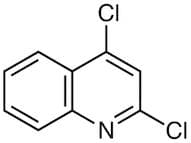
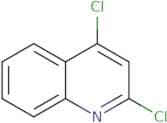
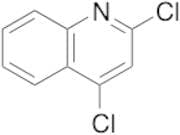
2,4-Dichlorchinolin ist eine organische Verbindung, die durch ihre Chinolinstruktur gekennzeichnet ist, die aus einem fusionierten Benzol- und Pyridinring besteht. Sie weist zwei Chlor-Substituenten an den Positionen 2 und 4 des Chinolins auf, was zu ihrer chemischen Reaktivität und ihren Eigenschaften beiträgt. Diese Verbindung ist typischerweise ein blassgelbes bis braunes Feststoff bei Raumtemperatur und ist wenig löslich in Wasser, aber besser löslich in organischen Lösungsmitteln wie Ethanol und Aceton. 2,4-Dichlorchinolin ist bekannt für seine potenziellen Anwendungen in der Pharmazie und Agrochemie, insbesondere als Zwischenprodukt bei der Synthese verschiedener biologisch aktiver Verbindungen. Es zeigt antimikrobielle und fungizide Eigenschaften, was es in der medizinischen Chemie von Interesse macht. Allerdings kann es, wie viele chlorierte Verbindungen, Umwelt- und Gesundheitsrisiken darstellen, was eine sorgfältige Handhabung und Entsorgung erforderlich macht. Seine chemische Formel ist C9H6Cl2N, und es hat ein Molekulargewicht, das die Anwesenheit der Chloratome widerspiegelt. Sicherheitsdatenblätter sollten für spezifische Informationen zur Handhabung und Toxizität konsultiert werden.
Formel:C9H5Cl2N
InChl:InChI=1/C9H5Cl2N/c10-7-5-9(11)12-8-4-2-1-3-6(7)8/h1-5H
SMILES:c1ccc2c(c1)c(cc(Cl)n2)Cl
Synonyme:- Quinoline, 2,4-Dichloro-
Sortieren nach
Reinheit (%)
0
100
|
0
|
50
|
90
|
95
|
100
8 Produkte.
2,4-Dichloroquinoline
CAS:Formel:C9H5Cl2NReinheit:>98.0%(GC)Farbe und Form:White to Yellow to Orange powder to crystalMolekulargewicht:198.052,4-Dichloroquinoline
CAS:2,4-DichloroquinolineFormel:C9H5Cl2NReinheit:98%Farbe und Form: off white to faint yellow crystalline powderMolekulargewicht:198.05g/mol2,4-Dichloroquinoline
CAS:2,4-Dichloroquinoline is a chlorinated heterocyclic chemical compound. This drug is used as a monosubstituted palladium complex in organic synthesis. It can be obtained by refluxing 2,4-dichloroquinoline with hydrochloric acid, phosphorus oxychloride, and a terminal alkene in the presence of an excess of dichloromethane. The resulting chloroquine can be converted to the corresponding dichloroquinolines by treatment with acetonitrile in the presence of malonic acid. The final step is the demethylation of the quinoline ring using sodium methoxide in methanol. 2,4-Dichloroquinoline has been shown to exhibit antibacterial activity against gram-negative organisms such as Escherichia coli and Pseudomonas aeruginosa. Magnetic resonance analysis (NMR) has also been used to study its properties.Formel:C9H5Cl2NReinheit:Min. 95%Farbe und Form:SolidMolekulargewicht:198.05 g/mol2,4-Dichloroquinoline
CAS:Kontrolliertes ProduktApplications 2,4-Dichloroquinoline is used in the synthesis of tRNA synthetase inhibitors with antibacterial activity against gram-positive bacteria. Also used in the preparation of arylquinolines displaying anthelmintic properties.
References Jarvest, R. et al.: Bioorg. Med. Chem. Lett., 13, 665 (2003); Rossiter, S. et al.: Bioorg. Med. Chem. Lett., 15, 4806 (2005);Formel:C9H5Cl2NFarbe und Form:NeatMolekulargewicht:198.05