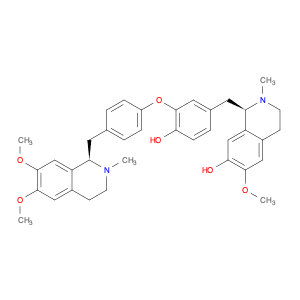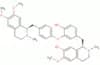
CAS 70553-76-3
:Daurisolin
Beschreibung:
Daurisolin, mit der CAS-Nummer 70553-76-3, ist eine chemische Verbindung, die zur Klasse der Alkaloide gehört, die natürlich vorkommende organische Verbindungen sind, die hauptsächlich basische Stickstoffatome enthalten. Es wird hauptsächlich aus bestimmten Pflanzenarten gewonnen, insbesondere aus der Familie der Amaryllidaceae. Daurisolin ist bekannt für seine potenziellen pharmakologischen Eigenschaften, einschließlich antitumoraler und entzündungshemmender Aktivitäten, was es in der medizinischen Chemie von Interesse macht. Die Verbindung weist typischerweise eine komplexe molekulare Struktur auf, die zu ihrer biologischen Aktivität beiträgt. Ihre Löslichkeitseigenschaften können variieren und sind oft in organischen Lösungsmitteln besser löslich als in Wasser, was für viele Alkaloide typisch ist. Darüber hinaus kann es, wie viele Alkaloide, eine Vielzahl von Wirkungen auf biologische Systeme zeigen und verschiedene physiologische Prozesse beeinflussen. Die Forschung zu Daurisolin untersucht weiterhin seine potenziellen therapeutischen Anwendungen und Wirkmechanismen und hebt die Bedeutung natürlicher Produkte in der Arzneimittelentdeckung und -entwicklung hervor.
Formel:C37H42N2O6
InChl:InChI=1S/C37H42N2O6/c1-38-15-13-26-20-36(43-4)37(44-5)22-29(26)30(38)16-23-6-9-27(10-7-23)45-35-18-24(8-11-32(35)40)17-31-28-21-33(41)34(42-3)19-25(28)12-14-39(31)2/h6-11,18-22,30-31,40-41H,12-17H2,1-5H3/t30-,31-/m1/s1
InChI Key:InChIKey=BURJAQFYNVMZDV-FIRIVFDPSA-N
SMILES:C([C@@H]1C=2C(=CC(OC)=C(OC)C2)CCN1C)C3=CC=C(OC4=CC(C[C@@H]5C=6C(=CC(OC)=C(O)C6)CCN5C)=CC=C4O)C=C3
Synonyme:- (1R)-1,2,3,4-Tetrahydro-1-[[4-hydroxy-3-[4-[[(1R)-1,2,3,4-tetrahydro-6,7-dimethoxy-2-methyl-1-isoquinolinyl]methyl]phenoxy]phenyl]methyl]-6-methoxy-2-methyl-7-isoquinolinol
- (1R)-1-[3-(4-{[(1R)-6,7-dimethoxy-2-methyl-1,2,3,4-tetrahydroisoquinolin-1-yl]methyl}phenoxy)-4-hydroxybenzyl]-6-methoxy-2-methyl-1,2,3,4-tetrahydroisoquinolin-7-ol
- (R,R)-Daurisoline
- (R-(R*,R*))-1,2,3,4-Tetrahydro-1-((4-hydroxy-3-(4-((1,2,3,4-tetrahydro-6,7-dimethoxy-2-methyl-1-isoquinolinyl)methyl)phenoxy)phenyl)methyl)-6-methoxy-2-methyl-7-isoquinolinol
- 7-Isoquinolinol, 1,2,3,4-tetrahydro-1-((4-hydroxy-3-(4-((1,2,3,4-tetrahydro-6,7-dimethoxy-2-methyl-1-isoquinolinyl)methyl)phenoxy)phenyl)methyl)-6-methoxy-2-methyl-, (R-(R*,R*))-
- 7-Isoquinolinol, 1,2,3,4-tetrahydro-1-[[4-hydroxy-3-[4-[[(1R)-1,2,3,4-tetrahydro-6,7-dimethoxy-2-methyl-1-isoquinolinyl]methyl]phenoxy]phenyl]methyl]-6-methoxy-2-methyl-, (1R)-
- D 610
- O(sup 7)-Demethyldauricine
- O<sup>7</sup>-Demethyldauricine
- O7-Demethyldauricine
- Daurisoline
Sortieren nach
Reinheit (%)
0
100
|
0
|
50
|
90
|
95
|
100
6 Produkte.
Daurisoline
CAS:Daurisoline ((R,R)-Daurisoline) is a hERG inhibitor. Daurisoline is also an autophagy blocker.Formel:C37H42N2O6Reinheit:98% - 99.96%Farbe und Form:Light Yellow PowderMolekulargewicht:610.74Daurisoline
CAS:Daurisoline is an isoquinoline alkaloid, which is a natural compound derived from plants, particularly from the root of Menispermaceae family plants such as Menispermum dauricum. Its mode of action involves interacting with ion channels and receptors, particularly impacting calcium channels, which plays a significant role in its pharmaceutical activity. Daurisoline has been explored for its potential anti-arrhythmic properties, as it affects cardiac conduction by modulating these ion channels. Additionally, it exhibits antioxidant and anti-inflammatory properties, making it a candidate for further exploration in treating cardiovascular diseases.Formel:C37H42N2O6Reinheit:Min. 95%Molekulargewicht:610.74 g/mol