CAS 706-14-9
:γ-Decalacton
Beschreibung:
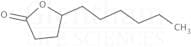
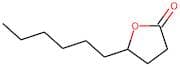
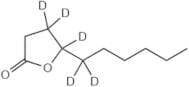
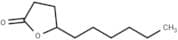
γ-Decalacton, mit der CAS-Nummer 706-14-9, ist ein zyklischer Ester, spezifisch eine Lacton, die aus der Oxidation von Fettsäuren abgeleitet ist. Er zeichnet sich durch sein angenehmes, cremiges und fruchtiges Aroma aus, das oft an Pfirsiche oder Kokosnüsse erinnert, was ihn zu einer beliebten Wahl in der Geschmacks- und Duftindustrie macht. Diese Verbindung ist bei Raumtemperatur eine farblose bis blassgelbe Flüssigkeit und hat einen relativ niedrigen Siedepunkt. γ-Decalacton ist in organischen Lösungsmitteln wie Ethanol und Ether löslich, hat jedoch eine begrenzte Löslichkeit in Wasser. Seine chemische Struktur weist einen zehngliedrigen Ring mit einer Carbonylgruppe auf, was zu seiner Reaktivität und Stabilität unter verschiedenen Bedingungen beiträgt. Neben seinen sensorischen Eigenschaften wird γ-Decalacton auch auf seine potenziellen Anwendungen in Lebensmitteln, Kosmetika und Pharmazeutika untersucht. Sicherheitsdaten zeigen, dass es allgemein als sicher anerkannt ist, wenn es angemessen verwendet wird, obwohl, wie viele Chemikalien, es mit Vorsicht behandelt werden sollte, um mögliche Reizungen oder unerwünschte Wirkungen zu vermeiden.
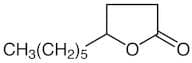
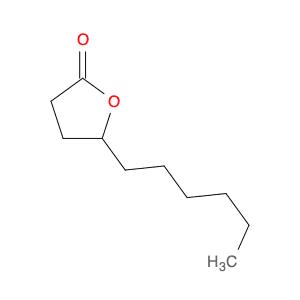
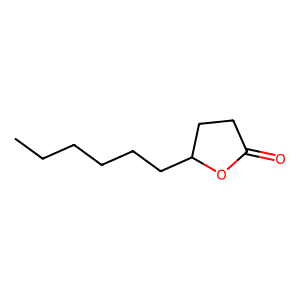
Formel:C10H18O2
InChl:InChI=1/C10H18O2/c1-2-3-4-5-6-9-7-8-10(11)12-9/h9H,2-8H2,1H3/t9-/m0/s1
InChI Key:InChIKey=IFYYFLINQYPWGJ-UHFFFAOYSA-N
SMILES:C(CCCCC)C1OC(=O)CC1
Synonyme:- (.+-.)-4-n-Hexylbutyrolactone
- (.+-.)-γ-Decanolactone
- (5R)-5-hexyldihydrofuran-2(3H)-one
- (5S)-5-hexyldihydrofuran-2(3H)-one
- (RS)-γ-Decalactone
- 2(3H)-Furanone, 5-hexyldihydro-
- 2-Decalactone
- 4-Decanolide
- 4-Hexyl-4-butanolide
- 4-Hexyl-γ-butyrolactone
- 4-Hydroxydecanoic acid lactone
- 4-Hydroxydecanoic acid γ-lactone
- 4-Hydroxydecanoic acid-gamma lactone
- 5-Hexyldihydro-2(3H)-furanone
- 5-Hexyloxolan-2-one
- 5-Hexyltetrahydro-2-furanone
- Capric acid, γ-hydroxy-, lactone
- DECALACTONE-γ
- Decan-4-Olide
- Decan-4-Olido
- Decan-4-olid
- Decane-4-Olide
- Decanoic acid, 4-hydroxy-, γ-lactone
- Decanolactone
- Furan(3H)-2-One, 5-Hexyldihydro-
- Gamma-Decalactone
- Nsc 24248
- Nsc 26510
- Synonyms 4-Hydroxydecanoic acid gamma-lactone
- gamma-Decalactone~4-Decanolide~4-Hydroxydecanoic acid gamma lactone
- gamma-Hexyl-gamma-butyrolactone
- γ-Decanolide
- γ-Hexyl-γ-butyrolactone
- γ-Hexylbutyrolactone
- γ-n-Hexyl-γ-butyrolactone
- g-Decalactone
- .gamma.-Decanolide
- 4-HYDROXYCAPRIC ACID LACTONE
- FEMA 2361
- 4,5-DIHYDRO-5-HEXYL-2(3H)-FURANONE
- 4-Decalactone
- DECALACTONE (GAMMA)
- 4-Hexyl-gamma-butyrolactone
- GAMMA-HYDROXYCAPRIC ACID LACTONE
- GAMMA-DECANOLACTONE
- Weitere Synonyme anzeigen
Sortieren nach
Reinheit (%)
0
100
|
0
|
50
|
90
|
95
|
100
11 Produkte.
γ-Decanolactone
CAS:Formel:C10H18O2Reinheit:>96.0%(GC)Farbe und Form:Colorless to Almost colorless clear liquidMolekulargewicht:170.25γ-Decanolactone, 98%
CAS:This Thermo Scientific Chemicals brand product was originally part of the Alfa Aesar product portfolio. Some documentation and label information may refer to the legacy brand. The original Alfa Aesar product / item code or SKU reference has not changed as a part of the brand transition to Thermo Sci
Formel:C10H18O2Reinheit:98%Farbe und Form:Liquid, Clear colorlessMolekulargewicht:170.25γ-decalactone
CAS:Gamma-decalactone (Decan-4-olide) is a food additive with a fruity peach flavor. Ricinoleic acid is used as a substrate in the production of γ-Decalactone.Formel:C10H18O2Reinheit:≥95%Farbe und Form:LiquidMolekulargewicht:170.254-Decanolide
CAS:Applications Please see 4-Dodecanolide (D525393).4-Decanolide was one of the organic compounds from meat charbroiling operations studied.
References Schauer, J., et al.: Environ. Sci. Technol., 33, 1566 (1999).Formel:C10H18O2Farbe und Form:NeatMolekulargewicht:170.255-Hexyldihydrofuran-2(3H)-one
CAS:Formel:C10H18O2Reinheit:97%Farbe und Form:LiquidMolekulargewicht:170.252γ-Decalactone
CAS:gamma-Decalactone is a cationic surfactant that is biosynthesized by the addition of an alkynyl group to isovaleric acid. It has been shown to have antimicrobial properties against type strain and wild-type strains of Escherichia coli, as well as Pseudomonas aeruginosa. The nmr spectra of gamma-Decalactone show a type of carbon source that may be natural compounds or fatty acids. Gamma-Decalactone can form through the action of pancreatic lipase on fatty acids, which are found in the pancreas. When gamma-Decalactone was tested for its ability to inhibit hydrogen bonding interactions, it was found to have no effect on these interactions.Formel:C10H18O2Reinheit:Min. 95%Farbe und Form:Clear LiquidMolekulargewicht:170.25 g/mol