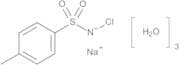
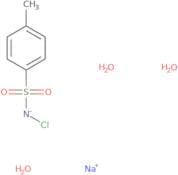
CAS 7080-50-4
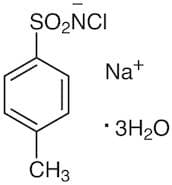
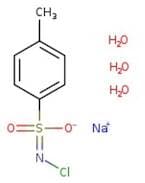
:Chloramin-T-Trihydrat
Beschreibung:
Chloramin-T-Trihydrat, mit der CAS-Nummer 7080-50-4, ist eine chemische Verbindung, die hauptsächlich als Desinfektionsmittel und Antiseptikum dient. Es handelt sich um einen weißen kristallinen Feststoff, der in Wasser löslich ist und eine Lösung bildet, die häufig in verschiedenen Anwendungen, einschließlich Laborumgebungen und medizinischer Desinfektion, verwendet wird. Die Verbindung ist ein Derivat von Chloramin und ist bekannt für ihre Stabilität und Wirksamkeit gegen ein breites Spektrum von Mikroorganismen, einschließlich Bakterien und Pilzen. Chloramin-T-Trihydrat setzt aktives Chlor frei, wenn es gelöst wird, was zu seinen antimikrobiellen Eigenschaften beiträgt. Es wird auch in der organischen Synthese als Reagenz zur Chlorierung verschiedener Substrate verwendet. Sicherheitsvorkehrungen sind erforderlich, wenn man mit dieser Verbindung umgeht, da sie die Haut und die Augen reizen kann, und es sollten geeignete Lagerbedingungen eingehalten werden, um eine Zersetzung zu verhindern. Insgesamt wird Chloramin-T-Trihydrat aufgrund seiner starken desinfizierenden Fähigkeiten in industriellen und gesundheitlichen Umgebungen geschätzt.
Formel:C7H8ClNO2S·3H2O·Na
InChl:InChI=1S/C7H8ClNO2S.Na.3H2O/c1-6-2-4-7(5-3-6)12(10,11)9-8;;;;/h2-5,9H,1H3;;3*1H2
InChI Key:InChIKey=XIFMVZLWZNEDNS-UHFFFAOYSA-N
SMILES:S(NCl)(=O)(=O)C1=CC=C(C)C=C1.[Na].O
Synonyme:- Benzenesulfonamide, N-chloro-4-methyl-, sodium salt, trihydrate
- Chloramine T sodium salt
- Chloramine-T trihydrate
- N-Chloro-p-toluenesulfonamide sodium salt trihydrate
- N-Chloro-p-toluenesulfonamide, sodium salt
- N-Chloro-p-toluenesulphonamide sodium salt trihydrate
- Sodium Chloro[(4-Methylphenyl)Sulfonyl]Azanide Hydrate (1:1:3)
- Sodium, (N-chloro-p-toluenesulfonamido)-, trihydrate
- Tosylchloramide sodium trihydrate
- benzenesulfonamide, N-chloro-4-methyl-, sodium salt, hydrate (1:1:3)
Sortieren nach
Reinheit (%)
0
100
|
0
|
50
|
90
|
95
|
100
11 Produkte.
Chloramine T Trihydrate
CAS:Formel:C7H7ClNNaO2S·3H2OReinheit:>98.0%(T)Farbe und Form:White to Light yellow powder to crystalMolekulargewicht:281.69Chloramine-T trihydrate, 98%
CAS:Chloramine-T trihydrate is used as an intermediate in the manufacture of chemical substances such as pharmaceuticals. It combines with iodogen or lactoperoxidase and is commonly used for labeling peptides and proteins with radioiodine isotopes. Hypochlorite released from chloramine-T acts as an effeFormel:C7H13ClNNaO5SReinheit:98%Farbe und Form:Crystals or powder or crystalline powder, WhiteMolekulargewicht:281.68Chloramine-T trihydrate, ACS, 98.0-103.0%
CAS:Reagent for selective oxidation of methionineFormel:C7H13ClNNaO5SReinheit:98.0-103.0%Molekulargewicht:281.68Chloramine T trihydrate
CAS:Formel:C7H7ClNNaO2S·3H2OReinheit:98.0 - 103.0 % (C7H7ClNNaO2S · 3H2O)Farbe und Form:White crystalline powderMolekulargewicht:281.69Chloramine-T trihydrate
CAS:Chloramine-T trihydrateFormel:C7H7ClNO2S·Na·3H2OReinheit:98%Farbe und Form: white crystalline powderMolekulargewicht:281.68959g/molTosylchloramide sodium trihydrate
CAS:Tosylchloramide sodium trihydrate is an agent of disinfectant. It is also used as a biocide in air fresheners and deodorants.Formel:C7H10ClNNaO3SReinheit:98%Farbe und Form:White To Off-White Crystalline PowderMolekulargewicht:246.66Chloramine-T Trihydrate
CAS:Kontrolliertes ProduktApplications Chloramine-T Trihydrate is used as a safe and convenient electrocyclisation (oxidizing) agent in the preparation of 8-chloro-[1,2,4]triazolo[4,3-a]pyrazine derivatives.
Not a dangerous good if item is equal to or less than 1g/ml and there is less than 100g/ml in the package
References Mal, S., et al.: Tetrahedron Lett., 56, 2896-2901 (2015)Formel:C7H7ClNO2S·3Na·3H2OFarbe und Form:Off-WhiteMolekulargewicht:736.98Chloramine T trihydrate
CAS:Formel:C7H13ClNNaO5SReinheit:96%Farbe und Form:SolidMolekulargewicht:281.68Chloramine T trihydrate
CAS:Chloramine T trihydrate is a water-soluble and biodegradable chemical that is used in wastewater treatment. It reacts with chloramines to produce chloramine, which has a higher disinfectant potential than chlorine. Chloramine T trihydrate also has antimicrobial properties and can be used to control microbial growth in biological samples. In addition, it can inhibit the activity of certain enzymes, such as aziridination, which is involved in the production of nitrosamines and nitric oxide. The matrix effect for chloramine-t may be different from other antimicrobial agents because it does not have a high affinity for proteins. It was found that benzalkonium chloride had an inhibitory effect on chloramine-t activity. MECHANISM OF ACTION: Chloramine T trihydrate is an oxidizing agent that reacts with organic matter to form chloramines and other oxidized products. When these reactions occur in the presence of water or organic material,Formel:C7H7ClNNaO2S•(H2O)3Reinheit:Min. 98 Area-%Farbe und Form:PowderMolekulargewicht:282.7 g/molChloramine-T Trihydrate extrapure AR, 98%
CAS:Formel:CH3C6H4SO2NClNa·3H2OReinheit:min. 98%Farbe und Form:White, Crystalline compound, Clear, ColourlessMolekulargewicht:281.69