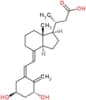
CAS 71204-89-2
:Calcitroinsäure
Beschreibung:
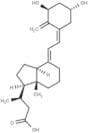
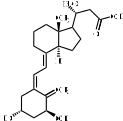
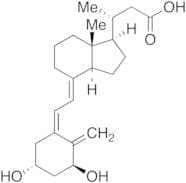
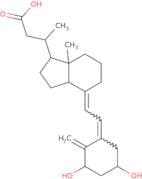
Calcitroinsäure, mit der CAS-Nummer 71204-89-2, ist eine chemische Verbindung, die als Metabolit von Calcitriol, der aktiven Form von Vitamin D, dient. Sie zeichnet sich durch ihre Rolle bei der Regulierung des Calcium- und Phosphatstoffwechsels im Körper aus. Strukturell weist Calcitroinsäure eine Hydroxylgruppe und eine Carbonsäuregruppe auf, die zu ihrer Löslichkeit in Wasser und ihrer biologischen Aktivität beitragen. Diese Verbindung ist hauptsächlich an der Rückkopplungsregulation der Vitamin-D-Spiegel beteiligt und beeinflusst die Synthese und den Abbau von Calcitriol. Ihre Präsenz in biologischen Systemen ist bedeutend für die Aufrechterhaltung der Knochengesundheit und der Calciumhomöostase. Darüber hinaus kann Calcitroinsäure Auswirkungen auf verschiedene physiologische Prozesse haben, einschließlich der Immunfunktion und der Zell-Differenzierung. Während spezifische Anwendungen in der Medizin oder Industrie möglicherweise nicht weit verbreitet dokumentiert sind, ist das Verständnis ihrer biochemischen Wege entscheidend für das Verständnis des Vitamin-D-Stoffwechsels und seiner Auswirkungen auf die menschliche Gesundheit.
Formel:C23H34O4
InChl:InChI=1S/C23H34O4/c1-14(11-22(26)27)19-8-9-20-16(5-4-10-23(19,20)3)6-7-17-12-18(24)13-21(25)15(17)2/h6-7,14,18-21,24-25H,2,4-5,8-13H2,1,3H3,(H,26,27)/b16-6+,17-7-/t14-,18-,19-,20+,21+,23-/m1/s1
InChI Key:InChIKey=MBLYZRMZFUWLOZ-ZTIKAOTBSA-N
SMILES:C[C@@]12[C@](\C(=C\C=C\3/C(=C)[C@@H](O)C[C@H](O)C3)\CCC1)(CC[C@@]2([C@@H](CC(O)=O)C)[H])[H]
Synonyme:- (βR,1R,3aS,4E,7aR)-4-[(2Z)-2-[(3S,5R)-3,5-Dihydroxy-2-methylenecyclohexylidene]ethylidene]octahydro-β,7a-dimethyl-1H-indene-1-propanoic acid
- 1α-Hydroxycalcioic acid
- 1H-Indene-1-propanoic acid, 4-[(2Z)-2-[(3S,5R)-3,5-dihydroxy-2-methylenecyclohexylidene]ethylidene]octahydro-β,7a-dimethyl-, (βR,1R,3aS,4E,7aR)-
- 24-Nor-9,10-secochola-5,7,10(19)-trien-23-oic acid, 1,3-dihydroxy-, (1α,3β,5Z,7E)-
- Calcitroic acid
Sortieren nach
Reinheit (%)
0
100
|
0
|
50
|
90
|
95
|
100
5 Produkte.
Calcitroic acid
CAS:Calcitroic acid is a vitamin D receptor (VDR) agonist that activates VDR-mediated transcription. It is the primary metabolite of 1,25-dihydroxyvitamin D3, showing the highest concentrations in the liver and mucosa of mice. The compound exhibits metabolic stability and extremely low toxicity.Formel:C23H34O4Farbe und Form:SolidMolekulargewicht:374.514Calcitroic Acid
CAS:Kontrolliertes ProduktStability Light Sensitive
Applications Calcitroic Acid is a major metabolite of Calcitriol (C144500).
Not a dangerous good if item is equal to or less than 1g/ml and there is less than 100g/ml in the package
References Esvelt, R.P. et al.: Arch. Biochem. Biophys., 206, 403 (1981); Onisko, B.L. et al.: Biochemistry, 19, 4124 (1980); Reddy, G.S. et al.: Biochemistry, 28, 1763 (1989);Formel:C23H34O4Reinheit:>85%Farbe und Form:NeatMolekulargewicht:374.51Calcitroic acid
CAS:Calcitroic acid is a metabolite of vitamin D, which is derived from the enzymatic degradation of calcitriol, the hormonally active form of vitamin D3. This compound is found within biological systems as a result of the breakdown processes occurring in the liver and kidneys, orchestrated by specific enzyme activities that convert calcitriol into calcitroic acid. Its mode of action involves participation in the metabolic pathways that facilitate the regulation of calcium and phosphate homeostasis in the body, albeit as a less active form compared to its precursor, calcitriol.Formel:C23H34O4Reinheit:Min. 95%Molekulargewicht:374.5 g/mol