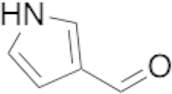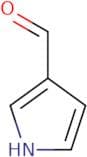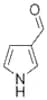
CAS 7126-39-8
:Pyrrol-3-carbaldehyd
Beschreibung:
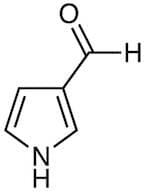
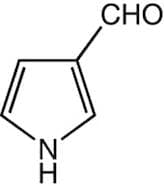
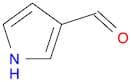
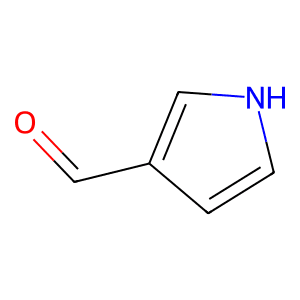
Pyrrol-3-carbaldehyd, mit der CAS-Nummer 7126-39-8, ist eine organische Verbindung, die durch ihre Pyrrolringstruktur gekennzeichnet ist, die ein fünfgliedriger aromatischer Heterozyklus ist, der Stickstoff enthält. Diese Verbindung weist eine Carboxaldehydfunktion (-CHO) an der Position 3 des Pyrrolrings auf, was zu ihrer Reaktivität und potenziellen Anwendungen in der organischen Synthese beiträgt. Pyrrol-3-carbaldehyd ist typischerweise eine farblose bis blassgelbe Flüssigkeit oder ein Feststoff, abhängig von Reinheit und Form. Es ist in organischen Lösungsmitteln wie Ethanol und Ether löslich, hat jedoch eine begrenzte Löslichkeit in Wasser. Die Anwesenheit der Aldehydgruppe macht es anfällig für Oxidation und nucleophile Angriffe, wodurch es an verschiedenen chemischen Reaktionen, einschließlich Kondensation und Polymerisation, teilnehmen kann. Pyrrolderivate sind von großem Interesse in der medizinischen Chemie und Materialwissenschaft aufgrund ihrer biologischen Aktivität und Nützlichkeit bei der Synthese komplexer organischer Moleküle. Sicherheitsvorkehrungen sollten beim Umgang mit dieser Verbindung getroffen werden, da sie Gesundheitsrisiken darstellen kann, wenn sie eingeatmet oder eingenommen wird.
Formel:C5H5NO
InChl:InChI=1S/C5H5NO/c7-4-5-1-2-6-3-5/h1-4,6H
InChI Key:InChIKey=CHNYVNOFAWYUEG-UHFFFAOYSA-N
SMILES:C(=O)C=1C=CNC1
Synonyme:- 1H-Pyrrole-3-carboxaldehyde
- 1H-pyrrole-3-carbaldehyde
- 3-Formylpyrrole
- Pyrrole-3-carboxaldehyde
Sortieren nach
Reinheit (%)
0
100
|
0
|
50
|
90
|
95
|
100
8 Produkte.
Pyrrole-3-carboxaldehyde
CAS:Formel:C5H5NOReinheit:>98.0%(GC)Farbe und Form:White to Brown powder to crystalMolekulargewicht:95.10Pyrrole-3-carboxaldehyde, 97%
CAS:This Thermo Scientific Chemicals brand product was originally part of the Alfa Aesar product portfolio. Some documentation and label information may refer to the legacy brand. The original Alfa Aesar product / item code or SKU reference has not changed as a part of the brand transition to Thermo SciFormel:C5H5NOReinheit:97%Farbe und Form:Powder, Cream to brownMolekulargewicht:95.101H-Pyrrole-3-carboxaldehyde
CAS:1H-Pyrrole-3-carboxaldehydeFormel:C5H5NOReinheit:97%Farbe und Form: faint beige to light beige crystalline solidMolekulargewicht:95.0993g/mol3-Formylpyrrole
CAS:Kontrolliertes ProduktStability Air Sensitive
Applications 3-Formylpyrrole is used as a starting material in the synthesis of the macrotricyclic part of roseophilin, a novel cytotoxic antibiotic.
References Mochizuki, T., et al.: Tetrahedron. Lett., 39, 6911 (1998)Formel:C5H5NOFarbe und Form:NeatMolekulargewicht:95.11H-Pyrrole-3-carbaldehyde
CAS:1H-Pyrrole-3-carbaldehyde is an organic compound that belongs to the diketone, carbocycle, and linker groups. It has potent cytotoxicity in vitro against a broad spectrum of human tumor cells and it inhibits NF-κB expression by preventing nuclear translocation. 1H-Pyrrole-3-carbaldehyde also has antiinflammatory properties and suppresses the production of nitric oxide (NO) in macrophages. The biosynthesis of 1H-pyrrole-3-carbaldehyde starts with the condensation of two acetyl CoA molecules to form acetoacetyl CoA, which then undergoes a series of modifications to produce the desired product. This process takes place in a bioreactor using organic solvents as reaction media.Reinheit:Min. 95%