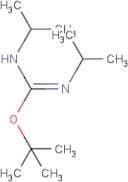
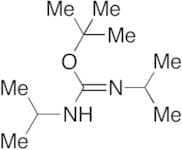
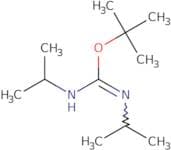
CAS 71432-55-8
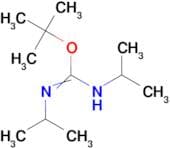
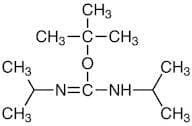
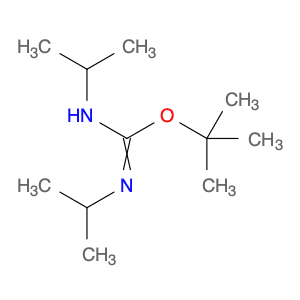
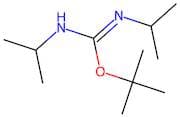
:1,1-Dimethylethyl N,N′-bis(1-methylethyl)carbamimidat
Beschreibung:
1,1-Dimethylethyl N,N′-bis(1-methylethyl)carbamimidat, mit der CAS-Nummer 71432-55-8, ist eine chemische Verbindung, die durch ihre einzigartige Struktur gekennzeichnet ist, die eine Carbamimidat-Funktionalgruppe umfasst. Diese Verbindung weist zwei tert-Butylgruppen auf, die an die Stickstoffatome gebunden sind, was zu ihrem sterischen Volumen beiträgt und potenziell ihre Reaktivität und Löslichkeit beeinflussen kann. Typischerweise sind Carbamimidate bekannt für ihre Rolle als Zwischenprodukte in der organischen Synthese und können Eigenschaften wie Basizität und Nucleophilie aufweisen. Das Vorhandensein der Dimethyl- und Bis(1-methylethyl)-Substituenten deutet darauf hin, dass diese Verbindung Anwendungen in verschiedenen chemischen Reaktionen haben könnte, einschließlich solcher, die einen nucleophilen Angriff beinhalten oder als Ligand in der Koordinationschemie fungieren. Darüber hinaus kann die durch die voluminösen Gruppen bereitgestellte sterische Hinderung ihre Wechselwirkung mit anderen Molekülen beeinflussen, was sie in Studien zur Katalyse oder Materialwissenschaft von Interesse macht. Wie bei vielen chemischen Substanzen sollten Sicherheitsdaten und Handhabungshinweise berücksichtigt werden, wenn mit dieser Verbindung in einem Laborumfeld gearbeitet wird.
Formel:C11H24N2O
InChl:InChI=1S/C11H24N2O/c1-8(2)12-10(13-9(3)4)14-11(5,6)7/h8-9H,1-7H3,(H,12,13)
InChI Key:InChIKey=FESDUDPSRMWIDL-UHFFFAOYSA-N
SMILES:O(C(=NC(C)C)NC(C)C)C(C)(C)C
Synonyme:- 1,1-Dimethylethyl N,N′-bis(1-methylethyl)carbamimidate
- 2-Tert-Butyl-1,3-Diisopropylisourea
- 2-tert-Butyl-1,3-diisopropylpseudourea
- CarbaMiMidic acid, N,N'-bis(1-Methylethyl)-, 1,1-diMethylethyl ester
- N,N′-Diisopropyl-O-tert-butylisourea
- O-tert-Butyl-N,N'-diisopropylisourea
- tert-Butyl N,N'-diisopropylcarbaMiMidate
- tert-Butyl N,N′-dipropan-2-ylcarbamimidate
Sortieren nach
Reinheit (%)
0
100
|
0
|
50
|
90
|
95
|
100
8 Produkte.
Tert-Butyl N,N'-diisopropylcarbamimidate
CAS:Reinheit:95.0%Farbe und Form:LiquidMolekulargewicht:200.3260040283203O-tert-Butyl-N,N'-diisopropylisourea
CAS:Formel:C11H24N2OReinheit:>95.0%(T)Farbe und Form:Colorless to Almost colorless clear liquidMolekulargewicht:200.332-tert-Butyl-1,3-diisopropylisourea
CAS:Formel:C11H24N2OReinheit:95%Farbe und Form:LiquidMolekulargewicht:200.3211Ref: IN-DA0035ZS
5kgNachfragen250mgNachfragen1g21,00€5g25,00€10g28,00€25g47,00€50g69,00€100g102,00€250g159,00€500g204,00€1kg365,00€O-Tert-Butyl-N,N-Diisopropylisourea
CAS:O-Tert-Butyl-N,N-DiisopropylisoureaReinheit:95%Molekulargewicht:200.33g/moltert-Butyl N,N'-diisopropylcarbamimidate
CAS:tert-Butyl N,N'-diisopropylcarbamimidate
Formel:C11H24N2OReinheit:95%Farbe und Form: colourless liquidMolekulargewicht:200.32g/molRef: 54-OR955440
1gNachfragen1mlNachfragen5gNachfragen5mlNachfragen25gNachfragen25mlNachfragen100gNachfragen100mlNachfragen500gNachfragen500mlNachfragen2-tert-Butyl-1,3-diisopropylisourea
CAS:Kontrolliertes ProduktApplications 2-tert-Butyl-1,3-diisopropylisourea is a useful synthetic intermediate in the synthesis of 5-Oxo Atorvastatin tert-Butyl Ester (O847160) which is a Boc-protected derivative of Atorvastatin (A791750, Ca Salt). 2-tert-Butyl-1,3-diisopropylisourea is also used as a reagent in the total synthesis of Citrafungin A which is an antifungal natural product.
References Kearney, A.S., et al.: Pharm. Res., 10, 1461 (1993); Heinonen, T.M., et al.: Clin. Ther., 18, 853 (1996); Whitfield, L.R., et al.: Eur. J. Drug Metab. Pharmacokinet., 25, 97 (2000); Calo, F., et al.: J. Org. Chem., 73, 9692 (2008)Formel:C11H24N2OFarbe und Form:NeatMolekulargewicht:200.322-tert-Butyl-1,3-diisopropylisourea
CAS:2-tert-Butyl-1,3-diisopropylisourea is a chemical compound that is an inhibitor of the hepatitis C virus NS5B polymerase. The compound has been shown to inhibit viral replication in cell culture and to protect against liver damage in mice. 2-tert-Butyl-1,3-diisopropylisourea inhibits the activity of the hepatitis C virus by binding to a region of the enzyme's active site called the "pharmacophore". This region is located at the end of a long, flexible arm that extends from the main body of the enzyme. This binding prevents formation of a critical thiol group linkage required for RNA synthesis. The compound can be used as an antiviral agent or as a potential therapy for chronic hepatitis B and C, which are viral diseases that lead to liver disease. 2-tert-Butyl-1,3-diisopropylisoureaFormel:C11H24N2OReinheit:Min. 95%Farbe und Form:Colorless Clear LiquidMolekulargewicht:200.32 g/mol