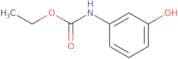
CAS 7159-96-8
:Ethyl-3-hydroxyphenylcarbamat
Beschreibung:
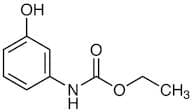
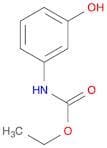
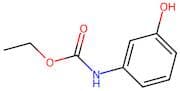
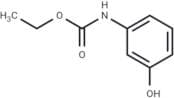
Ethyl-3-hydroxyphenylcarbamat, mit der CAS-Nummer 7159-96-8, ist eine organische Verbindung, die durch ihre Carbamat-Funktionalgruppe und eine phenolische Struktur gekennzeichnet ist. Sie erscheint typischerweise als weißer bis cremefarbener fester Stoff oder kristallines Pulver. Diese Verbindung ist bekannt für ihre potenziellen Anwendungen in der Pharmazie und Agrochemie und dient oft als Zwischenprodukt bei der Synthese verschiedener bioaktiver Moleküle. Ethyl-3-hydroxyphenylcarbamat zeigt eine moderate Löslichkeit in organischen Lösungsmitteln, während ihre Löslichkeit in Wasser je nach pH-Wert und Temperatur variieren kann. Die Anwesenheit der Hydroxylgruppe trägt zu ihrer Reaktivität und Fähigkeit zur Bildung von Wasserstoffbrücken bei, was ihre biologische Aktivität und Wechselwirkungen mit anderen Substanzen beeinflusst. Darüber hinaus kann diese Verbindung antioxidative Eigenschaften besitzen, was sie für die Forschung im Zusammenhang mit Gesundheit und Krankheitsprävention von Interesse macht. Wie bei vielen chemischen Substanzen sind eine ordnungsgemäße Handhabung und Sicherheitsvorkehrungen aufgrund potenzieller Toxizität oder Umweltauswirkungen unerlässlich.
Formel:C9H11NO3
InChl:InChI=1/C9H11NO3/c1-2-13-9(12)10-7-4-3-5-8(11)6-7/h3-6,11H,2H2,1H3,(H,10,12)
InChI Key:InChIKey=KCLZXXMMEDEBMF-UHFFFAOYSA-N
SMILES:N(C(OCC)=O)C1=CC(O)=CC=C1
Synonyme:- (3-Hydroxy-Phenyl)-Carbamic Acid Ethyl Ester
- (3-Hydroxyphenyl)carbamic acid ethyl ester
- 3-(Ethoxycarbonylamino)phenol
- 3-Carbethoxyaminophenol
- 3-Ethyloxycarbonylaminophenol
- Carbamic acid, (3-hydroxyphenyl)-, ethyl ester
- Carbamic acid, N-(3-hydroxyphenyl)-, ethyl ester
- Carbanilic acid, m-hydroxy-, ethyl ester
- Carbanilic acid, m-hydroxy-, ethyl esters
- Ethyl (m-hydroxyphenyl)carbamate
- Ethyl 3-hydroxycarbanilate
- Ethyl 3-hydroxyphenylcarbamate
- Ethyl N-(3-hydroxyphenyl)carbamate
- NSC 222551
- m-(Ethoxycarbonylamino)phenol
- Ethyl (3-hydroxyphenyl)carbamate
- Ethyl-3-hydroxyphenolcarbamate
- (3-hydroxyphenyl)-carbamicaciethylester
- ethyln-(3-hydroxyphenyl)carbamate
- ethylm-hydroxycarbanilate
- N-(3-Hydroxyphenyl)carbamic acid ethyl ester
- (3-Hydroxy-Phenyl)-carbanicacid ethyl ester
- m-hydroxy-carbanilicaciethylester
- ethyl3-hydroxycarbanilate
- AKOS BBS-00008072
- Weitere Synonyme anzeigen
Sortieren nach
Reinheit (%)
0
100
|
0
|
50
|
90
|
95
|
100
6 Produkte.
Ethyl (3-Hydroxyphenyl)carbamate
CAS:Formel:C9H11NO3Reinheit:>97.0%(GC)Farbe und Form:White to Light yellow powder to crystalMolekulargewicht:181.19Ethyl (3-hydroxyphenyl)carbamate
CAS:Formel:C9H11NO3Reinheit:%Farbe und Form:SolidMolekulargewicht:181.1885Ethyl 3-Hydroxyphenylcarbamate
CAS:Ethyl 3-HydroxyphenylcarbamateReinheit:99%Molekulargewicht:181.18854g/molEthyl (3-hydroxyphenyl)carbamate
CAS:Ethyl (3-hydroxyphenyl)carbamate is a bioactive chemical.Formel:C9H11NO3Reinheit:98%Farbe und Form:SolidMolekulargewicht:181.19Ethyl (3-hydroxyphenyl)carbamate
CAS:Formel:C9H11NO3Reinheit:95+%Farbe und Form:SolidMolekulargewicht:181.191Ethyl (3-Hydroxyphenyl)carbamate
CAS:Ethyl (3-Hydroxyphenyl)carbamate is a carbonyl group that is produced by the hydrolysis of triticum aestivum. This product has been shown to have a synergistic interaction with retroflexus and bioassay, an imaging technique used to measure the photosynthetic activity of plants. Ethyl (3-Hydroxyphenyl)carbamate has low light fluorescence properties, which are useful for the detection of sugarbeet in low light conditions. The symptoms of ethyl (3-hydroxyphenyl)carbamate exposure include a constant and acceptor, which is a molecule or atom that accepts electrons from an electron donor in chemical reactions. Ethyl (3-hydroxyphenyl)carbamate can react with proton to form arvensis, a sugar found in sugarbeets.
Formel:C9H11NO3Reinheit:Min. 95%Molekulargewicht:181.19 g/mol