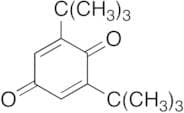
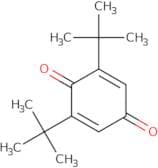
CAS 719-22-2
:2,6-Di-tert-butyl-1,4-benzochinon
Beschreibung:
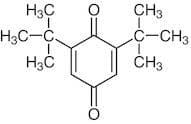
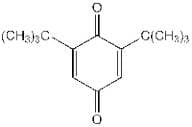
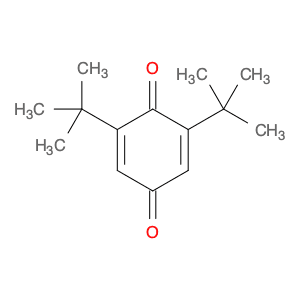
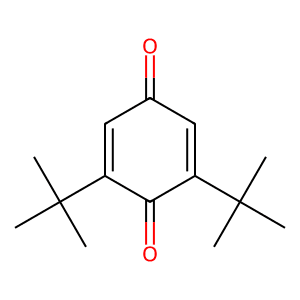
2,6-Di-tert-butyl-1,4-benzochinon ist eine organische Verbindung, die durch ihre Chinonstruktur gekennzeichnet ist, die zwei tert-Butylgruppen an den Positionen 2 und 6 des Benzolrings aufweist. Diese Verbindung ist bekannt für ihre starken antioxidativen Eigenschaften, was sie in verschiedenen Anwendungen nützlich macht, einschließlich als Stabilisator in Polymeren und als Reagenz in der organischen Synthese. Sie ist typischerweise ein gelbes bis orangefarbenes Feststoff bei Raumtemperatur und in organischen Lösungsmitteln wie Aceton und Chloroform löslich, hat jedoch eine begrenzte Löslichkeit in Wasser. Die Anwesenheit der voluminösen tert-Butylgruppen trägt zu ihrer sterischen Hinderung bei, was ihre Reaktivität und Stabilität beeinflusst. Darüber hinaus kann 2,6-Di-tert-butyl-1,4-benzochinon Redoxreaktionen durchlaufen, was es ihm ermöglicht, an Elektronentransferprozessen teilzunehmen. Sicherheitsvorkehrungen sollten beim Umgang mit dieser Verbindung getroffen werden, da sie gesundheitliche Risiken darstellen kann, wenn sie eingeatmet oder eingenommen wird. Insgesamt machen seine einzigartigen strukturellen Merkmale und Eigenschaften es zu einer wertvollen Verbindung sowohl in industriellen als auch in Forschungseinrichtungen.
Formel:C14H20O2
InChl:InChI=1/C14H20O2/c1-13(2,3)10-7-9(15)8-11(12(10)16)14(4,5)6/h7-8H,1-6H3
InChI Key:InChIKey=RDQSIADLBQFVMY-UHFFFAOYSA-N
SMILES:C(C)(C)(C)C=1C(=O)C(C(C)(C)C)=CC(=O)C1
Synonyme:- 2,5-Cyclohexadiene-1,4-dione, 2,6-bis(1,1-dimethylethyl)-
- 2,6-Bis(1,1-dimethylethyl)-2,5-cyclohexadiene-1,4-dione
- 2,6-Bis[1,1-dimethyl ethyl]quinone
- 2,6-Di-Tert-Butyl-P-Benzoquinon
- 2,6-Di-Tert-Butylcyclohexa-2,5-Diene-1,4-Dione
- 2,6-Di-tert-butyl-1,4-benzoquinone
- 2,6-Di-tert-butyl-2,5-cyclohexadien-1,4-dione
- 2,6-Di-tert-butyl-2,5-cyclohexadiene-1,4-dione
- 2,6-Di-tert-butyl-p-quinone
- 2,6-Di-tert-butylbenzoquinone
- 2,6-Di-tert-butylquinone
- 2,6-Ditert-butylcyclohexa-2,5-diene-1,4-dione
- 3,5-Di-tert-butyl-p-benzoquinone
- 3,5-Di-tert-butylquinone
- Dibutylpbenzoquinone
- NSC 14448
- p-Benzoquinone, 2,6-di-tert-butyl-
- DBQ
- 2,5-Cyclohexadiene-1,4-dione,2,6-
- 2,6-Di-tert-butyl-p-benzoquinone, 98+%
- 2,6-DI(TERT-BUTYL)BENZO-1,4-QUINONE
- 4-dione,2,6-bis(1,1-dimethylethyl)-5-cyclohexadiene-1
- 2,6-DI-T-BUTYL-1,4-BENZOQUINONE
- 2,6-di-tert-Butyl-p-benzoquino
- p-Benzoquinone, 2,6-bis-(1,1-dimethylethyl)
- 2,6-DI-T-BUTYL-P-BENZOQUINONE
- 2,6-DI-TERT-BUTYL-P-BENZOQUINONE
- Benzoquinone, 2,6-di-(1,1-dimethylethyl)
- Weitere Synonyme anzeigen
Sortieren nach
Reinheit (%)
0
100
|
0
|
50
|
90
|
95
|
100
8 Produkte.
2,6-Di-tert-butyl-1,4-benzoquinone
CAS:Formel:C14H20O2Reinheit:>98.0%(GC)Farbe und Form:Light yellow to Yellow to Orange powder to crystalMolekulargewicht:220.312,6-Di-tert-butyl-p-benzoquinone, 98+%
CAS:2,6-Di-tert-butyl-1,4-benzoquinone was used as an antioxidant to study the elimination rate of micro pollutant from storm and waste water. It was also used as a metabolite of butylated hydroxytoluene. It is used as a treatment agent to improve germination and plant health. This Thermo Scientific CheFormel:C14H20O2Reinheit:98+%Farbe und Form:Orange, Crystals or crystalline powderMolekulargewicht:220.312,6-Di-tert-butylcyclohexa-2,5-diene-1,4-dione
CAS:Formel:C14H20O2Reinheit:98%Farbe und Form:SolidMolekulargewicht:220.30742,6-di(tert-butyl)benzo-1,4-quinone
CAS:2,6-di(tert-butyl)benzo-1,4-quinoneFormel:C14H20O2Reinheit:98%Farbe und Form: yellow solidMolekulargewicht:220.31g/mol2,6-Di-tert-butyl-p-benzoquinone
CAS:Applications 2.6-Di-tert-butyl-p-benzoquinone was used as a treatment agent to improve germination, plant health and yield.
Formel:C14H20O2Farbe und Form:NeatMolekulargewicht:220.312,6-Di-tert-butylcyclohexa-2,5-diene-1,4-dione
CAS:Formel:C14H20O2Reinheit:98%Farbe und Form:Solid, Reddish yellow to yellow red powderMolekulargewicht:220.3122,6-Di-tert-butylcyclohexa-2,5-diene-1,4-dione
CAS:2,6-Di-tert-butylcyclohexa-2,5-diene-1,4-dione (BHT) is a chemical compound that is used as an oxygenation catalyst and analytical method. The molecular structure of BHT contains a hydroxyl group with a redox potential of 0.3 V and a thermal expansion coefficient of 7 x 10 K. This compound has been shown to be toxic in mice, causing lung damage and oxidative DNA damage. BHT also inhibits the transcriptional regulation of genes by binding to amines in the cell membrane. It can act as an antioxidant because it binds to reactive oxygen species and prevents them from oxidizing other molecules in the cell. These properties make it useful for protecting cells from oxidative stress caused by reactive oxygen species or peroxides.Formel:C14H20O2Reinheit:Min. 95%Molekulargewicht:220.31 g/mol